
Your weekly running volume can matter more than the calendar when deciding when to replace running shoes. Most pairs last around 500 to 800 kilometres, but that’s a guide, not a fixed expiry point. A runner covering more kilometres each week may reach that range sooner, while visible wear or a change in feel can signal it’s time for a new pair.
It’s not always easy to tell whether shoes are simply broken in or have lost the cushioning and support you rely on. Mileage is useful, but it doesn’t tell the whole story: body weight, wear patterns and how the shoes feel on a run also matter.
This guide explains how weekly kilometres can influence replacement timing, what to notice as cushioning changes, and why worn race shoes may not suit everyday running. Weigh mileage alongside the shoes’ condition to decide when it’s time to replace running shoes.
Key Takeaways
- Use your weekly kilometres to estimate how quickly your shoes may wear, then factor in body weight and running conditions.
- Look for changes in cushioning and rebound, not just worn tread, when assessing a pair’s condition.
- Consider new aches alongside shoe wear and running feel when deciding whether it’s time to replace your shoes.
- Worn race shoes may still feel springy, but reduced grip or uneven wear can make them less suitable for everyday runs.
- A Biomechanical Assessment can help explore how your movement and footwear relate when discomfort or wear patterns are a concern.
Does my body weight affect shoe life?
Yes. A runner’s weight affects the force placed on a running shoe with each ground strike. Greater force can compress the midsole more, so a heavier runner may reach the end of a shoe’s useful life sooner. Body weight isn’t the only factor: weekly distance, running surface, shoe construction and visible wear also matter. A typical pair often lasts around 500 to 800 kilometres, but that range is a guide, not a personal mileage guarantee. A heavier runner might need to assess cushioning nearer the lower end, especially if the shoe feels less supportive or shows uneven wear.
In Australia, return or warranty options for premature wear depend on the seller’s terms and whether the issue is considered a product fault or expected wear. Keep your receipt and note the kilometres run, when the wear appeared and where it is visible. These details help explain how the shoes have been used.
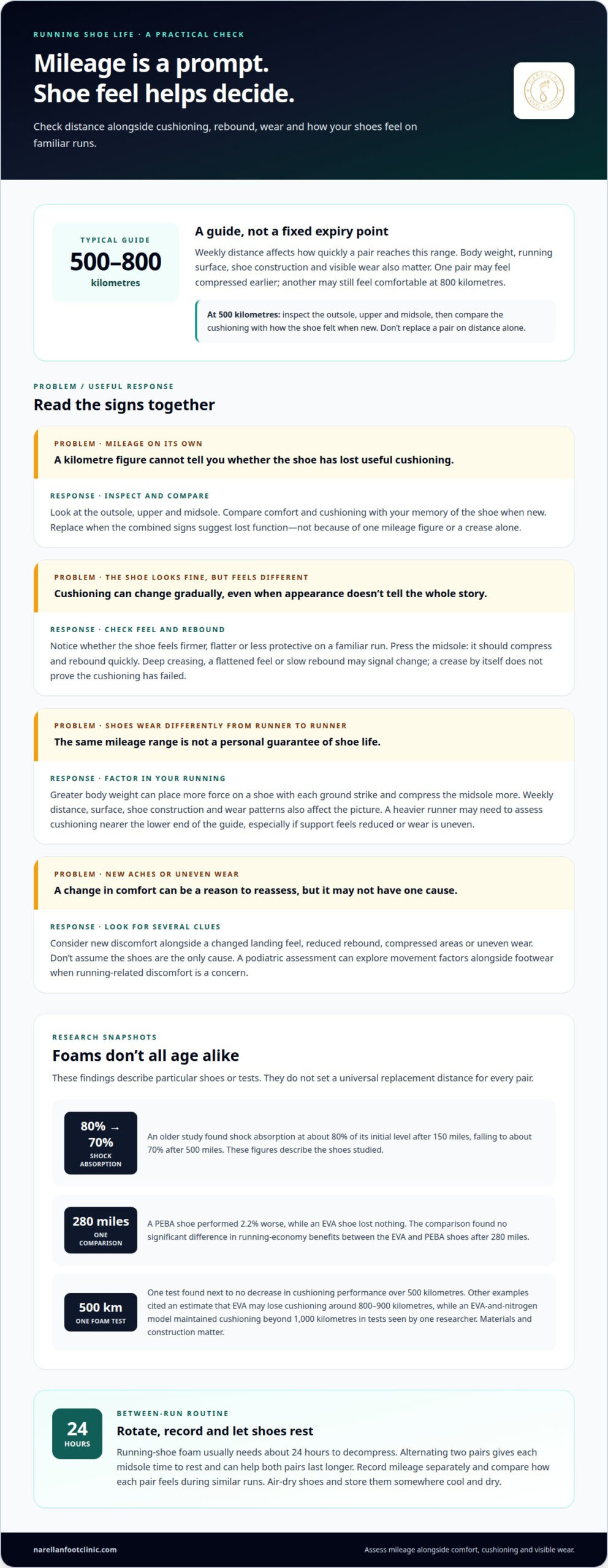
Midsole foam affects both cushioning and running economy, and modern materials don’t all age alike. In one comparison after 280 miles, a PEBA shoe performed 2.2% worse, while an EVA shoe lost nothing. The same study found no significant difference in running-economy benefits between the EVA and PEBA shoes after 280 miles. These findings don’t establish a universal lifespan for every foam. They show why the model, material and your own shoe’s feel matter more than judging by appearance alone. Pressing the midsole can offer a simple clue: foam should compress and rebound quickly. Deep creasing, a flattened feel or slower rebound may signal that cushioning has changed.
Alternating two pairs gives each midsole time to decompress between runs and can help both pairs last longer. Running-shoe foam usually needs about 24 hours to decompress. For example, a runner with two pairs can wear one while the other rests, rather than running in the same pair on consecutive days. Rotation also makes changes easier to notice: compare how each pair feels during similar runs, and record mileage separately. Air-drying shoes and storing them somewhere cool and dry can also help protect their materials.
Use distance as a prompt to assess, not an automatic replacement order. At 500 kilometres, inspect the outsole, upper and midsole, then compare cushioning with how the shoe felt when new. A pair at 800 kilometres may still feel comfortable, while another may feel compressed earlier. Weight, training volume and wear patterns help explain those differences. Replace a pair when the combined signs point to lost function, rather than relying on creasing or one mileage figure alone.
Changes in cushioning and responsiveness
Cushioning can change gradually, so a shoe’s appearance may not match how it feels. Pay attention to the midsole’s response underfoot as well as visible wear.
Cushioning Breakdown
Cushioning breakdown occurs as repeated loading compresses midsole foam and reduces its ability to absorb impact. The change can be subtle: a familiar shoe may start feeling firmer, flatter or less protective during the same run. An older study found shock absorption at about 80% of its initial level after 150 miles, falling to about 70% after 500 miles. Those figures describe the shoes studied, not every modern model.
Reduced shock absorption may add to cumulative joint stress over weeks of training. Treat a compressed midsole, new unevenness between shoes or a less comfortable landing as reasons to reassess the pair. A crease alone doesn’t prove cushioning has failed, but a change in feel alongside visible compression is a stronger signal.
Responsiveness and Energy Return
Responsiveness is the lively sensation a shoe gives as its midsole compresses and springs back. That sensation may fade with use, changing how a familiar running shoe feels during faster efforts or longer runs. In one test, foam showed next to no decrease in cushioning performance over 500 km. Results differ between materials and models, so that finding cannot predict every shoe’s lifespan.
Speed-focused shoes may use lighter designs and materials, which can make them less durable. A racer might notice a loss of pop before seeing obvious damage. Compare how the shoe feels now with your memory of its early runs, especially during similar sessions. If it feels dull or unusually firm, inspect the outsole and midsole instead of relying on kilometres alone.
Midsole Rebound
Midsole rebound is how quickly foam returns towards its original shape after compression. A quick rebound helps maintain the cushioning sensation between foot strikes. Press the midsole to see whether it compresses and springs back promptly. Slow recovery or a persistently flattened area may indicate fatigue. This check complements, but doesn’t replace, how the shoe feels while running.
Foams behave differently as they age. One researcher estimated that EVA may lose its cushioning at around 800-900 km, while a model using EVA foam and nitrogen maintained cushioning after more than 1,000 km in tests they had seen. These examples show why material and construction matter; neither figure sets a guaranteed replacement distance for your pair.
Assess several clues together: a changed landing feel, reduced rebound, compressed areas and wear that looks uneven. If discomfort appears alongside those changes, don’t assume the shoes are the only cause. A podiatric assessment of running-related discomfort can help examine movement factors alongside footwear.
How Often Should I Replace My Running Shoes?
Use changes in comfort, shoe structure and running conditions to judge whether a pair still suits your runs. A single worn patch or ache needs context, so look for several signs together.
Aches and Pains as Wear Signals
New aches during familiar runs can be a reason to reassess your shoes. Consider whether discomfort began as the pair’s cushioning or support changed, and whether it appears on your usual route or after a normal session. A new sore spot after an easy run, for example, may prompt a closer look at the shoes. Note when discomfort occurs and how the pair feels; pain alone doesn’t identify its cause.
Wear Beyond Visible Damage
A shoe can lose useful cushioning before its surface looks damaged. Midsole compression happens inside the shoe, so a clean upper or intact outsole doesn’t necessarily mean the cushioning feels unchanged. Compare how the pair responds underfoot with a newer or less-used pair, if available. Age matters too: shoe materials gradually degrade, and running shoes may need replacing every 6 to 12 months.
Running shoes older than a year are worth reassessing, especially after storage in hot, damp or sunny conditions. Age alone doesn’t determine whether to replace them. Consider it alongside kilometres, how the shoes feel and visible wear.
Gait and Uneven Wear Patterns
Uneven wear means one shoe, or one side of a sole, wears faster than the rest. Pronation and individual running style can affect where pressure falls, while worn shoes may also alter your stride. Turn both shoes over and compare their inner and outer edges. If one side is heavily worn or the shoes look noticeably different, include that pattern in your assessment.
Wear patterns show where a shoe meets the ground, but they don’t diagnose gait on their own. If one heel shows more wear, consider that pattern alongside comfort, midsole condition and any changes in stride.
Outsole and Upper Deterioration
The outsole is the shoe’s ground-contact layer; the upper covers and holds the foot. Smooth tread or gaps in the outsole can reduce grip, especially on wet paths. Check that tread remains across the areas that contact the ground. Fraying, tears or a damaged inner heel are further signs the shoe may be nearing the end of its useful life.
A lightweight shoe may use less robust materials than a daily trainer, so consider both visible damage and construction. Don’t judge a pair by price or appearance alone. Look for several signs, such as a torn upper combined with smooth tread, before deciding it’s no longer practical to run in.
Can running shoes be repaired or should they be replaced? A small upper tear may be repairable, but worn tread or a compressed midsole usually makes replacement the practical option.
How much do replacement running shoes cost in Australia? Prices vary by shoe type, materials and retailer, so no single cost applies to every pair.
Do running shoes wear out based on age as well as kilometres? Yes. Materials change over time, so consider age alongside distance, visible condition and changes in feel.
Using worn race shoes for everyday running
A race shoe can feel responsive after its best racing days, but that doesn’t automatically make it suitable for every run. One worn carbon racer may still feel bouncier after 200 miles than a new daily trainer.
Signs of Worn-Out Shoes
Worn-out shoes show changes in grip, structure or cushioning that affect how they feel during a run. Check the outsole for smooth patches, the upper for fraying or tears, and the midsole for flattening. Compare both shoes, because uneven wear can alter your stride. A common replacement rule of thumb is 300-500 miles, but mileage alone doesn’t answer whether your pair remains usable.
Lightweight racing shoes may have shorter useful lives than everyday trainers. Lightweight shoes and racing flats usually last 400-600 km before their cushioning flattens. Keep a separate mileage record for race shoes, then notice whether the pair still feels stable and comfortable on an ordinary run. A responsive sensation isn’t the only sign to consider; worn tread can matter even when the midsole still feels springy.
Risks of Worn-Out Shoes
Running in shoes with smooth outsoles can reduce grip and increase the risk of slipping, particularly on wet paths. Worn cushioning and support can also change how impact feels over repeated runs. Worn-out shoes may increase the risk of overuse injuries, plantar fasciitis, shin splints and joint irritation. These issues don’t prove footwear caused the discomfort, but they make shoe condition worth considering.
A worn race shoe may still have more bounce than a new daily trainer, as the 200-mile example shows. Bounce, however, doesn’t restore damaged tread or make a shoe stable on every surface. Before using an old racer for regular training, look at the outsole and upper, then consider how the shoe feels underfoot. If grip is poor or wear is uneven, set it aside for running.
Distance helps put wear in context. Most running shoes last around 500-800 kilometres, while a common rule of thumb gives 300-500 miles. These are broad guides, not a deadline for every pair. Construction, materials and use affect durability, so a well-kept daily trainer and a lightweight racer may wear differently at similar mileage.
After a run, note the distance, check both outsoles and record any changes in comfort or stability. For example, a race shoe that feels lively but has smooth tread calls for a different decision from one with intact grip and even wear. If your shoes feel less secure, don’t rely on responsiveness alone to decide they’re ready for everyday kilometres.
Weekly running volume and replacement timing
Your weekly kilometres help estimate how quickly a pair approaches its useful mileage. A 500-mile benchmark can be a prompt to pay closer attention, but training volume changes how soon you reach it. It also helps answer when to replace running shoes based on your own routine.
At an average of 30 km per week, running shoes may last approximately 4 to 6 months. At 60 km per week, they may need replacing after 2 to 3 months. Dedicated marathon runners covering 100 km per week may need new shoes every 5 to 8 weeks. These are estimates, not fixed schedules: shoe construction, running surface and visible wear affect how quickly a pair wears out.
Think about the mileage another way. A runner covering 20 km weekly may reach 500 km in around six months, while someone running 50 km weekly may reach that distance in about ten weeks. The second runner gets there faster because each week adds more kilometres to the shoes. If your training load increases, your replacement window can move closer too.
Training goals offer another useful comparison. Runners preparing for a 5K or 10K at 10 to 20 miles per week may need new shoes after 5 to 8 months. Half-marathon training at 20 to 40 miles weekly can mean replacing them about every 4 to 6 months. Marathon training at 40 miles or more weekly may bring that point forward to 2 to 3 months. Track kilometres or miles consistently, rather than mixing units in your log.
Running surface matters alongside distance. Regular running on concrete or hard pavement can wear shoes sooner than gentler use, while trail terrain affects trail shoes differently. Smooth, worn tread can reduce grip, particularly in wet conditions. Check comfort and tread as your mileage builds. A calendar estimate alone won’t tell you whether the shoes still feel stable on your usual route.
Keep a simple record for each pair: note the starting date, weekly distance and any increase in training. For example, if a training plan shifts from 30 km to 60 km per week, reassess the shoes sooner rather than relying on the earlier timeline. Compare both outsoles and notice changes in cushioning or comfort as the distance accumulates. This gives you a practical estimate based on your own routine.
If increased running volume has brought new discomfort or changed how you move, get support assessing your running biomechanics.
Narellan Foot Clinic
Narellan Foot Clinic offers a Biomechanical Assessment for runners concerned about recurring discomfort or changes in how they move. The assessment considers foot mechanics and movement alongside the condition and fit of your running shoes. It may help when mileage, visible wear and how the shoes feel don’t fully explain a new concern.
Replacing shoes is only one part of understanding running-related discomfort. An assessment can explore movement factors that may be relevant to your running, and Custom Orthotics may be considered where appropriate.
If you’d like support with running-related foot concerns, contact Narellan Foot Clinic.
Make your next run a more informed one
Knowing when to replace running shoes is part of looking after your comfort, but discomfort can have more than one cause. If a change in your shoes coincides with ongoing foot pain or a noticeable change in how you move, consider the wider picture rather than relying on footwear alone. Understanding what may be affecting your running can help you choose a sensible next step and return to training with greater confidence.
Narellan Foot Clinic can assess foot and movement concerns that arise alongside your running routine. Discuss what you’ve noticed, including when the discomfort began and how it affects your usual activity, to help guide the assessment.
Contact Narellan Foot Clinic for advice about your running-related foot concerns. A thoughtful next step can help you move forward with confidence.
Frequently Asked Questions
Do different surfaces wear shoes differently?
Yes, the surface changes the type and rate of wear. Hard pavement can wear running shoes sooner, while rough trails put extra demands on the outsole and upper. Shoes used mainly on concrete may develop smooth tread, while trail use can leave visible damage from uneven ground. Match shoes to their intended surface, then judge wear in the context of where you run most.
What Affects Running Shoe Lifespan?
Running shoe lifespan depends on construction, materials and use, not price alone. Weekly distance affects how quickly kilometres add up, while body weight changes the force placed on a shoe. Storage and care matter too: air-drying shoes and keeping them somewhere cool and dry helps protect their materials. Shoes used for running and everyday errands get more use than a pair reserved for runs.
What Factors Determine Shoe Life?
Consider how the shoe is built, which surfaces it meets and how your training routine changes. A road shoe regularly taken on trails faces different conditions from one used on footpaths. Sudden increases in weekly running volume also add wear more quickly. Compare the outsole, upper and cushioning together rather than relying on one feature. This gives you a better sense of whether the pair still suits your routine.
Why Is It Important to Retire Old Shoes?
Retiring shoes with reduced grip or cushioning can help you avoid running in footwear that no longer feels stable. Smooth outsole tread can make slipping more likely, especially in wet conditions. Worn-out shoes may also increase the risk of overuse injuries, shin splints, plantar fasciitis and joint irritation. These problems can have different causes, so treat new discomfort as a reason to reassess your shoes and running routine.
How many kilometres do running shoes typically last?
A typical pair often lasts around 500 to 800 kilometres, although individual pairs vary. Treat this as an inspection range, not a guaranteed lifespan or automatic retirement point. For a practical estimate, record the distance run in each pair and note when its feel changes. A shoe used frequently on hard pavement may show wear differently from one used for shorter runs on gentler terrain.
How can you tell when running shoes need replacing?
Look for several changes together: smooth outsole tread, a torn or fraying upper, uneven wear, or cushioning that feels flatter than before. Compare both shoes on a level surface and check whether one rocks or looks more compressed. Notice changes during a familiar run too, such as reduced comfort or stability. Several signs together tell you more than a single crease or scuff.
How does running surface affect running shoe lifespan?
Hard pavement can wear shoes sooner, while trails expose them to rough, uneven ground. The right shoe for the surface matters: road shoes are intended for roads, and trail shoes for trails. Using road shoes on rocky paths, for example, exposes their outsoles to conditions they weren’t designed for. Consider your usual route and inspect the areas that meet the ground most often.
Do body weight, running style, and training frequency affect shoe wear?
Yes. Greater body weight can increase force with each ground strike, while running style influences where the outsole wears. Training frequency and weekly distance determine how quickly use accumulates. If your schedule changes, such as adding runs or longer sessions, update your mileage record and reassess the pair sooner. Uneven wear between shoes can also affect your stride, so compare them regularly.