Ankle stretching belongs before exercise, not as an afterthought. A practical routine of exercises for weak ankles can combine gentle pre-exercise stretches and mobility with balance work, calf raises and squats to build strength and control gradually.
If an ankle wobbles, rolls easily or feels unsteady when you stand or walk, everyday movement can feel less secure. Start with controlled movement, keeping support nearby for balance and staying within a comfortable range.
This guide explains common signs of weak ankles and shows how to practise simple balance exercises, squats and calf raises, alongside ankle mobility and stretches to use before exercise. You’ll also find guidance on progressing gradually and recognising when discomfort means it’s time to pause. Begin gently and focus on steady, controlled movement rather than pushing for more.
Key Takeaways
- Notice signs such as an ankle that feels unsteady, wobbles or rolls easily, and use them to guide your next steps.
- Practise single-leg balance near a stable support, building control before progressing to more demanding squats.
- Use standing calf raises to work the lower legs and ankles, keeping the movement steady and controlled.
- Add gentle mobility work, such as tracing the alphabet with your big toe, to move each ankle through different directions.
- Start with manageable exercise and progress gradually, paying attention to how your ankles feel during and after movement.
Single-leg balance and squats
Practise steady balance work before adding squats, then increase the challenge gradually. These movements help train ankle control while you stand and move.
-
Practise single-leg balance
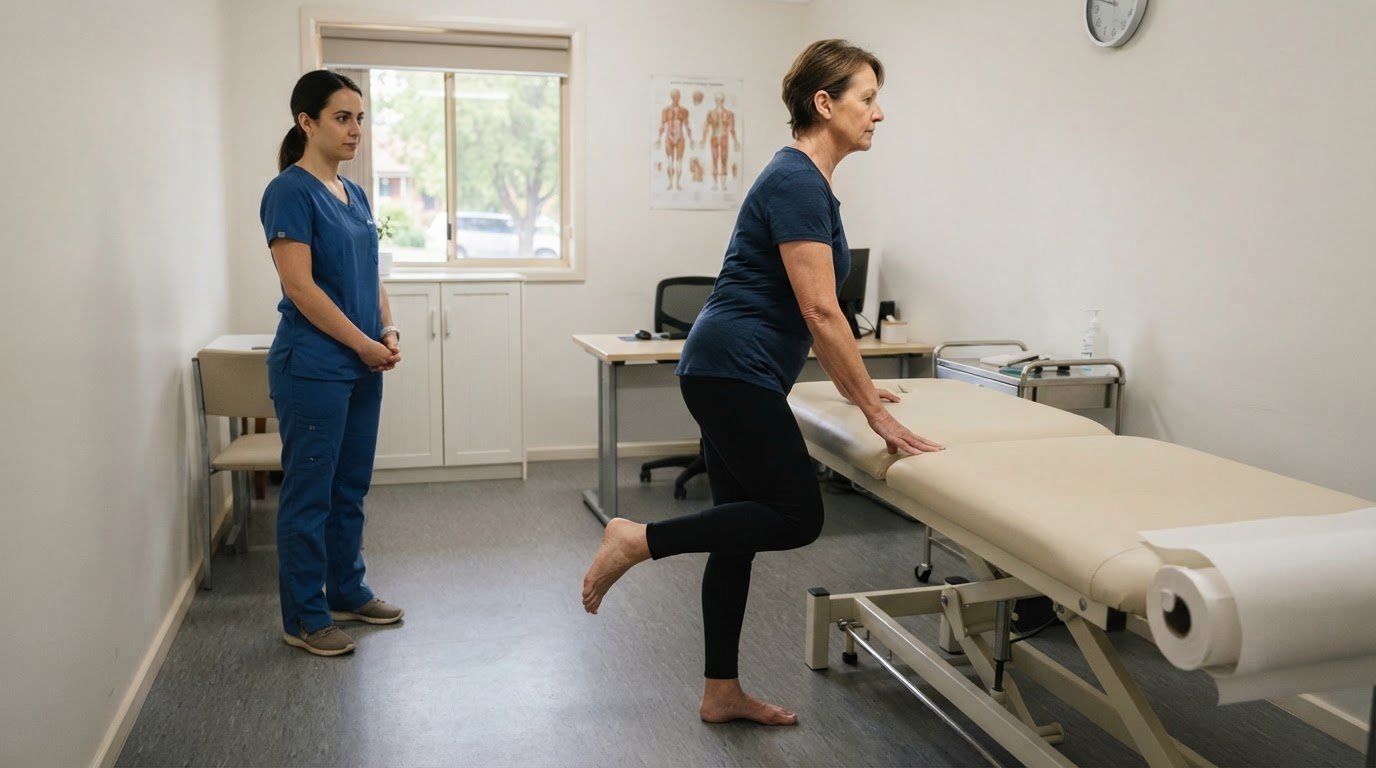
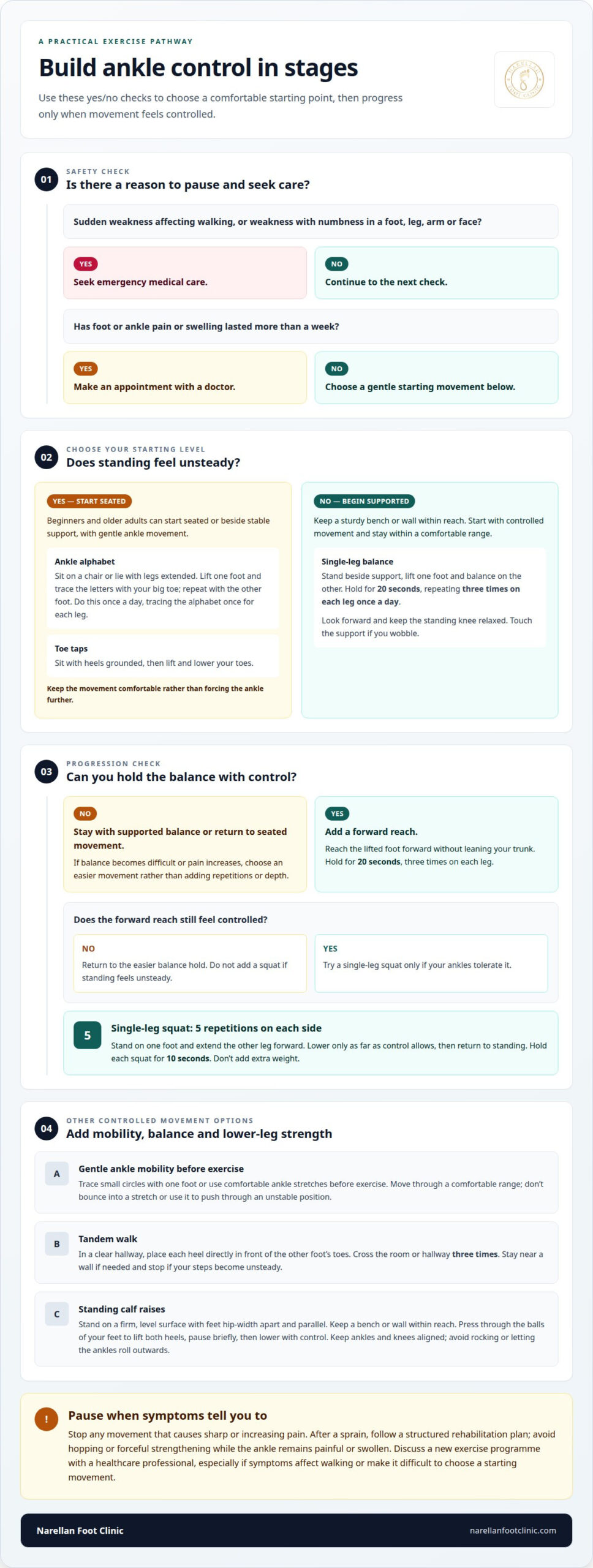
Stand beside a sturdy bench or wall, then lift one foot and balance on the other. Hold for 20 seconds, repeating three times on each leg once a day. Keep your gaze forward and your standing knee relaxed; touch the support if you wobble.
When this feels controlled, reach the lifted foot forward without leaning your trunk. Hold the forward reach for 20 seconds, three times on each leg. This challenges ankle control as your body shifts. Stronger balance may help you respond to unexpected movements, such as a change of direction, and may reduce the chance of a stumble or ankle injury.
-
Add balance challenges to daily activities
Practise a heel-to-toe walk along a clear hallway, placing each heel directly in front of the other foot’s toes. Cleveland Clinic recommends crossing the room or hallway three times for tandem walking. Stay near a wall if you need support, and stop if your steps become unsteady.
For another everyday challenge, balance on one leg while standing beside a bench. Keep it within reach and focus on a stable foot position rather than multitasking. Avoid practising near stairs, hot surfaces or other hazards. These simple movements add balance practice to a familiar routine without extra equipment.
-
Balance stretching with strengthening
Combine controlled ankle mobility with balance and strengthening rather than forcing a stretch. For example, trace small circles with one foot before standing on that leg. Move through a comfortable range when stretching; ankle-strengthening exercises challenge the muscles to control your position against gravity.
Keep the sequence manageable: mobilise the ankle, practise a supported balance hold, then try a squat only if standing feels steady. Stop any movement that causes sharp or increasing pain. Avoid bouncing into a stretch or using one to push through an unstable position.
-
Progress ankle strengthening safely
Start with supported balance and controlled movements, then progress gradually as they become easier. Add a forward reach before trying a squat. For a single-leg squat, stand on one foot, extend the other leg forward, lower only as far as control allows, then return to standing. Try five repetitions on each side, holding each squat for 10 seconds. Don’t add extra weight, and only attempt this movement if your ankles tolerate it.
For ankle rehabilitation in Australia, begin with controlled movements and progress gradually. Follow a structured rehabilitation plan while recovering from an injury. If balance becomes difficult or pain increases, return to an easier movement instead of adding repetitions or depth.
What Are Some Signs of Weak Ankles?
- Notice whether an ankle repeatedly wobbles, rolls or feels unstable while walking. Pain or swelling after an ankle sprain can also occur with ongoing instability. These signs can make everyday movements, such as stepping off a kerb or changing direction, feel less controlled. Ankles help manage forces during running and jumping, so reduced control may affect daily activities and sport.
If you’re a beginner or an older adult, start seated or beside a stable support, using gentle ankle movements. A seated ankle alphabet or toe taps are controlled options to try before standing exercises.
- Trace the alphabet with your big toe to move the ankle through different directions. Sit on a chair or lie with your legs extended, lift one foot, and draw the letters; repeat with the other foot. Do this once a day, tracing the alphabet twice in total, once for each leg. Keep the movement comfortable rather than forcing the ankle to reach further.
For foot muscles, try towel scrunches: draw a towel towards you with your toes, completing 8 to 12 repetitions before switching feet. These movements complement ankle strengthening by engaging muscles that help control the foot.
- Use a resistance band for controlled strengthening of the muscles at the front and sides of the ankle. For seated dorsiflexion, secure the band around the forefoot and pull the toes towards you against its resistance. Perform 10 repetitions per set for 2 to 3 sets. Keep your lower leg still so the ankle, rather than the whole leg, controls the movement.
Toe taps are another simple option: sit with heels grounded, then lift and lower your toes. They work the muscles at the front of the ankle. For the shin, tibia lifts progress from two sets of 10 repetitions to two sets of 20 over a few weeks. Stand with your back and buttocks against a wall, step forward about one foot, then lean back against it before lifting your toes.
- After a sprain, follow a structured rehabilitation plan and use controlled movements before progressing to more challenging activity. Avoid hopping or forceful strengthening while the ankle remains painful or swollen. If foot or ankle pain or swelling lasts more than a week, make an appointment with a doctor. Sudden weakness that affects walking, or weakness accompanied by numbness in a foot, leg, arm or face, requires emergency medical care.
Before starting a new exercise programme, discuss your plans with a healthcare professional. This can be especially helpful if ankle symptoms affect your walking or make it difficult to choose a suitable starting movement.
Standing calf raises
- Choose a firm, level surface and stand with your feet hip-width apart and parallel. Keep a bench or wall within reach, especially if your standing balance feels uncertain. Press through the balls of your feet and lift both heels, keeping your ankles and knees aligned. Pause briefly at the top, then lower your heels with control. Avoid rocking your body or letting your ankles roll outwards.
This movement works the calf muscles, which help lift your heels during walking. A steady position also makes it easier to notice whether one side feels less controlled.
- Begin with 10 calf raises in a row once a day, using the same slow movement each time. If that feels manageable, use two sets of 10 and build towards two sets of 20 over a few weeks. Rest between sets, and keep your weight even across both feet. Stop the set if your heels lift unevenly or your ankles cannot stay aligned.
Standing calf raises are among the exercises for weak ankles that train controlled heel lifting. Another approach is three sets of 10 repetitions. Choose a range you can perform with control, rather than rushing to complete more repetitions.
- Change the resistance only after the standing movement feels steady. A resistance band offers another challenge: sit with your leg extended, loop the band around your forefoot, then point your toes away against its pull. Return slowly to the starting position. Flexing and pointing your toes against band resistance works the ankle in two directions.
Keep the band tension comfortable and your lower leg still. Let your ankle guide the movement, with the band providing resistance without pulling your joints abruptly.
- Add a calf stretch after the raises if your calf feels tight. Stand facing a wall, place both hands on it, and step one foot behind you. Keep the back heel down and the back knee straight, then lean gently forwards until you feel a stretch in the calf. Hold for 20 to 30 seconds if possible.
Repeat for two to three sets, two to three times a day. To target the soleus, bend the back knee slightly while keeping the heel grounded. Use a comfortable stretch, not a bouncing movement.
- Use the next morning as a guide to how your ankle responded to the session. If pain is worse, reduce the range or repetitions next time. Calf raises should feel like controlled effort through the lower leg, not sharp pain around the ankle joint. Keep the surface stable, and wait until you can lower both heels smoothly on flat ground before trying raises on a step.
If you include calf raises in your exercises for weak ankles, pair them with a gentle calf stretch, then return to ordinary walking. Consistent, measured movements help you practise strength without losing control.
Ankle mobility exercises
Use controlled ankle movements to explore a comfortable range before adding more demanding activity. A steady pace helps you focus on movement without forcing the joint.
-
Practise ankle range-of-motion exercises
Sit or lie with your legs supported, then point and flex one foot slowly. For an ankle pump, move slowly between pointing and flexing your foot, using a comfortable range. Keep your knee still so the motion comes from your ankle, and stay within a comfortable range.
For a supine dorsiflexion stretch, draw your toes towards you and hold for 30 seconds. Repeat twice for each ankle once a day. Move gently between positions; avoid pulling sharply or forcing the foot past resistance. Controlled motion helps you notice differences between ankles.
-
Build ankle mobility and stability
Draw slow circles with one foot, completing 10 to 15 circles before changing direction and switching ankles. Keep the lower leg relaxed and make the circles smooth, not rushed. This mobility drill moves the ankle through different directions while letting you focus on control.
To connect mobility with ankle stability, sit near a sturdy support and practise lifting and lowering your toes while keeping your heels on the floor. Then stand beside the support and gently transfer your weight from one foot to the other. Keep your feet planted and your knees soft. Stop if your ankle rolls or becomes painful.
- Stretch the ankle before activity with a towel or resistance band. Sit with one leg extended, loop the towel around the ball of your foot, and gently draw the toes towards you. Hold the stretch for 30 seconds, keeping the knee straight and the pull even. Don’t jerk the towel or force a deeper stretch.
After stretching, try a small set of calf raises on a level surface if they feel comfortable. The stretch moves your ankle towards you; the raise practises controlled movement in the opposite direction. Together, these actions build range and active control without fast movements.
- Use a simple sequence before exercise: ankle pumps, circles, then a gentle stretch. Move each ankle smoothly through its comfortable range. If one side feels stiffer, make the movement smaller rather than forcing it to match the other foot.
Repeat this short sequence before walking or another activity involving repeated foot movement. Mobility work prepares the ankle to move, while stability depends on controlling that movement when standing and walking. Keep a wall or chair nearby if you need support as you move on to standing exercises.
How often should you do ankle strengthening exercises?
Set a schedule you can repeat, then adjust the amount to your ankle’s response. The suitable frequency and repetitions depend on the exercise and your symptoms.
- Choose a weekly rhythm you can maintain. Ankle-strengthening exercises can be practised three to four times a week. If you already work out three or four times per week, add a few controlled ankle movements to your warm-up. Keep the session focused: for example, include calf raises, toe taps or a balance hold rather than rushing through every exercise.
Some gentle movements, such as heel walks, can be part of a daily routine. Let the movement and your response guide how often you repeat it.
- Begin a new movement with 2 to 3 repetitions at a time, especially if your ankle is sore or deconditioned. If the movement stays comfortable and controlled, add 1 or 2 repetitions every few days. Build up gradually rather than making a large jump in repetitions in one session.
For a simple strengthening format, do 8 repetitions, rest for a minute, then complete another set. Adjust the routine to your comfort and control, and avoid forcing the movements.
- Use 2 sets of 15 repetitions as the suggested maximum for ankle exercises. You don’t need to reach that amount if your technique becomes less controlled. For example, stop calf raises when your heels lift unevenly, or reduce resistance if a band exercise causes you to twist your lower leg.
Keep track of each exercise, your repetitions and any symptoms. A brief note after each session can help you see whether increasing the workload changes how your ankle feels.
- Monitor pain during exercise using a 10-point scale. A score of 0 to 3 indicates minimal pain, while 4 to 5 is considered acceptable. Pain from 6 to 10 is excessive, so stop or reduce the movement rather than pushing through.
Check how your ankle feels the morning after exercise. Pain should be no worse. If it is, reduce the repetitions or range at your next session.
- If a longer session aggravates ankle pain, spread smaller amounts of exercise through the day. For example, you could repeat a few movements every hour. Keep each bout controlled and avoid stacking several demanding sessions together.
If you need guidance matching exercise frequency to your symptoms, arrange a professional ankle assessment. A measured plan can help you choose appropriate movements and progress them with control.
For weak ankles, heel walks are done once a day. Treat that as a distinct part of your routine, rather than assuming every movement needs the same schedule. Keep the pace comfortable and pay attention to whether your ankle remains controlled as you practise. If the planned amount feels difficult, scale the session back and return to a manageable level instead of forcing more work.
If you’re exercising for ankle pain, doing a few repetitions at intervals throughout the day is one way to break practice into brief bouts instead of concentrating it all in one session. Keep movements deliberate, and use your symptoms and control to decide whether to continue. A steady routine is more useful than adding repetitions when your ankle is already reacting poorly.
Narellan Foot Clinic
At Narellan Foot Clinic, a Biomechanical Assessment can evaluate how your foot mechanics relate to ankle weakness and instability. If your ankle keeps giving way, feels uncomfortable during walking or remains difficult to strengthen after an injury, the assessment can help evaluate how your feet and lower limbs move. The findings can guide discussion of suitable options, including whether Custom Orthotics may be appropriate for your foot mechanics.
Tell your podiatrist which movements feel difficult, such as standing on one leg or walking on uneven ground. Sharing when symptoms began and what aggravates them helps focus the assessment on your concerns. Contact Narellan Foot Clinic to discuss an assessment for ongoing ankle weakness.
Make ankle care part of your routine
Choose a regular time to practise, such as before a walk. Keeping your exercises for weak ankles manageable makes it easier to focus on smooth movement and notice how your ankle responds. Build consistency before making the routine more demanding.
Progress isn’t only about doing more. Notice whether everyday movements feel easier to control, and adjust your routine when symptoms change. Ongoing weakness, repeated ankle giving-way or difficulty staying active may be reasons to seek individual guidance. A professional assessment can help clarify what may be affecting your movement and shape an appropriate next step.
For support with ankle concerns, contact Narellan Foot Clinic. Keep your approach steady and patient, and take the next step towards moving with greater confidence.
Frequently Asked Questions
What exercises strengthen weak ankles?
A useful routine combines movements that challenge different aspects of ankle control. Try seated toe taps for the muscles at the front, resistance-band movements for controlled push and pull, and calf raises to lift through the lower legs. Add foot-muscle work, such as towel scrunches, if comfortable. Begin with movements you can perform smoothly, and choose a smaller range if an ankle feels stiff or unsteady.
What are the best ankle balance and stability exercises?
Single-leg balance and tandem walking are practical choices for training control. You can also practise a single-leg isometric hold, keeping the ankle steady against a fixed position for at least 30 seconds. Use a stable support nearby and keep the practice area clear. A useful challenge is maintaining an even foot position while your body shifts, rather than adding speed or making the surface unstable.
What equipment is useful for ankle exercises, such as resistance bands?
A resistance band can provide adjustable resistance for seated ankle movements, while a towel can help with stretching or drawing your toes towards you. A sturdy chair or wall provides support during standing balance practice. You can do several mobility movements without equipment. Choose a band that lets you move smoothly, and avoid jerking against its pull or letting it slip from your foot.
What are the risks or warning signs when exercising weak ankles?
Reduce or stop an exercise if pain reaches 6 to 10 on a 10-point scale, or if your ankle feels worse the following morning. New weakness that affects walking or comes with numbness in your foot, leg, arm or face needs emergency medical care, as these can be signs of stroke. After an ankle injury, use a structured rehabilitation plan rather than progressing into high-impact drills without controlled technique.