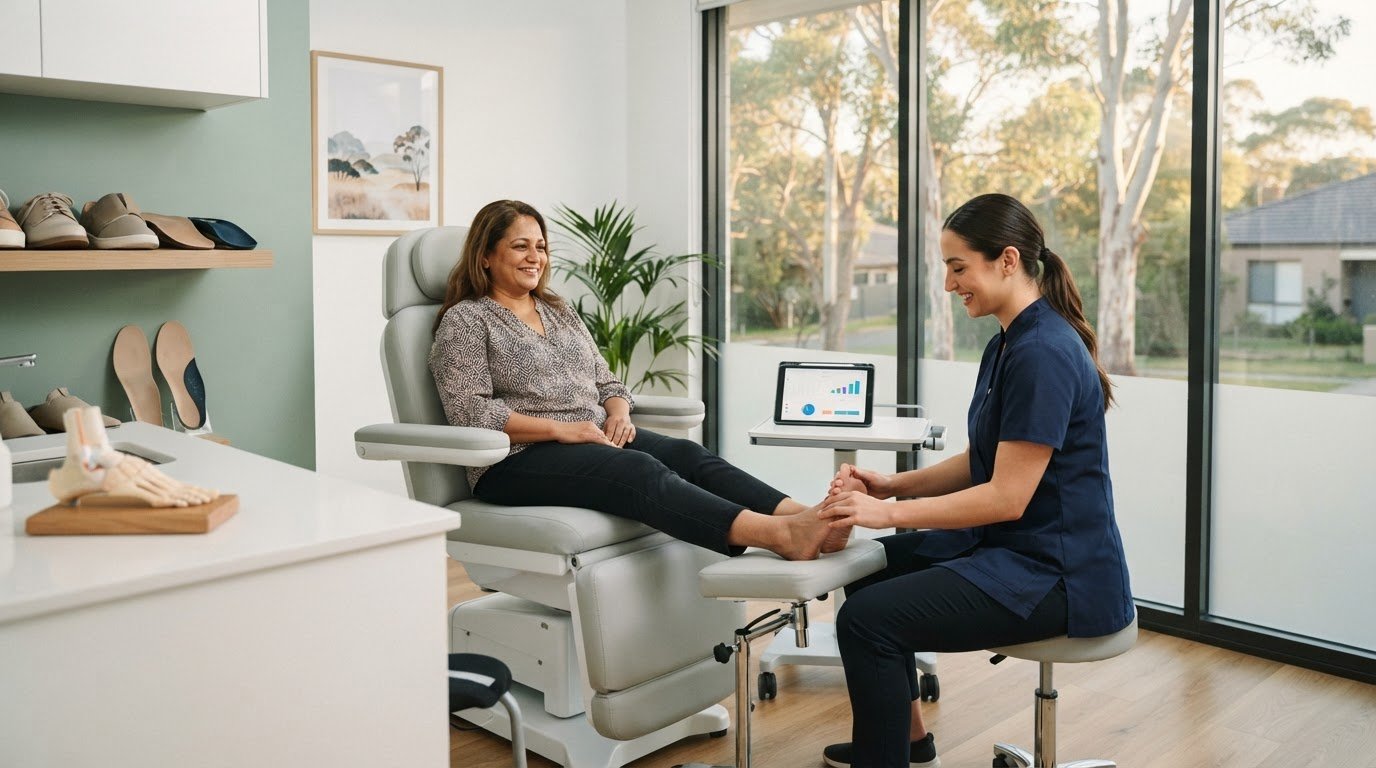
What if you could bypass the GP waiting room entirely and get your foot pain treated today? If you are wondering, “do I need a GP referral for a podiatrist NSW,” the short answer is usually no. Under Australian healthcare regulations, podiatrists are primary contact practitioners, meaning you can legally book an appointment directly without seeing a doctor first.
We know how frustrating it is to put your life on hold while waiting weeks for a general practice consultation, especially when every step is uncomfortable. You shouldn’t have to delay proper care or juggle administrative hurdles just to find relief. In this guide, you will discover exactly when you can book directly, how private health insurance extras work on the spot, and the specific circumstances where a GP referral is required to unlock Medicare subsidies or DVA funding.
Here is everything you need to know about accessing expert podiatric treatment across New South Wales quickly, clearly, and without unnecessary paperwork.
Key Takeaways
- If you are asking “do I need a GP referral for a podiatrist NSW”, you can book immediately as a private patient without waiting to see a doctor first.
- A formal GP referral is mandatory only if you are claiming Medicare allied health rebates, DVA healthcare funding, or NSW Workers Compensation (SIRA).
- Private health fund extras can be claimed on the spot via electronic HICAPS terminals with zero medical paperwork required.
- Bringing proper footwear, previous orthotics, and relevant lower limb imaging to your initial consultation helps ensure an accurate clinical assessment.
- Direct booking allows residents across Narellan and the Macarthur region to access timely foot care without administrative delays.
Do You Need a GP Referral to See a Podiatrist in NSW?
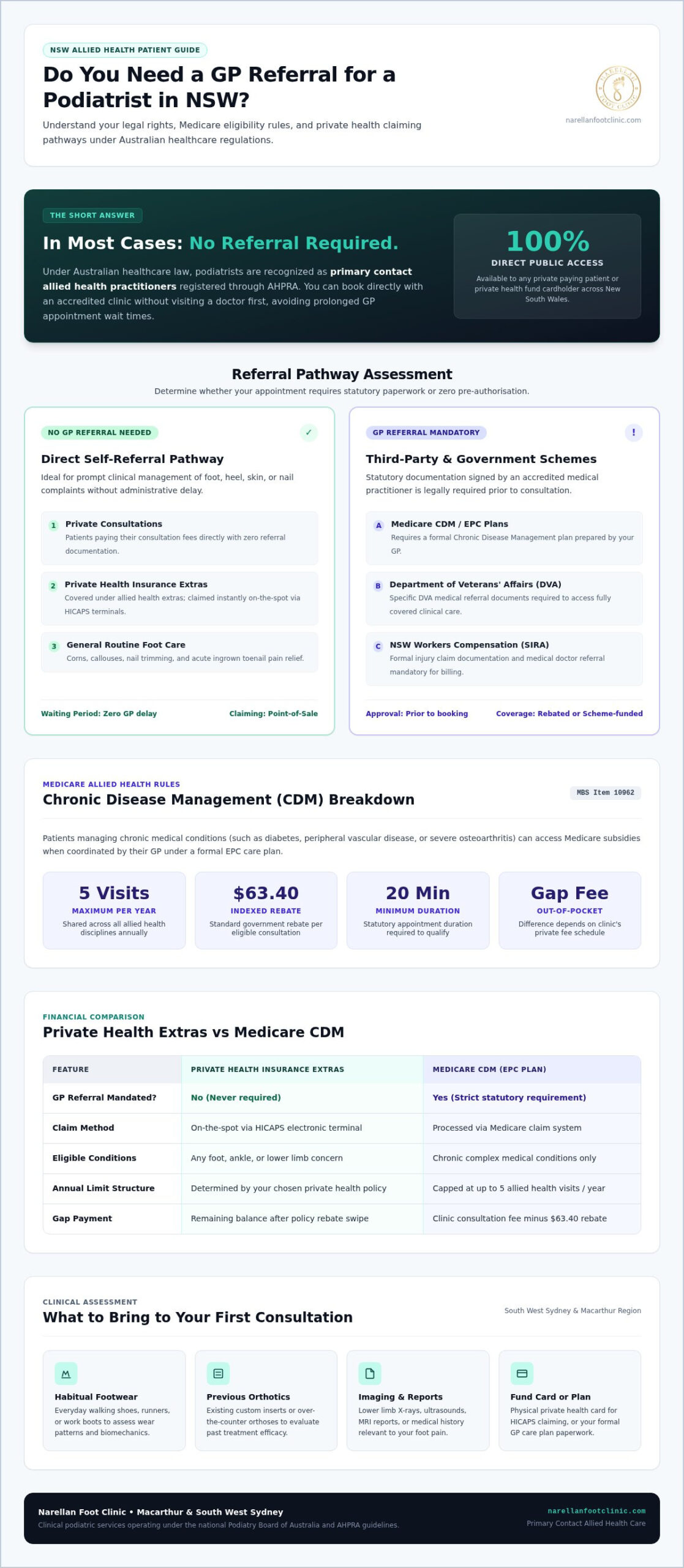
If you find yourself asking, “do I need a GP referral for a podiatrist NSW”, the answer for most people is simple: no, you don’t. In New South Wales, podiatrists are recognized as primary contact allied health practitioners. That classification means you possess the legal right to book an appointment directly with a clinic whenever foot, heel, or ankle discomfort arises, completely bypassing your local doctor’s surgery.
Many patients mistakenly assume that all specialised healthcare requires an initial sign-off from a general practitioner. This misconception often causes people to endure persistent pain while waiting weeks for an available GP consultation. In reality, a referral is only necessary if you intend to claim financial coverage through specific government-funded initiatives such as Medicare care plans or Department of Veterans’ Affairs programs. If you are funding your consultation privately or claiming through private health insurance extras, no doctor’s letter is required.
What It Means That Podiatrists Are Primary Healthcare Providers
In Australia, allied health professions operate under strict national regulation. Registered through the Podiatry Board of Australia and the Australian Health Practitioner Regulation Agency (AHPRA), podiatrists undergo rigorous clinical university training. This education empowers them to independently examine, diagnose, and prescribe clinical management for foot and lower leg disorders.
Because the scope of podiatric care allows these practitioners to act as a primary point of contact, they do not rely on a doctor’s preliminary evaluation to initiate treatment. When sharp pain from an infected ingrown toenail strikes or sudden heel pain impedes your daily walk, you can contact an accredited clinic directly for rapid, focused care.
When Self-Referral Is the Fastest Route to Relief
Choosing to self-refer is often the most practical, stress-free route to restoring comfort. It removes unnecessary paperwork and puts you in front of a clinician who focuses solely on lower limb biomechanics and skin pathologies.
Self-referral offers several distinct advantages:
- No GP appointment wait times: You avoid booking delays, taking time off work for preliminary visits, or sitting in crowded medical waiting rooms.
- Direct private health claiming: Private health funds never demand a referral to process podiatry extras, allowing simple point-of-sale claims.
- Timely intervention: Prompt evaluation prevents mild structural aches or localized lesions from becoming chronic, debilitating conditions.
Whether you require corn debridement, nail trimming, or callous management, booking routine general foot care ensures your feet stay healthy and mobile without administrative roadblocks slowing you down.
When a GP Referral Is Legally Required in NSW: Medicare, DVA, and WorkCover
While you do not usually need a referral to walk into an allied health clinic, third-party funding schemes play by different rules. If you are asking “do I need a GP referral for a podiatrist NSW” because you hope to have government subsidies or an insurer cover your clinical costs, the answer changes entirely. In these specific circumstances, appropriate paperwork from a registered medical practitioner is a strict statutory requirement before claims can be processed.
Chronic Disease Management (CDM) and Medicare EPC Plans
Patients managing chronic medical conditions, such as diabetes, peripheral vascular disease, or severe osteoarthritis, can access subsidised care under the Medicare Chronic Disease Management framework. Your doctor determines clinical eligibility and creates a formal care plan, previously known as an EPC, that allocates up to 5 rebated allied health visits per calendar year across all disciplines. Consultations must run for a minimum duration of 20 minutes to qualify under MBS Item 10962. Medicare issues an indexed rebate of $63.40 per consultation, leaving an out-of-pocket gap depending on the clinic’s private fee schedule. For high-risk individuals, early detection of sensory changes during a regular diabetic foot assessment Narellan appointment is vital for avoiding serious lower limb complications.
Department of Veterans Affairs (DVA) Podiatry Pathways
DVA cardholders require formal documentation to access fully covered clinical treatments. Gold Card holders are covered for all clinically necessary foot and lower limb therapies, whereas White Card holders are covered exclusively for accepted, service-related conditions. To initiate treatment:
- Your GP must complete a standard D904 referral form or structured referral letter.
- The referral activates a treatment cycle lasting for up to 12 sessions or 12 months, whichever finishes first.
- At the end of each cycle, your podiatrist submits a progress report back to your GP before a new referral can begin.
SIRA WorkCover NSW and CTP Insurance Claims
Work-related lower limb trauma operates under unique guidelines set by the State Insurance Regulatory Authority (SIRA). While certain therapies allow initial consultations without paperwork, podiatrists explicitly require a formal referral and a valid Certificate of Capacity from your Nominated Treating Doctor before commencing care. Insurers must approve this treatment in writing to ensure claims are settled smoothly. For self-managed or plan-managed NDIS participants, a GP referral is generally not mandatory, provided podiatry supports are deemed reasonable and necessary under your active budget.
If you hold an active care plan or DVA paperwork, you can book an appointment with our experienced clinical team at Narellan Foot Clinic to arrange seamless digital processing on the day.
Private Health Insurance vs Medicare: Choosing Your Payment Pathway
Deciding how to fund your podiatric care often resolves the question: do I need a GP referral for a podiatrist NSW? If you hold private health insurance with allied health extras, the process is straightforward. Private health funds do not require a doctor’s referral to cover podiatric care. You simply book an appointment, receive clinical treatment, and claim your rebate directly at the clinic.
A crucial rule under Australian health legislation governs these options. Under Section 10 of the Health Insurance Act 1973, you cannot claim both Medicare benefits and private health insurance extras for the exact same consultation. Nor can you use private insurance to pay the out-of-pocket gap left by a Medicare rebate. You must select one payment avenue per visit, making it essential to understand how each system operates.
How On-the-Spot HICAPS Claiming Works
Modern clinics make claiming your private health benefits effortless through electronic HICAPS terminals. When your appointment finishes, our reception team swipes your physical membership card or scans your digital health fund pass via your smartphone. The terminal communicates instantly with your insurer, processing the fund benefit on the spot.
You only pay the remaining balance, known as the gap fee. The exact rebate amount depends entirely on your insurer, your specific policy level, and your remaining annual allied health limits. This electronic transaction eliminates paper claim forms and online rebate submissions entirely.
Medicare Chronic Plan vs Private Health Extras: Key Differences
Choosing between Medicare and your health fund comes down to clinical eligibility and long-term planning. To access Medicare support, you must have an established chronic medical issue and obtain a formal GP chronic condition management plan before your podiatry consultation. Private health insurance extras, by comparison, require only an active policy that includes podiatry.
Many patients use a balanced strategy across the year:
- Medicare allocation first: Utilise your allocated subsidised visits for chronic disease reviews or recurring maintenance care.
- Private health extras second: Transition to your private health cover once your annual Medicare visits are exhausted.
- Advanced diagnostic care: Apply your private health benefits towards specialised diagnostic services, such as an in-depth biomechanical assessment to evaluate walking patterns and joint alignment.
Understanding these distinct pathways helps you make informed choices about your healthcare expenditure while ensuring you receive consistent, uninterrupted lower limb treatment.
What to Bring to Your First Podiatry Appointment in NSW
Preparing for an initial consultation involves more than simply securing a spot in the appointment book. While asking “do I need a GP referral for a podiatrist NSW” helps you determine whether doctor documentation is required, gathering the right physical and administrative materials ensures your clinician can conduct a thorough, accurate evaluation from the minute you sit in the chair.
Arriving well prepared turns a routine visit into a highly productive assessment. Having your full health background readily available gives your practitioner clear insight into factors influencing your discomfort, while physical items like daily shoes reveal crucial mechanical clues.
Administrative and Clinical Documentation
Having accurate documentation on hand streamlines registration and prevents unexpected billing delays. Pack these essentials before heading to the clinic:
- Cards and identification: Bring your Medicare card, private health fund card (or digital wallet app), and any DVA Gold or White cards.
- Referral documentation: Carry a paper or digital copy of your GP Chronic Condition Management Plan or formal medical referral if you intend to claim government-subsidised rebates.
- Diagnostic imaging: Include physical films, USB drives, or written radiologist reports for recent lower limb X-rays, ultrasounds, or MRI scans.
- Medical background: Prepare an up-to-date medication list, noting any anticoagulants or diabetes medications, along with a summary of prior foot surgeries.
Footwear and Physical Preparation
Your shoes tell an undeniable clinical story. The friction marks, heel compression, and tread wear patterns across your soles give your podiatrist valuable data about how forces travel through your joints. Bring your primary daily walking shoes, occupational work boots, and running or gym sneakers so they can be inspected alongside your bare feet.
Remember to pack any existing custom or over-the-counter arch supports, as testing their current integrity helps identify whether they still provide adequate structural control. Wear comfortable, loose-fitting trousers or shorts so the practitioner can easily examine your feet, ankles, and knees during static and dynamic movement tests. Thorough footwear and gait analysis is fundamental when assessing heel pain treatment strategies and resolving plantar fascia irritation.
Ready to take the first step toward lasting mobility? You can easily book your initial consultation with our experienced team to get your lower limb health back on track.
Accessing Experienced Podiatric Care in Narellan and South West Sydney
Living with constant foot, heel, or ankle discomfort disrupts every part of your routine. When mobility is compromised, waiting weeks for a preliminary medical consultation only adds to the stress. As we have established, the answer to “do I need a GP referral for a podiatrist NSW” is that private patients can seek help straight away. Having rapid access to a trusted local clinic means you can address painful symptoms before they interfere with work, exercise, and family life.
For residents across Narellan, Campbelltown, Camden, and the broader Macarthur region, experienced care is readily accessible close to home. Choosing an established community practice ensures your lower limb concerns are managed with clinical precision, clear communication, and genuine personal attention.
Why Local Experience Matters for Your Lower Limb Health
Established circa 1998, Narellan Foot Clinic brings over 25 years of dedicated experience to South West Sydney. Led by principal podiatrist David J. Miller, our clinic provides thorough assessments and tailored therapies within a fully sterilised clinical environment. Over two and a half decades of practice foster a refined understanding of regional patient needs, from active sporting injuries to complex degenerative conditions.
Long-standing community roots deliver tangible clinical advantages:
- Collaborative care networks: Strong professional relationships with local Macarthur medical centres and diagnostic imaging facilities ensure smooth coordination if collaborative care is needed.
- Individualised treatment plans: Management is customized to your daily footwear, physical demands, and recovery goals rather than relying on generic recommendations.
- Clinical continuity: Seeing an experienced practitioner provides consistent monitoring of long-term progress, helping you maintain comfort and mobility year after year.
Effortless Appointment Scheduling and Immediate On-Site Processing
Accessing high-standard lower limb care should never feel like an administrative chore. Whether you are self-referring for sudden heel discomfort or presenting an eligible GP Chronic Condition Management Plan, our reception processes are built around ease and transparency. We handle digital Medicare processing and point-of-sale HICAPS transactions directly at the front desk, ensuring your claims are completed without fuss.
Don’t let lower limb discomfort hold you back from the activities you enjoy. Book an appointment at Narellan Foot Clinic today to receive focused, professional care tailored entirely to your feet.
Take the First Step Toward Comfortable, Pain-Free Movement
Navigating healthcare rules shouldn’t keep you from getting rapid relief. If you were wondering, “do I need a GP referral for a podiatrist NSW”, you now know that private patients can book immediately without waiting for a doctor’s appointment. A formal GP referral is only necessary when claiming government rebates under Medicare Chronic Condition Management Plans, DVA entitlements, or NSW Workers Compensation.
With over 25 years of trusted clinical experience serving Narellan and the Macarthur region, principal podiatrist David J. Miller and the team provide comprehensive, evidence-based care tailored to your daily needs. Our practice features seamless on-the-spot HICAPS and digital Medicare claiming, taking the stress out of your appointment so you can focus entirely on your recovery.
Painful feet should never dictate how you live your life. Book your consultation with Narellan Foot Clinic today and experience attentive, expert support designed to keep you walking comfortably.
Frequently Asked Questions
Do I need a GP referral to see a private podiatrist in NSW?
No, you don’t. Podiatrists in New South Wales are primary contact health practitioners registered under AHPRA. This means you can book an appointment directly without visiting your general practitioner first. If you are wondering “do I need a GP referral for a podiatrist NSW”, the simple answer is no for private consultations, whether you are paying out of pocket or using private health insurance extras cover.
How does an EPC or Chronic Disease Management plan work for podiatry?
An allied health care plan allows eligible patients with chronic medical conditions to claim Medicare rebates. Your GP assesses your condition and lodges the formal plan, allocating up to 5 subsidised allied health visits across all disciplines per calendar year. Each consultation requires a minimum 20-minute clinical duration. Our clinic processes your referral electronically on the day, crediting the standard Medicare benefit directly back into your bank account.
Can I claim podiatry on private health insurance without a doctor’s letter?
Yes, you can claim private health insurance benefits without any referral letter or doctor documentation. Private health funds classify podiatry as an ancillary or extras service. All you need is an active policy that includes podiatry cover. At your consultation, our team simply swipes your digital or physical membership card through our electronic HICAPS terminal, allowing your health fund rebate to be deducted instantly from the consultation fee.
Can I claim Medicare and private health insurance on the same visit?
No, Australian law strictly prevents dual claiming for the exact same consultation. Under Section 10 of the Health Insurance Act 1973, you must choose either a Medicare rebate or a private health insurance extras claim for an individual appointment. You also cannot use your private health fund to cover the remaining out-of-pocket gap left by Medicare. Many patients choose to exhaust their Medicare allocation before switching to private health extras.
Does a referral from a GP expire for podiatry visits?
Yes, GP referrals under Medicare Chronic Condition Management Plans operate within specific time limits. Unused sessions from an allocated plan generally carry forward across calendar years, but you cannot exceed five Medicare-subsidised visits in any single calendar year. In contrast, DVA referrals operate under a strict 12-session or 12-month treatment cycle. Once these parameters are reached, your podiatrist must provide a clinical progress report to your doctor before a new referral is issued.
What happens if my GP refers me to a different podiatrist by name?
You are completely free to choose where you receive care. Under Medicare allied health guidelines, a referral made out to a specific practitioner or clinic remains valid at any registered podiatry practice across New South Wales. If your doctor nominated a different clinic, simply bring your referral documentation to your appointment with us. We will accept the referral, communicate with your referring doctor, and process your Medicare rebate without requiring a rewritten letter.
Will Medicare cover routine nail cutting or general skin care?
Medicare does not cover routine toenail maintenance or minor skin management unless there is an underlying chronic illness that poses serious clinical risks. To be claimable under a GP Chronic Condition Management Plan, treatment must directly contribute to managing a complex condition, such as diabetic neurovascular complications or severe peripheral arterial disease. For everyday grooming and standard callous care, patients generally choose convenient self-referral, paying privately or utilising their private health extras cover.