

Did you know that up to 56% of recreational runners experience at least one injury every single year? It’s a staggering figure that highlights just how common it is to feel held back by physical setbacks. You’ve likely felt that familiar sense of frustration when a sharp ache or persistent throb forces you to cut your training session short. It’s perfectly natural to worry about whether your running foot pain is a simple case of overexertion or a sign of something more serious that might require surgery or months of rest.
While foot health is our focus, we know that runners often deal with a range of physical setbacks. For those also managing abdominal or groin issues, the Brisbane Hernia Clinic provides specialised surgical information that can be a vital part of a comprehensive recovery plan.
We understand the anxiety that comes with being sidelined from the sport you love. This clinical guide is designed to replace that confusion with clarity. You’ll discover the genuine root causes of your discomfort and learn how a professional biomechanical assessment can provide the precise diagnosis you need to move forward. We’ll preview the latest 2026 rehabilitation strategies and practical steps to ensure your return to the track is both swift and sustainable. By focusing on modern load management and expert gait analysis, we’ll help you transition from a state of worry to the comfort of pain-free performance.
Key Takeaways
- Learn how to differentiate between minor muscle soreness and chronic running foot pain to protect your long-term mobility.
- Understand the impact of your unique gait cycle and how overpronation or supination can lead to repetitive stress injuries.
- Discover how to select the ideal running shoes for Narellan’s varied terrain and when to replace them to maintain proper support.
- Use the “48-Hour Rule” to triage training niggles and identify red flags that require a professional clinical assessment.
- See how biomechanical assessments and custom orthotics can resolve alignment issues and get you back to pain-free running.
Common Causes of Running Foot Pain: Identifying the Culprits
Understanding the source of your discomfort is the first step toward a successful recovery. We often see athletes who struggle to distinguish between an acute injury, like a sudden ligament sprain, and chronic overuse syndromes that develop over hundreds of kilometres. While an acute injury happens in a split second, most instances of running foot pain result from the cumulative stress of repetitive impact. Every time your foot hits the pavement, it absorbs several times your body weight in force. It’s a significant load for the small structures of the foot to manage.
If your biomechanics aren’t perfectly aligned, this force isn’t distributed evenly across your joints and soft tissues. Over time, these minor imbalances lead to common running injuries that can sideline even the most dedicated athlete. Ignoring a small “niggle” is a risky strategy. When you change your gait to avoid a tiny bit of discomfort, you inadvertently put extra pressure on other muscles and tendons. This often leads to secondary compensatory injuries, turning a simple fix into a complex rehabilitation journey. Seeking professional advice early is always the safest path to staying on the track.
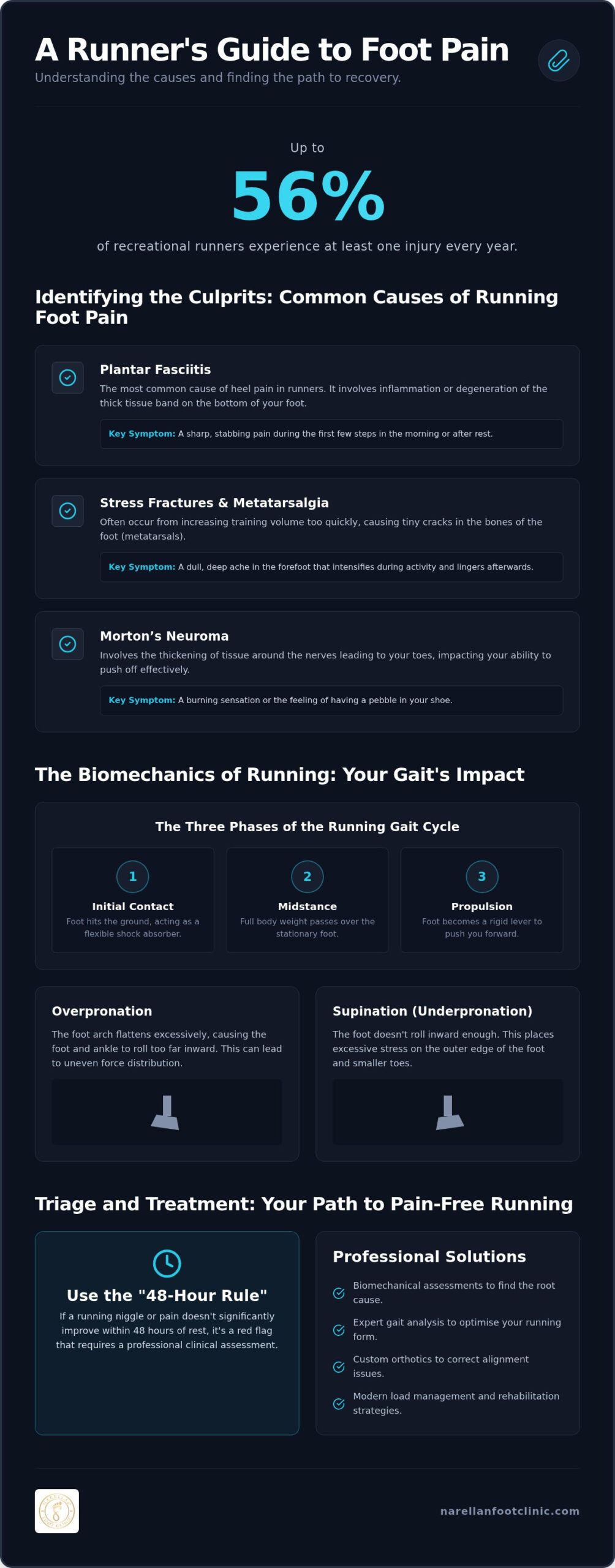
Plantar Fasciitis is the most common cause of heel pain in runners, involving inflammation or degeneration of the thick band of tissue running across the bottom of your foot.
Plantar Fasciitis and Heel Pain
The hallmark of this condition is a sharp, stabbing sensation during those first few steps of a morning run or after sitting for a long period. During the propulsion phase of your stride, the plantar fascia undergoes significant mechanical strain as it helps stabilise the arch and transfer energy. If the load exceeds what the tissue can handle, micro-tears occur. Pushing through this heel pain is counterproductive. It often leads to chronic thickening and scarring of the fascia, which makes the condition much harder to resolve with conservative treatments later on.
Stress Fractures and Metatarsalgia
Not all pain is inflammatory. A dull, deep ache that intensifies during activity and lingers afterwards might indicate a metatarsal stress reaction. These injuries are particularly common when you’ve recently increased your training volume or intensity too quickly. The bone simply hasn’t had enough time to adapt to the new load. Forefoot pain can also stem from conditions like Morton’s Neuroma, which involves the thickening of tissue around the nerves leading to your toes. This often causes a burning sensation or the feeling of a pebble in your shoe, significantly impacting your ability to push off effectively during toe-off.
The Biomechanics of Running: How Your Gait Impacts Foot Health
Every step you take while running involves a precise sequence of movements known as the gait cycle. It’s a coordinated effort from your hips down to your toes, rather than just a simple foot movement. When this sequence is disrupted, the result is often persistent running foot pain that doesn’t seem to go away with rest alone. Understanding how your body moves is essential for both recovery and long-term performance.
The running gait cycle consists of three primary phases: initial contact, midstance, and propulsion. During initial contact, your foot hits the ground and must act as a flexible shock absorber. In the midstance phase, your entire body weight passes over the stationary foot. Finally, during propulsion, the foot must transform into a rigid lever to push you forward. Imbalances during any of these stages can lead to trouble. For instance, overpronation occurs when the arch flattens too much, while supination means the foot doesn’t roll inward enough. Both issues cause uneven force distribution across your joints and soft tissues.
Your foot strike is also heavily influenced by the kinetic chain, particularly hip stability. If your hip stabilisers are weak, your leg may rotate inward, forcing the foot into an awkward position to compensate. It’s a delicate balance; a 1-degree misalignment at the ankle can multiply force at the knee, showing how a small mechanical flaw can cause pain further up the body.
Footstrike Patterns and Impact Forces
Whether you’re a heel striker or a midfoot striker, your technique changes how your body absorbs shock. Heel striking often creates higher impact peaks through the skeleton, whereas midfoot striking places more demand on the Achilles tendon for energy storage and return. Your arch is designed to naturally deform under load to dissipate these forces. However, if your footwear or foot structure doesn’t support this process, the repetitive stress can quickly lead to injury. If you are concerned about your technique, a professional biomechanical assessment can provide the clarity you need to run safely.
The Importance of Gait Analysis
A podiatrist uses a treadmill-based assessment to look for subtle movement patterns that might be causing your discomfort. We specifically look for “braking forces,” which happen when your foot lands too far in front of your body, effectively acting as a brake. Using digital gait analysis, we gather objective data that the human eye simply cannot catch. This precise information allows us to create a treatment plan that addresses the root cause of your pain, ensuring you aren’t just treating the symptoms but fixing the foundation of your movement.
Footwear and Surfaces: Choosing the Right Gear for Narellan Terrain
Selecting the right footwear is often the most confusing part of managing running foot pain. With so many brands competing for attention, it’s easy to get distracted by bright colours and marketing claims rather than focusing on what your feet actually need. The reality is that the “best” brand doesn’t exist; the best shoe is simply the one that matches your unique biomechanical profile and training environment. Whether you’re a seasoned marathoner or just starting out, your choice of gear acts as the primary interface between your body and the ground.
Generally, running shoes fall into three categories: neutral, stability, and motion control. Neutral shoes are designed for those with higher arches or a more rigid foot structure that doesn’t roll inward enough. Stability shoes offer a moderate level of support for those who overpronate, while motion control shoes are built for runners with flatter feet who require significant structural guidance. Using the wrong category can lead to unnecessary strain on your joints, as the shoe won’t be complementing your natural movement.
Even the perfect shoe has a shelf life. The trend in 2026 is towards lighter, more responsive foams that provide a “super shoe” feel for everyday training. While these are incredibly comfortable, they can sometimes mask the fact that the midsole has lost its integrity. We typically recommend replacing your runners every 600 to 800 kilometres. In Narellan, where many of us run on the hard concrete paths around the Town Centre or the bike tracks through Camden, this loss of cushioning is often felt much sooner through increased joint jarring.
Matching Shoes to Your Foot Type
Many people rely on the “Wet Foot Test” to determine their arch height at home, but this only provides a static snapshot of your foot. A professional clinical fitting is far more reliable because it considers how your foot moves under the dynamic load of running. We also pay close attention to the width of the toe box and the heel-to-toe drop. Transitioning to a different drop can sometimes relieve pressure on the heel, but it’s a change that must be managed gradually to avoid putting excessive strain on your Achilles tendon.
Environmental Factors in the Macarthur Region
The local environment plays a surprisingly large role in foot health. The intense heat and humidity of a Western Sydney summer can cause your feet to swell significantly during a long run, making a shoe that felt fine in the shop feel restrictive and painful an hour into your session. Additionally, the uneven camber on some of our local roads forces one foot to work harder than the other, which can compromise ankle stability over time. Choosing gear that accounts for these local conditions is a vital part of staying injury-free and enjoying your runs.
Triage and Treatment: When to See a Narellan Podiatrist
Deciding when to transition from home management to professional care is a common challenge for local athletes. While some soreness is expected after a heavy training block, it’s vital to recognise the difference between muscle adaptation and a brewing injury. We recommend using the “48-Hour Rule” as your primary guide. If your running foot pain persists for more than two days after a session, or if it returns as soon as you start your next run, your body is signalling that it can’t cope with the current load.
There are several red flags that require immediate clinical attention rather than a “wait and see” approach. If you experience pain that wakes you up at night, noticeable swelling around the joints, or an inability to bear weight without limping, these are signs of structural stress. Early intervention is the most effective way to prevent a minor strain from becoming a long-term injury that requires you to stop running entirely. We focus on an “active recovery” model, which often means modifying your training rather than complete rest, allowing you to maintain fitness while the tissue heals.
The RICE Method and Initial Home Care
In the first 72 hours following an injury, the RICE method remains a reliable standard. Apply ice for 15 minutes every few hours to manage inflammation, and use compression to limit swelling. It’s helpful to be cautious with anti-inflammatory medications; while they reduce discomfort, they can sometimes mask serious structural issues, leading you to run on an injury that needs professional stabilisation. Gentle mobility exercises, such as ankle circles or seated towel scrunches, can help maintain range of motion without adding further strain to the affected area.
Clinical Triage Steps
When you visit us, we follow a methodical process to get you back to your peak performance. If you’ve noticed these red flags, it’s time to book a professional biomechanical evaluation to stop a minor niggle from becoming a major setback. Our triage steps include:
- Step 1: Documenting the exact onset of pain and whether it’s sharp, dull, or burning.
- Step 2: Assessing your current footwear for uneven wear patterns, which often reveal underlying gait imbalances.
- Step 3: Performing a digital gait analysis to identify the specific mechanical triggers of your discomfort.
- Step 4: Implementing a structured return-to-run program that gradually increases load based on your body’s specific tolerance.
By following this logical progression, we ensure your recovery is based on objective data rather than guesswork. This methodical approach gives you the confidence to return to the road, knowing your foundation is secure and your movement patterns are optimised for longevity.
Professional Solutions at Narellan Foot Clinic
Narellan Foot Clinic has served as a reliable sanctuary for the Macarthur community for over 25 years. Led by David J. Miller, our practice combines decades of clinical experience with advanced gait analysis technology to resolve persistent running foot pain. We understand that every athlete’s journey is unique. That’s why we prioritise a patient-centric approach that moves at your pace. For the convenience of our local residents, we offer on-the-spot HICAPS claims to make your clinical experience as seamless as possible. You aren’t just another appointment; you’re a member of a community we’ve supported for a quarter of a century.
Custom Orthotics for Runners
It’s common for runners to try generic, chemist-bought insoles when they first feel discomfort. While these might provide a bit of extra cushioning, they’re often a “band-aid” solution that fails to address the underlying biomechanical flaws we’ve discussed. Custom Orthotic Therapy is a vastly different experience. We use high-precision 3D scanning to create a medical-grade device tailored specifically to your foot morphology and gait patterns. These aren’t just for pain relief; they’re a sophisticated tool for performance. By ensuring your foot stays in an optimal position during the propulsion phase, we help you run more efficiently while protecting your joints from repetitive stress.
Advanced Clinical Techniques
Our toolkit extends well beyond footwear and supports. We frequently use dry needling to target myofascial trigger points in the lower limbs. This technique is particularly effective at releasing deep-seated tension in the calves and arches that can exacerbate running foot pain. For runners dealing with stubborn soft tissue injuries, photo-biomodulation offers a modern way to accelerate tissue repair and reduce inflammation without invasive procedures. We also recognise that some runners face additional health challenges, which is why we provide comprehensive diabetic foot assessments. This ensures that even those with chronic conditions can maintain an active lifestyle without compromising their safety. Our goal is to provide a clear, actionable path from worry to physical freedom.
Book your biomechanical assessment at Narellan Foot Clinic today and let our seasoned experts help you return to the activities you love with confidence.
Taking the Next Step Toward Lasting Recovery
Overcoming running foot pain is about more than just temporary rest; it’s about understanding the unique mechanical forces at play in every single stride. By recognising early red flags and ensuring your footwear is precisely matched to your foot type and the local Macarthur terrain, you can protect your long-term mobility. A professional assessment provides the objective data needed to move from a state of frustration to one of physical freedom and confidence. You deserve a clear diagnosis and a structured path back to the sport you love.
Just as foot health is vital for mobility, maintaining your skin’s health is essential for overall confidence. For those interested in advanced non-surgical aesthetic treatments, bellacomplexion.com.au provides expert care to help you look and feel your best.
At Narellan Foot Clinic, we offer over 25 years of local podiatry experience in helping athletes return to their peak performance. Our convenient Narellan location features easy parking and full HICAPS and Medicare facilities for a seamless, stress-free clinical experience. You don’t have to navigate this recovery journey alone; we are here to provide the expert guidance you need. Schedule your professional running gait analysis at Narellan Foot Clinic today. We look forward to helping you ensure your next run is your strongest and most comfortable yet.
Frequently Asked Questions
Should I stop running if I have foot pain?
Not necessarily, but you must modify your training load to allow for healing. Complete rest can sometimes lead to muscle deconditioning, so we often advocate for an active recovery approach where you reduce intensity to a level that doesn’t trigger symptoms. If your pain is sharp, causes a limp, or persists for more than 48 hours, it’s a clear signal to pause and seek a professional review.
Can the wrong running shoes cause permanent foot damage?
While permanent structural damage is rare, wearing incorrect footwear significantly increases the risk of chronic overuse injuries. Shoes that don’t match your unique foot type can lead to persistent running foot pain by forcing your joints to absorb impact they aren’t designed to handle. Over time, this repetitive stress can cause structural changes like bunions or chronic tendon thickening that may eventually require more intensive clinical intervention.
How do I know if my foot pain is a stress fracture?
Stress fractures typically present as a deep, localised ache that intensifies during activity and lingers long after you’ve finished your session. Unlike soft tissue injuries, the pain is often felt directly on the bone and may be sensitive to the touch. If you notice localised swelling or pain that worsens even when walking, it’s essential to get a clinical assessment and potentially imaging to confirm the diagnosis and prevent a full fracture.
Are custom orthotics worth the investment for a casual runner?
Yes, because injury prevention is valuable regardless of your weekly mileage or pace. Custom orthotics are precision-moulded to your feet, providing structural support that generic, chemist-bought insoles simply cannot match. For a casual runner, they offer a way to correct biomechanical imbalances that might otherwise lead to long-term wear and tear. They act as a stable foundation for your movement, helping you enjoy years of pain-free activity.
How long does it take to recover from plantar fasciitis?
Recovery times vary between individuals, but most patients see significant improvement within three to six months with a structured rehabilitation plan. Early intervention is the key to a faster return to sport; ignoring the initial symptoms often leads to chronic thickening of the tissue. We use a combination of load management, specific stretching, and custom orthotics to accelerate the healing process and ensure your return to the track is sustainable.
What is a biomechanical assessment and do I need one?
A biomechanical assessment is a comprehensive evaluation of how your feet, ankles, and legs move while you are in motion. We use advanced gait analysis technology to identify subtle mechanical flaws that contribute to running foot pain. You should consider one if you have recurring injuries, persistent discomfort, or if you simply want to optimise your running efficiency. It provides the objective data needed to create a truly personalised treatment plan.
Can podiatrists help with shin splints as well as foot pain?
Absolutely, as shin splints are often a direct result of poor foot mechanics or improper footwear choice. The muscles in your lower leg are intricately connected to how your foot strikes the ground and absorbs force. By addressing issues like overpronation or inadequate shock absorption through a biomechanical review, we can significantly reduce the strain on your shins. This holistic approach ensures we treat the root cause of the pain rather than just the symptoms.
Does Narellan Foot Clinic accept health fund claims on the day?
Yes, we provide on-the-spot HICAPS claims for all major Australian private health funds at our clinic. This means you only need to pay the gap at the time of your consultation, making the process quick and convenient for Macarthur residents. We also accept Medicare referrals for those on a chronic disease management plan from their GP. Our goal is to make professional foot care accessible and straightforward for our entire community.


1 Comment
[…] subtle imbalances before they lead to a sideline injury. If you are currently dealing with running foot pain, understanding the precise mechanical cause is essential for a safe and lasting recovery. During […]