
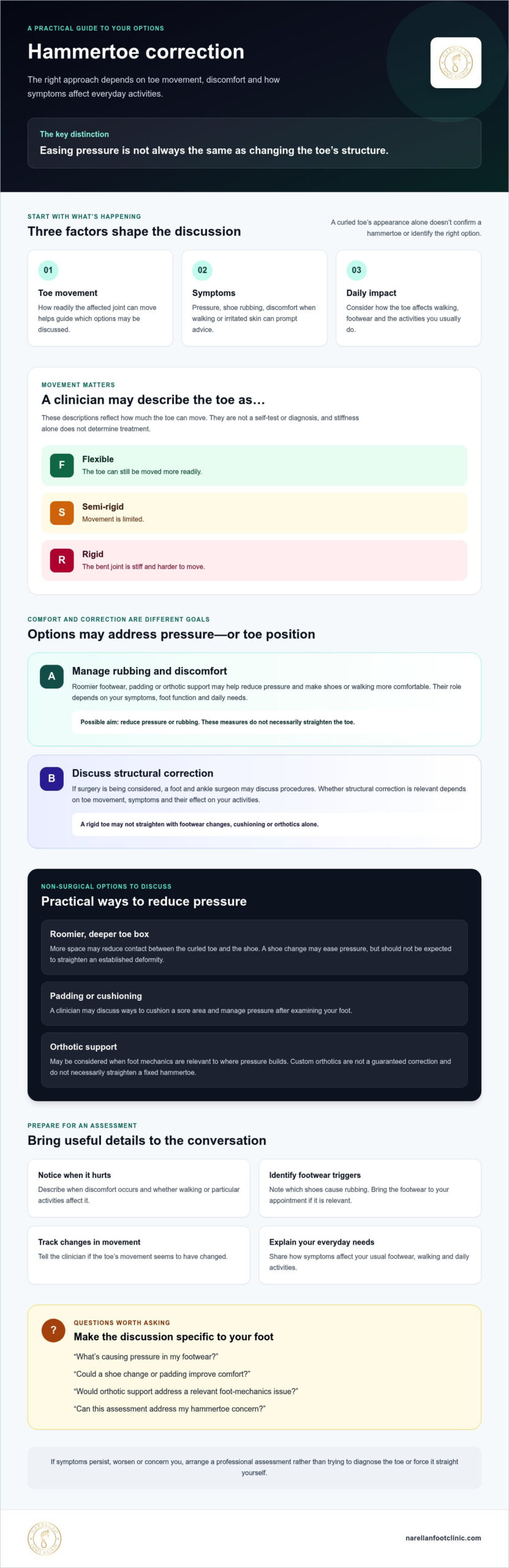
A curled toe doesn’t automatically mean surgery is your only option. The right hammertoe correction options depend on whether the toe can still move, how much discomfort it causes and how it affects your daily activities.
If shoes rub against the toe or pressure makes walking uncomfortable, it’s understandable to want a lasting solution. Roomier footwear, padding or orthotics may help reduce pressure and manage symptoms. They may not straighten a toe that has become rigid, though, so symptom relief and structural correction aren’t always the same thing.
This guide explains how toe flexibility and symptoms shape the options, from practical footwear changes to procedures a foot and ankle surgeon may discuss if surgery is being considered. You’ll also find questions to raise with a podiatrist about foot function and footwear pressure. An assessment can help clarify what may suit your situation and what to consider next, without relying on risky self-treatment.
Key Takeaways
- Learn how a bent toe joint may affect comfort and why easing pressure isn’t always the same as changing the toe’s structure.
- Compare footwear changes with clinician-guided options, and consider what to ask before trying padding or orthotic support.
- Understand how hammertoe correction options may differ when symptoms persist, including procedures a foot and ankle surgeon could discuss.
- Prepare for an assessment by noting your symptoms, footwear triggers and any changes in toe movement.
- A biomechanical assessment at Narellan Foot Clinic may be a starting point for discussing foot function. Ask whether it can address your hammertoe concern.
What are hammertoe correction options, and what can they address?
A hammertoe is a toe deformity in which one or more joints bend, often making the toe curl downwards instead of lying straight. The bend can cause pressure where the toe rubs against footwear or the ground. A curled toe can have other causes, too, so its appearance alone doesn’t confirm a hammertoe. The overview of Hammer toe describes how the deformity can involve different joints.
Treatment options may aim to ease discomfort, reduce rubbing or change the toe’s structure. These are different outcomes: roomier shoes or cushioning may reduce pressure, but they don’t necessarily straighten the toe. Whether structural correction is considered depends on the toe’s movement, your symptoms and how they affect activities such as walking or wearing everyday shoes. An assessment helps make the discussion specific to your needs.
How does a hammertoe differ from a flexible or rigid toe?
A clinician checks how much the affected toe can move. A flexible toe can still be moved more readily; a semi-rigid toe has limited movement; and a rigid toe is stiff and harder to move at the bent joint. These descriptions aren’t a self-test or a diagnosis. Stiffness can shape which options are discussed, but it doesn’t determine treatment on its own.
What symptoms might lead someone to explore correction?
Shoe rubbing, pressure over a bent joint, discomfort when walking or irritated skin can prompt someone to seek advice. Rubbing may be more noticeable in shoes with limited room for the toes. Symptoms vary: one person may have ongoing discomfort, while another may mainly notice a change in toe shape. Neither appearance nor discomfort alone tells you which option is appropriate.
If symptoms persist, worsen or concern you, arrange a professional assessment rather than trying to diagnose the toe or force it straight yourself. Be ready to describe when it hurts, which footwear aggravates it and whether it affects your usual activities. This context helps a clinician consider whether the focus should be on easing pressure or addressing the toe’s position, as the following hammertoe correction options explain.
Which non-surgical hammertoe options may ease pressure and discomfort?
Non-surgical care is considered in light of your symptoms, foot function and daily needs. The aim may be to reduce rubbing, ease pressure or make walking and footwear more comfortable. These measures can help manage symptoms, but they don’t necessarily change the toe’s structure, particularly if it has become fixed. A clinician can help set realistic goals and discuss which approaches may be appropriate for you.
Can footwear changes reduce hammertoe rubbing?
Start by checking how your shoes fit. A roomy, deep toe box gives curled toes more space and may reduce contact with the upper or front of the shoe. If rubbing happens during a particular activity, bring that footwear to your appointment. A clinician can help you consider whether the shoe’s shape and fit suit your foot and routine. Changing shoes may ease pressure, but it shouldn’t be expected to straighten an established deformity.
When might padding or orthotic support be discussed?
After examining your foot, a clinician may discuss padding or other ways to cushion a sore area and manage pressure. Orthotic support may also be considered if foot mechanics are relevant to where pressure builds. Custom orthotics aren’t a guaranteed correction and don’t necessarily straighten a fixed hammertoe. Their potential role should be weighed alongside comfort, shoe fit and what you need to do each day.
For more on how orthotics are assessed and made, see this custom orthotics guide. Narellan Foot Clinic offers custom orthotics, but whether they’re suitable for your toe concern depends on an individual clinical assessment.
Useful questions to ask include: “What’s causing pressure in my footwear?”, “Could a shoe change or padding improve comfort?” and “Would orthotic support address a relevant foot-mechanics issue?” The hammertoe treatment options overview also describes conservative approaches alongside surgical care, offering context for that conversation.
If you’d like to discuss foot function and footwear pressure, ask about a biomechanical assessment at Narellan Foot Clinic. This may be a starting point, but check whether the clinic can assess your hammertoe concern. A focused assessment can help clarify what may be worth considering next.
When is hammertoe surgery considered, and how do procedures differ?
Surgery isn’t an automatic next step for a bent toe. It may be discussed if discomfort persists, footwear remains difficult despite suitable non-surgical measures, or examination finds a rigid deformity that affects function. Toe stiffness alone, or the way a toe looks, doesn’t mean an operation is needed.
What factors may prompt a surgical discussion?
A clinician considers the whole picture: where and when symptoms occur, how they affect walking and shoe fit, how much the toe moves, your general health and what you hope to achieve. If surgery is being considered, an appropriately qualified foot and ankle surgeon can assess your circumstances and explain potential benefits, risks and alternatives. Ask what outcome is realistic for your activities and what recovery may involve.
Symptom-management options aim to ease pressure and discomfort; surgical correction aims to change the toe’s structure. These approaches have different goals. The right discussion depends on your assessment, not a single symptom.
How do tendon procedures differ from joint fusion?
Tendon procedures address soft tissues that influence the toe’s position. A surgeon may lengthen or release a tendon to reduce a pulling force, or transfer a tendon to help rebalance forces around the toe. Joint fusion takes a different approach: the surgeon removes cartilage at the affected joint and joins the bones so they heal together in a straighter position. The fused joint won’t bend as it did before.
| Procedure type | Broad aim | Key distinction |
|---|---|---|
| Tendon lengthening or release | Reduce soft-tissue tension pulling the toe into a bend | Addresses a tendon’s effect on toe position |
| Tendon transfer | Change the direction of tendon pull to help rebalance the toe | Uses a tendon to alter soft-tissue forces |
| Joint fusion | Join bones at the affected joint in a straighter position | Corrects position while making that joint rigid |
This comparison is a guide, not a recommendation. Procedure choice depends on toe flexibility, examination findings, your health and your priorities. Ask the surgeon why a particular approach is being considered, what alternatives remain and how it may affect movement and footwear. Understanding these differences can make a conversation about hammertoe correction options clearer and help you weigh the trade-offs without assuming surgery is inevitable.
How can an assessment help you compare hammertoe correction options?
An assessment connects what you’re experiencing with factors that may be contributing to it. Rather than choosing an option based on toe shape alone, a clinician can consider movement, pressure points, footwear and relevant foot mechanics. This can help clarify whether to focus on reducing pressure, improving comfort or exploring structural correction. It doesn’t guarantee that a particular treatment will be suitable.
A simple way to prepare is to:
- Note your symptoms: Record where discomfort occurs, when it started and what makes it better or worse.
- Identify footwear triggers: Notice which shoes or activities cause rubbing, pressure or difficulty walking.
- Have an examination: The clinician may assess toe movement, areas of pressure, footwear and relevant foot function.
- Discuss options: Ask how the findings relate to possible next steps and your everyday goals.
What should you expect during a podiatry assessment?
Be ready to describe when the toe concern began, how it affects your activities and which footwear feels uncomfortable. The podiatrist may ask about relevant health history and examine toe movement, pressure areas and foot mechanics. The findings guide the conversation but don’t automatically point to one treatment. Mention any persistent skin pressure or corns, as these may need separate assessment and care.
A biomechanical assessment considers foot function as part of an assessment. At Narellan Foot Clinic, it may be a starting point for discussing foot function and footwear pressures. Contact the clinic to check whether it can assess hammertoe concerns specifically.
What questions should you ask before choosing an option?
Clear questions help you understand the purpose and limits of each approach. Consider asking:
- Is this option intended to ease pain or pressure, improve function, or change toe alignment?
- What alternatives could suit my symptoms and daily activities?
- What are the likely limitations, risks and review arrangements for me?
- If surgery is proposed, what recovery and aftercare should I plan for, and why is it suitable for my circumstances?
For surgery-specific advice, discuss these questions with the treating foot and ankle surgeon. To ask about a biomechanical assessment as a possible first step, contact Narellan Foot Clinic and check whether it can address your concern.
Where can Narellan patients start with hammertoe concerns?
If toe pressure or rubbing is making shoes uncomfortable, a conversation about foot function may be a sensible first step. Narellan Foot Clinic offers biomechanical assessment, which may provide an opportunity to discuss how your feet move and where pressure occurs. The clinic has served the Narellan community for more than 25 years. Contact the clinic to ask whether its assessment is suitable for a hammertoe concern.
Could a biomechanical assessment be a useful first step?
A biomechanical assessment looks at foot function. If an assessment is appropriate, you could discuss what you notice when walking, which shoes cause rubbing and where pressure builds. These details may help frame a conversation about foot mechanics and footwear, but they don’t determine a diagnosis or guarantee a particular treatment. Confirm suitability with the clinic.
If pressure has led to a corn, you can also read this corn removal podiatrist guide for background. It’s separate from advice about correcting a hammertoe.
When should you seek further clinical advice?
Arrange a professional review if pain, shoe rubbing or difficulty moving the toe persists or worsens. Don’t try to force the toe straight or cut away a corn yourself, particularly if you have diabetes. Seek prompt professional guidance about concerning skin changes or any wound, as foot problems may need careful assessment.
Narellan Foot Clinic offers biomechanical assessment, but contact the clinic to ask whether it covers hammertoe concerns. If surgery is being considered, discuss potential options, risks and alternatives with an appropriately qualified foot and ankle surgeon. A local biomechanical assessment may be a first conversation about foot function, but don’t assume it includes a surgical referral pathway.
If you’re in Narellan, contact Narellan Foot Clinic to discuss an assessment and ask whether your concern is within the scope of its biomechanical assessment. This can help clarify a sensible next step without assuming which hammertoe correction options will suit you.
Take a considered next step towards greater comfort
The right hammertoe correction options depend on toe movement, symptoms and how the problem affects everyday life. Shoe changes or clinician-guided support may help ease pressure, while surgery is a separate discussion for persistent symptoms or specific clinical findings. An assessment can help clarify what may be contributing to discomfort and what questions to ask next.
Narellan Foot Clinic has served the local community for more than 25 years and offers biomechanical assessment. Contact the clinic to check whether an assessment may suit your hammertoe concern. If you’re considering an operation, discuss the procedure, alternatives and personal suitability with an appropriately qualified foot and ankle surgeon.
Contact Narellan Foot Clinic to discuss whether an assessment is suitable. A clear conversation can help you take a sensible next step without assuming surgery is your only path to greater comfort.
Frequently Asked Questions
Can a hammertoe be corrected without surgery?
Non-surgical care may ease pressure and discomfort, particularly if footwear rubs against the toe. Roomier shoes, clinician-guided padding or orthotic support may be considered, depending on your foot and symptoms. These hammertoe correction options mainly aim to improve comfort and function; they may not straighten a fixed deformity. A podiatrist or doctor can assess toe movement and help set realistic goals without promising that conservative care will change the toe’s structure.
Does a hammertoe get worse if it is left untreated?
Progression varies, and not every hammertoe follows the same course. Some may remain relatively stable, while others become stiffer or more troublesome over time. Persistent pain, rubbing against shoes or increasing difficulty moving the toe are good reasons to seek an assessment. A clinician can review the toe and discuss suitable options. Don’t assume the toe will inevitably worsen, but don’t ignore symptoms that affect walking or everyday footwear.
How do I know whether my hammertoe is flexible or rigid?
A clinician assesses how much the toe and its affected joint can move. A flexible toe moves more readily, while a rigid one is stiff; movement may also be limited rather than fully free or fixed. Trying to bend the toe yourself can’t confirm a diagnosis or show which treatment is appropriate. If toe pressure or symptoms affect daily life, seek advice from a podiatrist or doctor in Narellan or elsewhere in NSW, including Sydney, Blacktown, Campbelltown, Windsor or Penrith.
When is surgery considered for a hammertoe?
Surgery may be discussed when symptoms persist or clinical findings suggest it could address the problem, taking toe rigidity and your goals into account. A bent appearance or one symptom alone doesn’t mean an operation is required. An appropriately qualified foot and ankle surgeon can explain whether it may suit your circumstances, along with non-surgical alternatives, potential risks and expected recovery. Ask how the proposed approach relates to your daily activities and priorities.
What happens during hammertoe surgery?
The procedure depends on the toe and the surgeon’s assessment. Broadly, surgery may involve adjusting tendons that affect toe position or joining bones at a joint to hold the toe straighter. These are different approaches, and the exact operation can’t be predicted from appearance alone. Ask your treating surgeon to explain the intended benefits, risks, alternatives, recovery expectations and aftercare for your case before deciding whether to proceed.
Can orthotics straighten a hammertoe?
Orthotic support may be considered if foot mechanics or pressure distribution are relevant to your symptoms. Its role is to support the foot or help manage pressure, not to guarantee that a curled toe will straighten. A fixed deformity may not change with orthotics. Suitability depends on an individual assessment, your footwear and what you need to do each day. Discuss the intended goal with a podiatrist before choosing orthotic support.
Which shoes are better for hammertoes?
Shoes with enough room around the toes may reduce pressure and rubbing over the affected area. Check that the toe box doesn’t press against the bent joint, and consider how the shoes feel during the activities you do most. Footwear needs vary, so one style won’t suit everyone. If pain, rubbing or skin irritation continues despite changing shoes, seek professional advice rather than trying to force the toe straight.