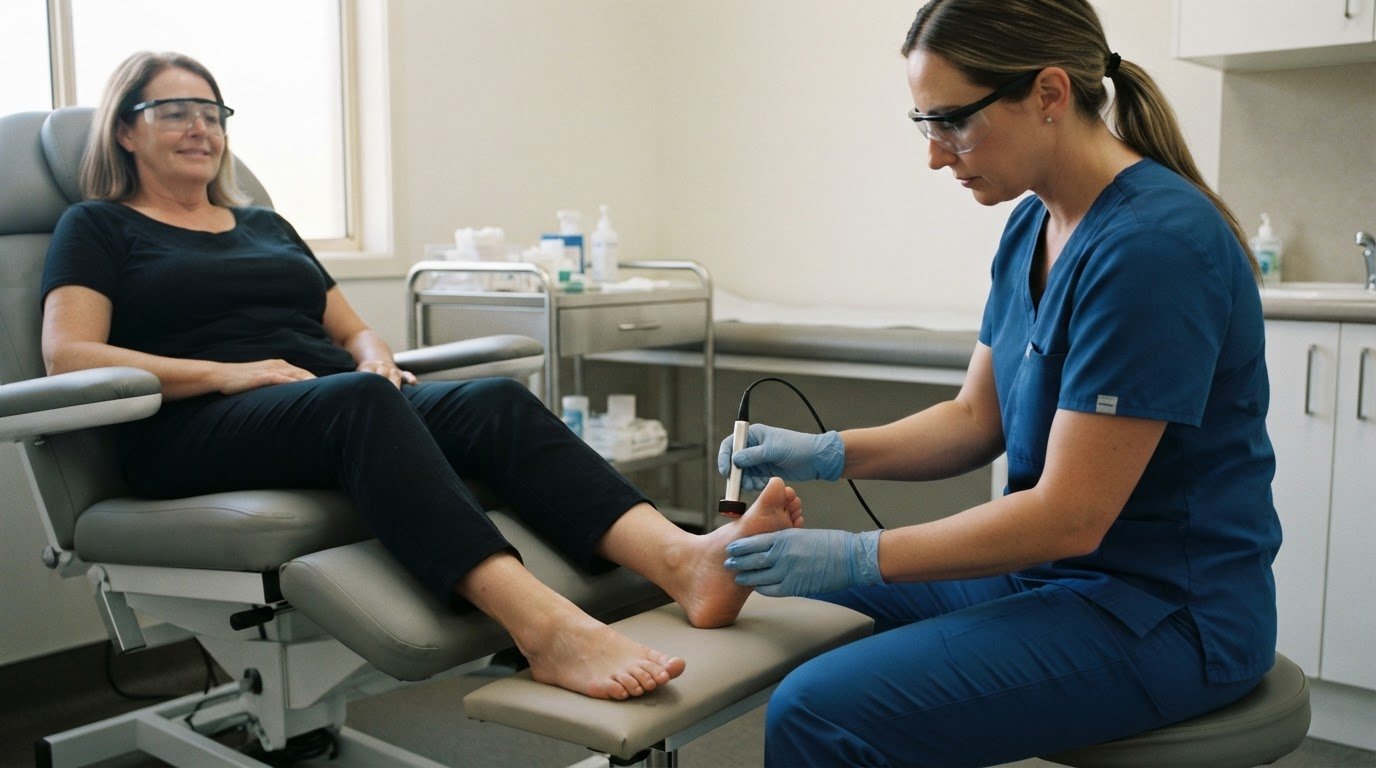
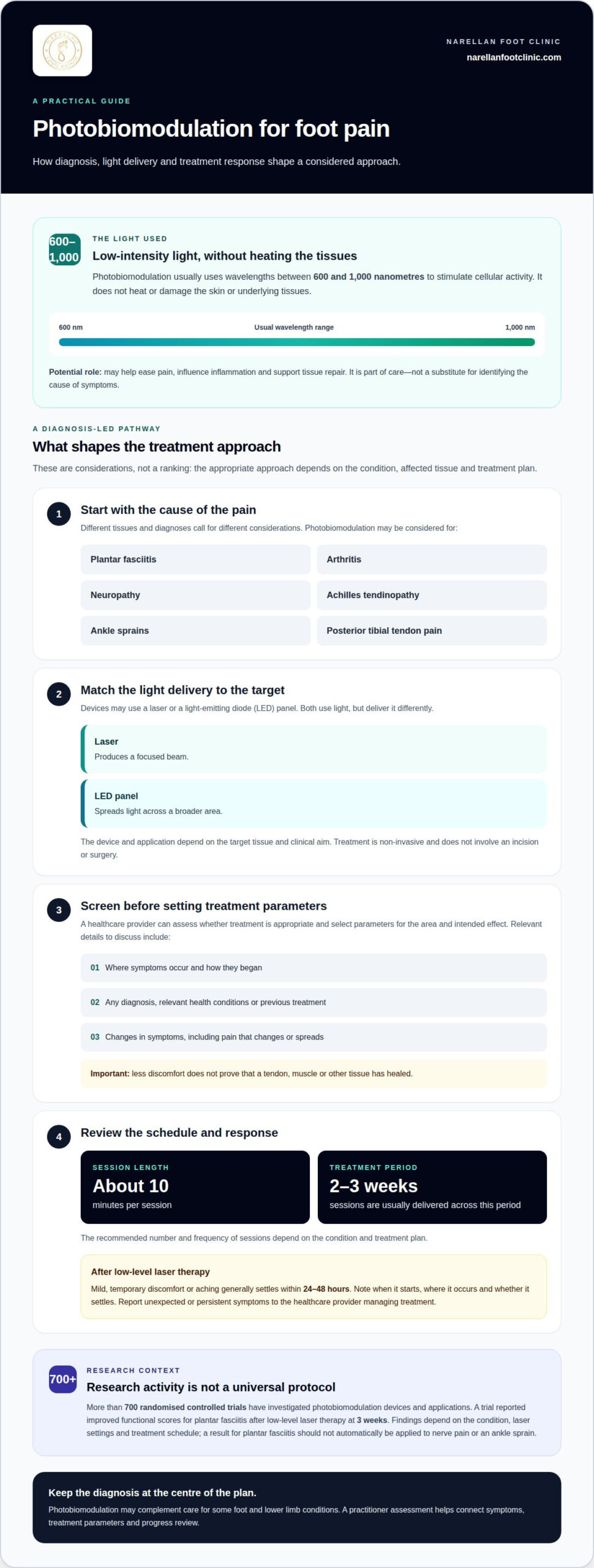
Light can support healing without heating the tissues. For foot pain, photo-biomodulation therapy uses low-intensity light, usually at wavelengths between 600 and 1,000 nanometres, to stimulate cellular activity; it doesn’t heat or damage the skin or underlying tissues. It may help ease pain and support tissue repair, depending on the condition being treated.
If persistent foot or lower limb pain is limiting your walking or daily activities, you may be wondering what photo-biomodulation therapy for foot pain involves and whether it could suit you. This article explains how photobiomodulation works, the conditions it may help manage, who should take care before treatment, and what to expect from session timing and frequency. Treatment plans vary, so understanding the approach can help set realistic expectations.
Key Takeaways
- Photobiomodulation may help manage pain associated with conditions such as plantar fasciitis, arthritis and neuropathy, but it isn’t a one-size-fits-all approach.
- Light exposure may support cellular energy production and tissue repair, which helps explain how this therapy could assist recovery.
- Speak with a healthcare provider about whether treatment is appropriate and which parameters suit your condition.
- Sessions are generally short, while the number and frequency of treatments depend on the condition and the treatment plan.
- For ongoing foot pain, a biomechanical assessment can help identify how your foot function may be contributing to symptoms.
How can Photobiomodulation Therapy help with my lower limb pain/condition?
Photobiomodulation may help manage pain and inflammation in some foot and lower limb conditions. Whether it is relevant depends on the affected tissue, diagnosis and treatment approach.
Photobiomodulation and Low-Level Laser Therapy
Photobiomodulation, also called low-level laser therapy (LLLT), uses low-intensity light to influence cellular activity without heating or damaging tissue. For foot pain, it offers a non-invasive approach that may complement care for the underlying condition. Devices may use lasers or light-emitting diode (LED) panels, and treatment does not involve an incision or surgery.
Laser therapy may be considered for plantar fasciitis, arthritis and neuropathy. Other examples include Achilles tendinopathy, ankle sprains and posterior tibial tendon pain. These conditions affect different tissues, so diagnosis helps guide treatment. If you are considering photo-biomodulation therapy for foot pain, the first step is to understand what is causing your symptoms.
Evidence for Laser Therapy
Research has investigated both low-level and high-intensity laser therapy, but these approaches aren’t interchangeable. A randomised controlled trial reported improved functional scores for plantar fasciitis after low-level laser therapy at 3 weeks. Other research compared high-intensity laser therapy with low-level laser therapy, while a placebo-controlled study examined low-level laser therapy at 635 nm.
More than 700 randomised controlled trials have investigated photobiomodulation devices and applications. That shows substantial research activity, but doesn’t establish one protocol for every foot condition. Study results depend on the condition, laser settings and treatment schedule. A finding for plantar fasciitis shouldn’t automatically be applied to nerve pain or an ankle sprain. Those considering photo-biomodulation therapy for foot pain should understand how the proposed treatment relates to their diagnosis.
LED light therapy and laser treatment both use light but deliver it differently. Lasers produce a focused beam, while LED panels spread light across a broader area. The device and application depend on the target tissue and clinical aim. Photobiomodulation may influence circulation and inflammatory responses, which could help reduce pain or swelling. It is considered as part of care, not a substitute for identifying the cause of symptoms.
Is photobiomodulation covered by Medicare or private health insurance in Australia? Coverage depends on the billed service, eligibility and your private health policy. Check the relevant benefit details before relying on a rebate.
What does treatment cost in Australia? The price depends on the case and is provided after a quote request. Factors include the treatment area and recommended course.
How can I find a qualified provider in Australia? Look for a healthcare practitioner with relevant photobiomodulation training who assesses your condition, explains the treatment parameters and considers your medical history. A clear discussion should connect the proposed approach to your diagnosis and explain how progress will be reviewed.
What are the contraindications (exclusions)?
Suitability for photobiomodulation depends on the person’s condition and treatment parameters, so screening matters before light is applied. A healthcare provider can assess whether it is appropriate and select suitable parameters. For foot pain, discuss where symptoms occur, how they began and whether an existing diagnosis explains them.
Tell the practitioner about relevant health conditions, previous treatment and any changes in symptoms. This context helps guide decisions, whether you have heel pain that worsens with walking or nerve symptoms that include altered sensation. The same approach should not be assumed to suit different tissues or causes of pain. An assessment helps determine whether photobiomodulation is appropriate for the problem being treated.
Light-based treatment is intended to influence pain and inflammation, not confirm that an injury has healed. Reduced discomfort can affect how you move, but it does not establish that a tendon, muscle or other tissue has recovered. For example, easing heel pain does not by itself show whether plantar fascia irritation or another issue is causing symptoms. This distinction matters when assessing progress.
Photobiomodulation typically has minimal to no side effects. Mild, temporary discomfort or aching after low-level laser therapy generally settles within 24 to 48 hours. This response is different from lasting relief: note when discomfort starts, where it occurs and whether it settles within that period. Report unexpected or persistent symptoms to the healthcare provider managing treatment, rather than changing the treatment intensity yourself.
Screening also helps the practitioner set treatment parameters for the target area and intended effect. The aim may be to manage pain, influence inflammation or support tissue repair, but these goals are not identical. A treatment plan should reflect the condition and area being treated, with changes reviewed across sessions. If pain changes or spreads, that information can help guide a review of the approach.
Photobiomodulation can be considered as part of care, not as a replacement for identifying the cause of foot pain. If symptoms are continuing, discussing the diagnosis and treatment suitability with a podiatrist can help guide the next step. A podiatry care discussion can put the potential role of light therapy in context alongside your symptoms and treatment history.
Treatment duration and frequency
Photobiomodulation treatment is usually delivered in short sessions across 2-3 weeks, with each session taking about 10 minutes. The recommended schedule depends on the condition, treatment settings and response over time.
For plantar fasciitis, the right timeframe needs perspective: becoming pain-free can take 6-12 months. Conservative management can form part of care, with activity adjustments, suitable footwear and exercises selected around the person’s symptoms and foot function. Light therapy is one possible component, rather than a replacement for addressing factors that keep aggravating the heel.
There is no established photobiomodulation protocol for plantar fasciitis covering treatment frequency, dose and wavelength. It is important to distinguish a general schedule from a proven, condition-specific standard. Treatment plans should account for the diagnosis and area being treated, then review changes in pain and function rather than assume everyone needs the same course.
For general treatment timing, sessions are typically given two or more times a week. The clinic’s reported course averages 6 to 10 sessions, and most patients experience positive results after 4 sessions. These figures describe a typical schedule, not a guarantee of pain relief. Treatment effects are described as cumulative, building across sessions.
Timing may also reflect whether the injury is acute or chronic. Acute injuries are those treated within 72 hours of injury; subacute injuries are treated from 72 hours to 5 days after injury; chronic conditions are more than 5 days old. These categories help describe timing, but the diagnosis and tissue involved still guide treatment decisions.
Foot and ankle examples include plantar fasciitis, Achilles tendinopathy, ankle sprains, osteoarthritis and posterior tibial tendon pain. Treatment duration can differ because a tendon, joint and plantar fascia are distinct targets. For example, a plan for an ankle sprain should not automatically be applied to chronic osteoarthritis pain.
How many sessions are usually needed, and how long does each session take? A session typically takes about 10 minutes, and an average course is 6 to 10 sessions. Treatment is commonly scheduled two or more times weekly, with the plan shaped by the condition and response.
How does photobiomodulation compare with physiotherapy, medication and other foot pain treatments? Photobiomodulation uses light and is non-invasive, while physiotherapy and medication work differently. It may be considered alongside other care, rather than as a universal substitute. The appropriate combination depends on the diagnosis, symptoms and treatment goals.
Side effects are typically minimal to none, though temporary mild discomfort or aching after treatment usually settles within 24 to 48 hours. Track pain and walking tolerance during the course, and discuss persistent symptoms with the healthcare provider overseeing care.
Cellular activity and tissue repair
Photobiomodulation applies light to influence cellular processes involved in repair. For a sore foot, this helps explain why treatment focuses on affected tissue, not pain alone.
ATP Production and Cellular Activity
ATP is the energy-carrying molecule cells use to perform functions, including those involved in healing. Photobiomodulation light interacts with mitochondria, the structures that produce ATP, and may increase cellular ATP production. With more energy available, cells can support repair processes in injured tissue. This is a proposed biological pathway, not a measure of how quickly a particular foot condition will improve.
Light can also affect cellular metabolism and circulation. Photobiomodulation is reported to increase nitric oxide levels, which can support blood flow, and reduce oxidative stress. These processes are relevant to tissue affected by irritation or injury, such as a painful tendon. Wavelength and treatment settings influence how light is applied to the target area.
Tissue Repair and Recovery
Tissue repair is the body’s process of restoring damaged structures after injury or surgery. Photobiomodulation may support that process through collagen production, reduced swelling and tissue regeneration. Collagen is a structural component of connective tissue, including tendons. For someone recovering from a foot or ankle injury, these mechanisms help explain the treatment’s intended role.
Recovery also depends on the tissue’s condition and the demands placed on it. A tendon irritated by repeated activity has different needs from tissue healing after surgery. Photobiomodulation may be used to support healing, but it does not replace injury assessment or other care directed at the cause. Changes in pain and function help indicate how recovery is progressing.
Wound healing is another area where cellular repair mechanisms matter. Photobiomodulation may promote wound healing by supporting collagen production, reducing swelling and enhancing tissue regeneration. For an ulcer, these effects relate to the tissue’s repair environment, not simply discomfort. The wound’s location, surrounding skin and underlying health factors are important considerations in care.
Inflammation is part of the body’s response to injury, but persistent inflammation can accompany pain and swelling. Photobiomodulation may modulate this response while supporting cellular activity. For example, someone with post-surgical swelling may have different tissue-repair needs from someone managing a chronic tendon problem. The treatment goal and target area therefore shape how the light is applied.
These mechanisms explain the rationale for photobiomodulation, not a guaranteed timeline or outcome. ATP production, circulation and collagen formation are biological processes; they do not independently confirm that an ulcer, tendon or other tissue has healed. Monitoring the wound or injury alongside symptoms gives a clearer picture of recovery than pain relief alone.
Definition of photobiomodulation therapy
Photobiomodulation therapy is a non-invasive treatment that applies low-intensity light to influence biological activity in tissue. The term describes how light interacts with the body, rather than a single device or foot condition; similar light and energy applications are also utilised in modern wellness and aesthetic clinics such as NAWRA to support cellular function and recovery.
The therapy generally uses wavelengths between 600 and 1,000 nanometres. Devices can include handheld units, lasers or light-emitting diode panels. Unlike treatments designed to heat tissue, photobiomodulation uses light at an intensity that doesn’t heat or damage the skin or underlying tissues. It’s also described as painless, with no incision involved.
Photobiomodulation was formerly called low-level laser therapy, often shortened to LLLT. The older name refers to one light-delivery method, while the newer term also includes LED-based applications. This distinction explains why treatment descriptions may mention both laser therapy and LED light, even though the equipment differs.
Light wavelength and delivery method help define treatment. A focused laser beam and a broader LED panel do not deliver light in the same way. The selected approach is intended to expose a target area, such as the heel or ankle, to specific light parameters. For plantar fasciitis, the plantar fascia is the target tissue; arthritis involves a joint instead.
The word “controlled” matters here. Photobiomodulation is not simply shining any light on a painful area; it uses equipment and treatment parameters selected for therapeutic application. Wavelength, intensity, delivery and target area shape how light reaches tissue. For example, treatment directed at a superficial area differs from an approach intended to reach deeper tissue or nerves.
Photobiomodulation is intended to support processes associated with pain management, circulation and tissue repair. This differs from surgery, which physically changes or removes tissue, and medication, which acts through a drug. For foot pain, the practical question is whether the treatment’s purpose aligns with the diagnosed problem and your goals, such as walking more comfortably.
Photobiomodulation may be considered for conditions including plantar fasciitis, neuropathy and arthritis, but it is not a universal treatment. The condition, tissue involved and treatment parameters matter. A clear definition helps set realistic expectations: it is a light-based therapeutic approach, not a diagnosis or a stand-alone explanation for pain.
If foot pain is affecting your movement, a biomechanical assessment can help examine how foot function relates to symptoms and guide suitable care.
Narellan Foot Clinic: Biomechanical Assessment
Narellan Foot Clinic offers a Biomechanical Assessment for people whose foot pain affects walking or daily activities. It can help examine how foot movement relates to symptoms and whether Custom Orthotics may be relevant to your care.
If you are considering photobiomodulation, an assessment can put it in context alongside your diagnosis, symptoms and foot function. It can also be useful when heel or ankle pain persists or discomfort changes how you walk. The findings help guide discussion about suitable podiatry care, rather than treating light therapy as a stand-alone answer.
For concerns such as an ingrown toenail or fungal nail infection, Narellan Foot Clinic also offers Ingrown Toenail Surgery and Fungal Nail Laser Treatment. Contact Narellan Foot Clinic or visit narellanfootclinic.com to discuss your foot care.
Choose a next step that fits your foot pain
Persistent foot pain can gradually change how you walk, exercise and manage everyday tasks. A useful next step is to identify what triggers your symptoms and what you want to get back to doing. Note where discomfort occurs, which movements aggravate it, and whether it affects your balance or mobility. These details can make a discussion about care more specific and practical.
With that context, you can discuss whether photo-biomodulation therapy for foot pain may be relevant to you, alongside other suitable podiatry care. The cause of discomfort matters: pain linked to a tendon, joint or nerve may call for a different approach. Treatment should address the problem affecting your foot and your movement goals, not just the location of the pain.
If you’re ready to talk through your symptoms and possible next steps, contact Narellan Foot Clinic. A clear, considered plan can help you move towards more comfortable daily activity.
Frequently Asked Questions
What is Photobiomodulation Therapy (PBM Healing Laser)?
Photobiomodulation therapy is a light-based treatment, and “PBM Healing Laser” is a descriptive term for a laser-delivered form. It does not mean a separate type of healing or guarantee a particular result. For example, a practitioner may consider it for heel pain after identifying the affected tissue and assessing how symptoms affect walking. The diagnosis guides whether the treatment approach is relevant.
How many treatments will I need?
The number varies with the condition and how symptoms respond. A typical course averages 6 to 10 sessions, and positive results are reported by most patients after 4 sessions. Each treatment is typically about 10 minutes, often scheduled two or more times weekly. For plantar fasciitis, a treatment frequency, dose and wavelength protocol hasn’t been established, so don’t assume every patient follows the same schedule.
What is photobiomodulation?
Photobiomodulation describes using light to influence biological activity in the body. The term includes low-level laser and LED-based applications, so it describes a treatment approach rather than a single machine. For instance, light may be applied to a particular foot area as part of care for pain or tissue recovery. The condition being addressed determines the treatment goal and application.
Can LLLT cause cancer?
A blanket statement about cancer risk is not appropriate for every person or treatment situation. If you have current or previous cancer, tell the healthcare professional assessing your suitability before light-based treatment. They can consider the treatment area, your health history and the proposed parameters. This is particularly important if treatment would be applied near a known or suspected tumour.
How Does PBM Work?
Photobiomodulation light interacts with mitochondria, the cell structures that produce ATP, a molecule used to power cellular functions. This interaction may increase ATP production and influence processes linked with repair. For example, cells in irritated tendon tissue require energy for normal activity. The proposed effect is cellular, rather than light heating tissue to create a change.
How Is PBM Delivered?
Photobiomodulation can be delivered with handheld devices, lasers or LED panels. The device is applied to the selected treatment area, such as the heel or ankle, using parameters chosen for the intended application. Laser and LED equipment deliver light differently, so the device is part of the treatment method. The area being treated and the condition guide how it is applied.
Is Low Laser Level Therapy scientifically well documented?
Yes, research activity is extensive: more than 4,000 laboratory studies and over 2,500 clinical studies and published research reports have investigated LLLT or photobiomodulation across health issues. About half of published randomised clinical trials on photobiomodulation focus on pain. This volume doesn’t mean every condition has an established protocol; plantar fasciitis, for example, lacks an established frequency, dose and wavelength protocol.
Is PBM Safe?
Photobiomodulation typically has minimal to no side effects. Mild, temporary aching or discomfort after treatment usually settles within 24 to 48 hours. Before treatment, consult a healthcare provider about whether it suits your health circumstances and which parameters are appropriate. Mention changes in symptoms or persistent discomfort during treatment, so the response can be considered as the care plan progresses.