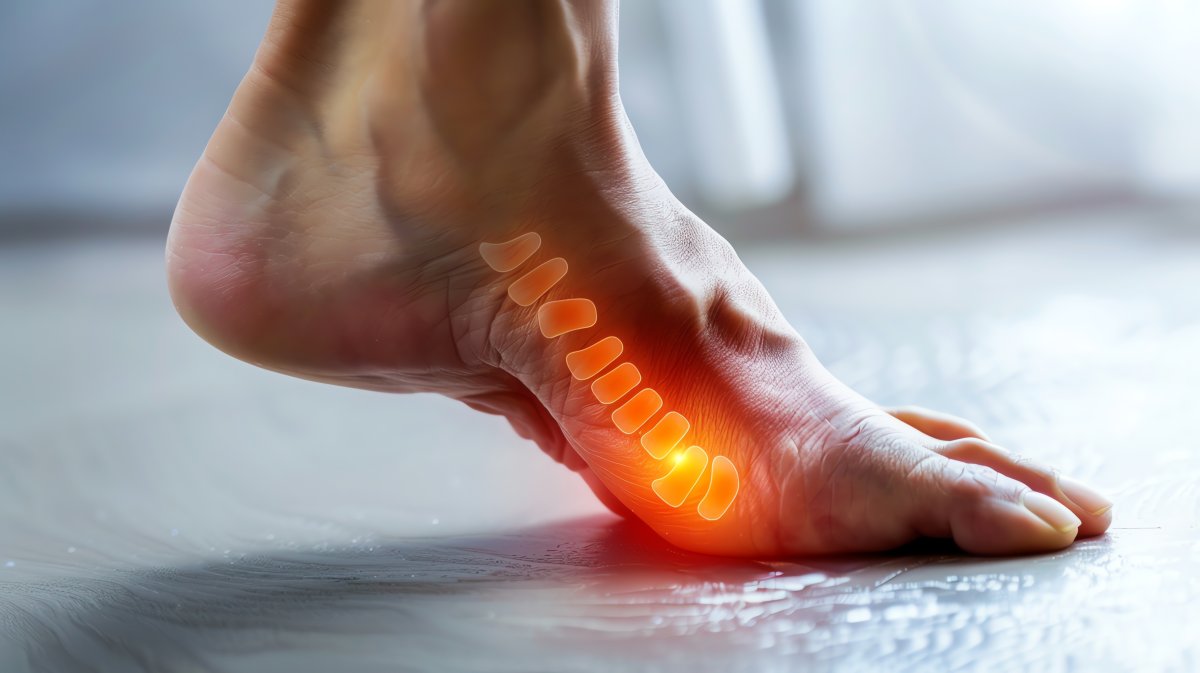
Imagine waking up and dreading that first step because of a sharp, stabbing sensation under your foot. Or perhaps you’ve felt that deep, familiar ache while browsing through Narellan Town Centre, forcing you to find the nearest bench for a rest. You aren’t alone in this struggle, but you shouldn’t have to accept it as your new normal. Finding the right arch pain treatment is about more than just temporary comfort; it’s about identifying the mechanical warning light your body is flashing.
We understand how frustrating it is when simple activities like a morning walk or a gym session become sources of stress rather than joy. You deserve to move through your day with confidence and ease. In this guide, we’ll explore why your arches are complaining and how professional clinical interventions can provide a permanent solution. From biomechanical assessments to custom orthotics, you’ll discover the practical steps needed to reclaim your mobility and walk pain-free once again.
Key Takeaways
- Understand the mechanical reasons why arch discomfort often feels most intense during those first few steps out of bed or after sitting for long periods.
- Learn to identify the difference between common conditions such as plantar fasciitis and more complex issues like tendon dysfunction that require specialised care.
- Discover why a professional biomechanical assessment is essential for moving beyond temporary fixes to find a permanent solution for your foot health.
- Explore clinical arch pain treatment strategies, including custom orthotics and targeted exercises designed to restore your ability to walk and run without discomfort.
- Gain peace of mind by understanding when your foot pain requires expert intervention from a clinic with over 25 years of experience in the Macarthur community.
Understanding Arch Pain: Why Your Feet Are Complaining
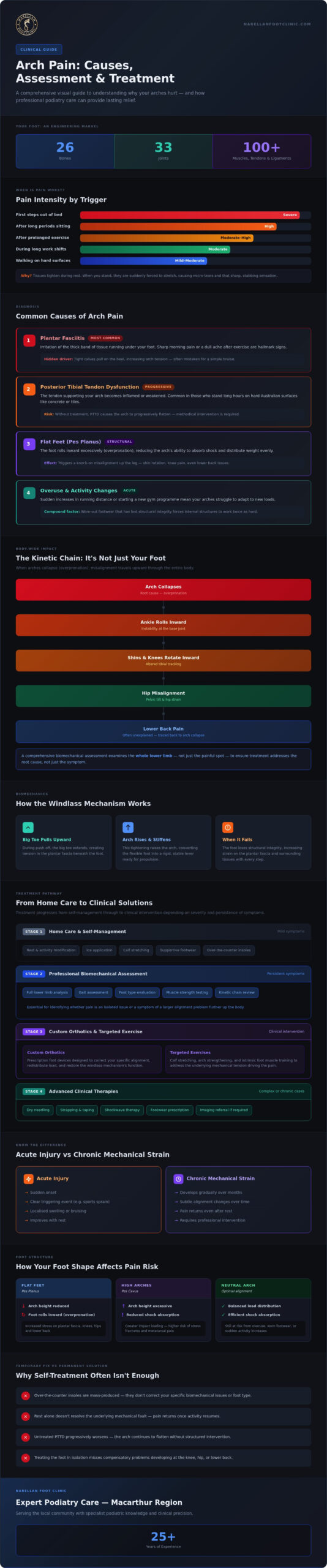
Your foot is an engineering marvel. It contains 26 bones, 33 joints, and over 100 muscles, tendons, and ligaments all working in unison to support your entire body weight. When you experience arch pain, it’s rarely a random occurrence. It’s usually a clear signal that this complex structure is struggling to manage the loads placed upon it. Many people find their discomfort is most intense during those first few steps out of bed or after sitting at a desk for several hours. This happens because the tissues naturally tighten while you are resting. When you finally stand, those tissues are suddenly forced to stretch, causing micro-tears and that sharp, familiar ache.
It’s vital to distinguish between an acute injury and chronic mechanical strain. An acute injury might be a sudden sprain during a netball match at the local Macarthur courts, whereas chronic strain develops more subtly over months as your foot alignment shifts. Without proper arch pain treatment, what starts as a mild niggle during a long shift at work can evolve into a persistent problem that stops you from enjoying weekend sports or walks through our local parks. Understanding whether your pain is a one-off event or a result of long-term structural stress is the first step toward recovery.
The Role of the Plantar Vault
The medial longitudinal arch is the primary shock absorber of your foot. It forms a structural bridge that distributes your weight across the foot while adapting to every surface you encounter, from the hard pavement of Narellan’s streets to the uneven bush trails nearby. A critical part of this function is the windlass mechanism. The windlass mechanism is the mechanical process where the big toe pulling upwards tightens the plantar fascia, effectively raising the arch and transforming the foot into a stable lever for propulsion. When this mechanism fails to engage correctly, your foot loses its structural integrity and becomes prone to injury.
The Kinetic Chain: It’s Not Just Your Foot
Your feet are the foundation of your entire body. When the arch collapses, a process known as overpronation, it triggers a knock-on effect up your leg. This misalignment often causes your shins and knees to rotate inwards, which can eventually lead to unexplained hip or lower back pain. This is why a comprehensive biomechanical assessment is so important for effective arch pain treatment. We don’t just look at the spot that hurts; we examine the whole lower limb to ensure we aren’t just treating a symptom of a much larger alignment issue further up the kinetic chain.
Identifying the Source: Common Causes of Arch Pain
Identifying the exact cause of your discomfort is the cornerstone of effective recovery. While many people assume all arch pain is the same, several distinct conditions can trigger that familiar ache. One frequent culprit is Posterior Tibial Tendon Dysfunction (PTTD). This occurs when the tendon that supports your arch becomes inflamed or weakened. It’s particularly common in individuals who spend long hours standing on hard Australian surfaces like concrete or tiles, which offer little natural shock absorption. Unlike a simple muscle strain, PTTD is a progressive condition that requires a methodical approach to prevent the arch from flattening further.
Sudden changes in activity levels often lead to overuse injuries. If you’ve recently increased your weekend running distance or started a new fitness regime at a local Macarthur gym, your arches might be struggling to adapt to the new loads. Poorly supportive footwear can exacerbate this, as shoes that have lost their structural integrity fail to provide the necessary stability. When your footwear doesn’t support your foot’s natural mechanics, the internal structures have to work twice as hard, leading to fatigue and eventually, pain.
Plantar Fasciitis and Arch Strain
Plantar fasciitis is arguably the most common reason patients seek professional help. It involves irritation of the thick band of tissue running under your foot. Signs of excessive tension include sharp pain in the morning or a dull ache after exercise. Interestingly, tight calves are often the hidden driver behind this condition. When your calf muscles are tight, they pull on the heel, which in turn increases the tension on your arch. This is why many people mistake the persistent inflammation for a simple bruise when it’s actually a mechanical strain that won’t resolve without addressing the underlying tension.
Structural Issues: Flat Feet and High Arches
Your natural foot shape plays a significant role in how you move and manage weight. If you have flat feet (pes planus), your foot tends to roll inwards excessively. This overpronation places immense stress on the soft tissues of the arch as they try to maintain your foot’s structure. Conversely, high arches (cavus feet) have the opposite problem. They are often rigid and poor at absorbing shock, meaning the impact of every step travels directly into your bones and joints. Because each foot type presents different challenges, your foot type determines the best arch pain treatment for your specific needs. If you’re finding it difficult to stay active, a professional assessment can help you understand your unique foot structure and provide a path toward lasting comfort.
The Importance of a Professional Biomechanical Assessment
When you’re dealing with persistent foot discomfort, it’s tempting to look for a quick fix. You might find yourself scrolling through ‘Dr Google’ or picking up a pair of generic, one-size-fits-all inserts from the chemist shelf. While these might provide a moment of cushion, they rarely offer a long-term arch pain treatment because they don’t address why the pain started in the first place. A professional diagnosis is the only way to move from guesswork to a clear, actionable path toward recovery. Generic solutions often fail because they treat the arch as an isolated part, ignoring the complex interactions of your unique anatomy.
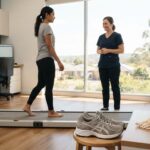
At our clinic, a biomechanical assessment is a thorough investigation into your unique movement patterns. We look beyond just the arch to see how your entire lower limb functions as a unit. This involves testing joint range of motion, assessing muscle strength, and identifying any subtle imbalances that are forcing your arches to work harder than they should. By pinpointing these mechanical flaws, we can design a strategy that actually works for your specific body type. It’s about providing a safe pair of hands to guide you through the transition from worry to physical freedom.
Gait Analysis: Seeing the Unseen
Static measurements only tell half the story. To truly understand your foot health, we need to see how your feet behave under the pressure of movement. Our gait analysis tracks your foot through every phase of a step, from the moment your heel hits the ground to the point where you push off with your toes. This process often reveals compensation patterns. These are subtle shifts in your stride that your body uses to avoid pain, which often end up causing secondary issues in your ankles or knees. We use specialised technology to map pressure distribution across your sole, providing a data-driven foundation for your clinical care.
A Tailored Management Plan
We believe that every patient deserves a bespoke strategy that fits their specific lifestyle. Your clinical history is a vital part of this process. We take the time to understand your daily routine, your footwear choices, and your long-term physical goals. Whether you want to return to competitive weekend sports or simply want to walk through the local shops without an ache, we set realistic milestones for your recovery. This personalised approach ensures that your arch pain treatment isn’t just a temporary patch, but a sustainable solution for lasting mobility and comfort.
Arch Pain Treatment: From Home Care to Clinical Solutions
Effective arch pain treatment requires a balanced strategy that addresses both the immediate symptoms and the underlying mechanical cause. While resting and icing can settle acute inflammation, they don’t fix the reason the tissue became irritated initially. We often use clinical interventions like dry needling or manual therapy to release deep-seated tension in the calf and foot muscles. These techniques provide faster relief than home care alone by targeting the specific trigger points that contribute to your discomfort. It’s about moving beyond temporary comfort to achieve a state of lasting physical freedom.
Footwear education is another vital component of your recovery. Many popular shoe styles offer plenty of cushion but very little lateral stability, which often forces your arch to collapse under load. Switching to a shoe with a firm heel counter and appropriate midfoot support can make a world of difference during your daily activities. We help you identify which features are necessary for your specific foot type, ensuring your footwear works with your body rather than against it. This proactive approach helps protect your feet from the hard surfaces we encounter every day around the Macarthur region.
Stretches and Strengthening for Arch Support
Specific exercises are essential for building a resilient foot that can handle the demands of your lifestyle. Calf stretches are particularly effective because they reduce the constant tension on the plantar fascia, allowing the tissue to heal without being constantly overstretched. To build local strength, we often recommend the ‘towel scrunch’ and other intrinsic muscle exercises that improve your foot’s natural ability to support its own arch. Load management is the process of carefully controlling the amount of physical stress placed on the foot to ensure your activity levels don’t exceed the tissue’s current capacity for repair. This careful balance prevents re-injury while you work toward full recovery.
Custom Orthotics: Correcting the Foundation
For many patients, long-term relief requires a more permanent structural intervention. Custom orthotics differ significantly from generic store-bought insoles because they are engineered to your exact foot shape and gait requirements. Unlike mass-produced inserts that provide basic padding, these medical devices are created after taking a precision mould of your feet in a neutral position. This ensures the corrective forces are applied exactly where your anatomy needs them most. Alignment correction is widely considered the gold standard for chronic arch pain treatment because it removes the mechanical stress that causes recurring inflammation. If you’re ready to stop managing the symptoms and start fixing the cause, book a consultation with our experienced team to discuss a tailored solution for your feet.
Expert Podiatry Care at Narellan Foot Clinic
Choosing where to receive your arch pain treatment is a significant decision. You need more than just technical expertise; you need a practitioner who understands the local community and the specific challenges of your lifestyle. At Narellan Foot Clinic, we’ve spent over 25 years building a reputation as a trusted sanctuary for those seeking relief from physical discomfort. Our approach is deeply patient-centric, ensuring that every person who walks through our doors feels heard, supported, and confident in their path to recovery.
We’ve streamlined the clinical process to make your visit as stress-free as possible. This includes the convenience of on-the-spot HICAPS and Medicare claims, allowing you to focus on your health rather than paperwork. By combining modern clinical techniques with a warm, empathetic touch, we help you transition from a state of worry to one of comfort and ease. Our goal is to provide a methodical, trustworthy environment where your long-term wellness is the primary focus.
Why Choose David J. Miller and the Team?
Principal podiatrist David J. Miller brings decades of experience to every consultation. Having served the Macarthur region since approximately 1998, our clinic offers a safe pair of hands for even the most complex cases. We maintain a fully sterilised clinical environment that meets the highest standards of safety and hygiene. However, clinical excellence is only part of the story. We pride ourselves on personalised care that treats you as an individual. We take the time to explain your diagnosis in plain English, ensuring you understand exactly how your arch pain treatment plan will restore your mobility.
Booking Your Assessment in Narellan
Preparing for your first consultation is simple. To get the most out of your biomechanical assessment, we recommend bringing the footwear you wear most often, whether that’s your work boots, school shoes, or favourite running trainers. If you have previous X-rays or scans related to your foot pain, please bring those along too. These details help us build a comprehensive picture of your foot health from day one.
Your journey toward pain-free walking begins with a single step. Don’t let arch discomfort dictate your schedule or limit your time with family and friends. Contact us today to arrange your assessment and discover how professional care can help you reclaim the active, comfortable life you deserve.
Reclaim Your Mobility and Comfort
Persistent arch discomfort is more than a nuisance; it’s a signal that your feet need professional support. We’ve explored how a tailored approach to arch pain treatment, grounded in clinical evidence rather than generic fixes, can restore your physical freedom. By identifying structural imbalances through a detailed assessment, you can stop managing symptoms and start addressing the underlying cause. True relief comes from understanding your unique mechanics and providing the specific correction your body requires.
Our clinic has served the Macarthur community for over 25 years, providing a reliable sanctuary for those struggling with foot and leg pain. Principal Podiatrist David J. Miller and our dedicated team are here to guide you through every stage of your recovery. We make the process seamless with on-the-spot HICAPS health fund claims, ensuring you can focus entirely on your journey back to health. Book your Biomechanical Assessment at Narellan Foot Clinic today. You don’t have to live with discomfort; let’s get you back on your feet with confidence and ease.
Frequently Asked Questions
Can I treat arch pain at home with ice and rest?
You can use ice and rest to manage acute inflammation and provide temporary relief from discomfort. These strategies are helpful for settling a flare-up, but they don’t address the underlying mechanical cause of the strain. If your symptoms return once you resume normal activity, it’s a sign that you need a more comprehensive arch pain treatment plan to fix the structural issue permanently.
Is arch pain always caused by flat feet?
No, arch pain can affect any foot type, including those with very high arches. While flat feet often suffer from overpronation and soft tissue strain, high arches are frequently too rigid to absorb shock effectively. This lack of flexibility transfers excessive pressure into the bones and joints of the midfoot. Both foot structures require different clinical approaches to ensure long-term comfort and stability.
How do I know if my arch pain is plantar fasciitis?
Plantar fasciitis typically presents as a sharp, stabbing sensation during your first few steps in the morning or after sitting for a long time. The pain often settles as you move around and the tissues warm up, but it may return after a long day of standing. If you experience this specific pattern of “start-up” pain, it’s highly likely that the plantar fascia is under excessive tension.
Will I need to wear orthotics forever for arch pain?
Not everyone needs to wear orthotics indefinitely. Some patients use them as a short-term rehabilitative tool to allow inflamed tissues to heal, while others with permanent structural misalignments benefit from long-term support. Your podiatrist will determine the duration based on your specific foot mechanics and activity goals. The ultimate aim is to get you back to your daily routine without relying on temporary fixes.
Can the wrong running shoes cause my arches to hurt?
Yes, wearing shoes that don’t match your foot’s natural mechanics is a common cause of discomfort. If you have a flexible foot but wear a shoe with no lateral stability, your arches will collapse excessively during every stride. This repetitive strain leads to muscle fatigue and injury. Choosing footwear that provides the right balance of cushion and support is a vital part of effective arch pain treatment.
When should I stop ignoring arch pain and see a podiatrist?
You should seek professional advice if your pain persists for more than two weeks or if it prevents you from completing daily tasks. Ignoring the problem often leads to compensation patterns, where you change the way you walk to avoid pain. This shift can cause secondary issues in your ankles, knees, or hips. Early intervention is the most efficient way to prevent a minor niggle from becoming a chronic condition.
Does Medicare cover podiatry appointments for arch pain?
Medicare rebates are available for podiatry if you have a Chronic Disease Management (CDM) plan organised by your GP. This plan is generally for patients with chronic conditions that have lasted, or are expected to last, for at least six months. For those with private health insurance, we offer on-the-spot HICAPS claims at our clinic, which allows you to claim your rebate immediately at the time of your appointment.
What is the difference between a custom orthotic and a store-bought insole?
The primary difference is clinical precision. Store-bought insoles provide generic cushioning and a “one-size-fits-all” arch shape, which may not align with your actual anatomy. Custom orthotics are medical devices manufactured from a 3D mould or scan of your feet. They are specifically prescribed to correct your unique biomechanical flaws, providing the exact level of support and redirection needed to take the stress off your injured tissues.


1 Comment
[…] also frequently assist children with high arches who require specialised arch pain treatment to redistribute pressure away from the ball of the foot and the heel. Additionally, addressing gait […]