

What if the ‘bathroom surgery’ you are currently considering is actually the very thing keeping you trapped in a cycle of stabbing pain and recurring infection? It’s incredibly frustrating when a tiny sliver of nail makes every step feel like you’re treading on glass, particularly when you just want to get through a Saturday morning of sport or a busy day at work in Narellan. You might feel a sense of anxiety about seeking professional help, perhaps fearing a painful needle or worrying that your entire nail will be ripped off, but modern ingrown toenail treatment is designed to be gentle, precise, and focused on your long-term comfort.
In this guide, you’ll discover the most effective ways to manage this discomfort and learn how professional clinical care compares to home remedies for lasting relief. We’ll explore when a simple salt soak is enough, when it’s time to see a podiatrist, and why today’s advanced procedures are far less daunting than you might imagine. By understanding your options, you can move from a state of constant worry back to the physical freedom of walking and moving without pain.
Key Takeaways
- Understand why an ingrown nail behaves like a painful splinter in your skin and why salt water soaks are only a temporary hygiene measure.
- Learn how professional ingrown toenail treatment provides a sterile, long-term alternative to risky ‘bathroom surgery’ and helps prevent recurring infections.
- Discover permanent clinical solutions like Partial Nail Avulsion (PNA) that can stop the cycle of stabbing pain for good.
- Identify the biomechanical factors, such as over-pronation or specific footwear choices, that may be forcing your nails to grow incorrectly.
- Gain peace of mind by choosing a clinical environment with over 25 years of experience serving the Narellan and Campbelltown communities.
What is an Ingrown Toenail and Why Does it Hurt?
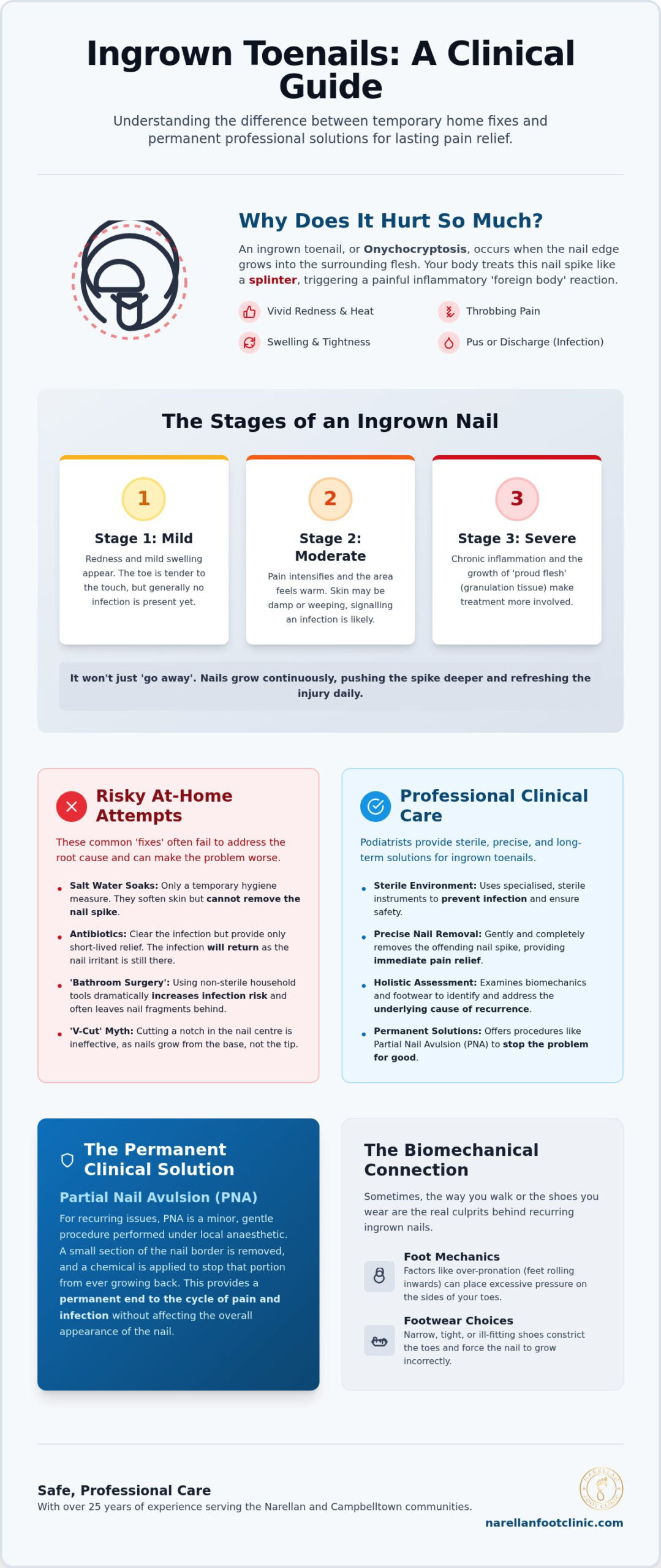
An Ingrown nail, known medically as Onychocryptosis, occurs when the side or corner of your toenail grows into the soft flesh of the toe. It’s a common condition, but the discomfort it causes is far from ordinary. Your body treats the invading nail like a splinter, triggering a ‘foreign body’ reaction that leads to significant inflammation. This isn’t just a surface-level scratch; it’s a structural issue where a hard object is piercing your skin from the inside out.
Common symptoms to watch for include:
- Vivid redness and a feeling of heat around the nail border.
- Swelling that makes even your most comfortable shoes feel restrictive.
- A persistent, ‘throbbing’ pain that often feels worse when you’re resting.
- The presence of discharge or pus, which indicates a secondary infection has taken hold.
Why does this happen? Often, the culprits are everyday habits or physical factors. Cutting your nails in a rounded shape instead of straight across is a primary cause. Wearing tight footwear, such as narrow-toed heels or restrictive work boots, can also place excessive pressure on the nail wall during daily activities or sport. In some cases, your genetics determine the shape of your nail, making you more prone to ingrowth regardless of how carefully you trim.
The Stages of Nail Ingrowth
Stage 1 is characterised by redness and mild swelling. You’ll feel tenderness when you press on the side of the toe, but there is generally no infection at this point. By Stage 2, the pain intensifies and the area may feel quite warm. You might notice the skin is damp or weeping, suggesting the barrier has been breached and an infection is likely. Stage 3 involves chronic inflammation. Here, the body may produce ‘granulation tissue’, also known as proud flesh, which is an overgrowth of skin that can make effective ingrown toenail treatment a more involved process.
Why It Won’t Just ‘Go Away’ on Its Own
Because your nails never stop growing, the irritant is constantly being pushed deeper into the sensitive tissue. This creates a cycle where the injury is refreshed every single day. If you ignore the signs, you risk developing paronychia, a painful skin infection that requires professional attention. While rare, untreated infections can occasionally migrate to the bone, leading to serious health complications. Seeking ingrown toenail treatment is most effective when started early, before these complications take root. Choosing to ‘wait it out’ often allows the nail to penetrate deeper into the tissue, which frequently leads to the need for more complex surgery later.
Home Remedies vs. Professional Podiatry Treatment
When that sharp, stabbing pain first hits, your first instinct might be to reach for the bathroom cabinet. While warm salt water soaks are a common first step for Ingrown toenail diagnosis and treatment, they only address the surface level of the problem. Soaking helps maintain hygiene and can temporarily soften the skin, but it cannot physically shift the nail edge that is piercing your flesh. Similarly, many people visit their GP and receive a course of antibiotics. While this medication clears the immediate redness and pus, the relief is often short-lived. If the nail spike remains embedded in the toe, the infection will almost certainly return once the course finishes because the physical irritant is still present.
Using non-sterile tools at home can introduce bacteria deep into the wound. This often leads to increased swelling and throbbing, making the eventual professional treatment more complex. A podiatrist doesn’t just cut the nail; they assess the entire foot to prevent the problem from coming back. If you are struggling with a persistent issue, seeking professional help at Narellan Foot Clinic can provide the clarity and comfort you need.
The Risks of DIY Treatment
Attempting ‘bathroom surgery’ with nail clippers or tweezers is a risky move that often leaves the problem worse than before. Most household tools aren’t sterile, which significantly increases the risk of a secondary infection. Many patients also fall for the ‘V-cut’ myth, believing that cutting a notch in the centre of the nail will relieve pressure at the sides. In reality, nail growth occurs from the base, not the tip, so this does nothing to help. For those requiring a diabetic foot assessment or those with poor circulation, DIY cutting is particularly dangerous. A small nick can lead to serious complications that are difficult to heal and may require urgent medical attention.
What a Podiatrist Does Differently
Professional ingrown toenail treatment at a clinic provides a level of precision and safety that home care simply cannot match. We use medical-grade, fully sterilised instruments to gently clear the offending nail edge without causing further trauma to the surrounding tissue. Our practitioners have the expertise to determine if your pain is caused by the nail’s shape or an issue with the skin fold itself. If your toe is too sensitive to touch, we can provide local anaesthetics to ensure the procedure is completely comfortable. This methodical approach transforms a stressful ordeal into a quick, manageable path to relief.
Clinical Treatment Options: Conservative to Permanent Solutions
When home remedies fail to provide lasting comfort, professional clinical care offers a range of pathways to return you to pain-free movement. For mild cases where the nail has only just begun to irritate the skin, routine podiatry care is often sufficient. This involves a skilled podiatrist gently clearing the offending nail edge using specialised, sterile instruments. It’s a conservative approach that provides immediate relief without the need for anaesthetic or downtime. However, for those experiencing recurring infections or chronic pain, a more definitive ingrown toenail treatment is required to break the cycle once and for all.
The gold standard for permanent resolution is a procedure known as a Partial Nail Avulsion (PNA). Unlike the outdated methods people often fear, modern clinical management of ingrown toenails focuses on precision and patient comfort. We don’t ‘rip’ the nail off; instead, we remove only the narrow sliver that is causing the trouble, leaving the rest of your nail looking natural and intact.
The PNA Surgery Process Explained
We understand that the idea of a clinical procedure can be daunting, but the process is methodical and designed to be entirely stress-free. Our approach follows four clear steps:
- Step 1: We apply a local anaesthetic to the base of the toe. This ensures the entire area is completely numb before we begin any work.
- Step 2: Once you’re comfortable, we carefully remove the thin section of nail that has been piercing the skin fold.
- Step 3: We apply phenol, a specialised chemical, to the exposed nail root. This cauterises the small section of the growth plate to prevent that specific edge from ever growing back.
- Step 4: The toe is dressed in a sterile, protective bandage, and we provide a clear follow-up plan to monitor your healing.
Recovery and Aftercare
Recovery is typically straightforward with minimal downtime. Most patients find they can return to light daily activities within 24 to 48 hours. During the initial healing phase, we recommend wearing open-toed shoes or loose trainers to avoid any pressure on the dressing. Because phenolisation has a high success rate of approximately 98.5% in preventing recurrence, this small investment in time leads to a lifetime of relief. For a deeper dive into what to expect during the procedure, you can read our comprehensive guide on Ingrown Toenail Surgery: A Professional Guide to Permanent Relief.
The Biomechanical Connection: Why Do Nails Keep Ingrowing?
While clearing the immediate pain is vital, true long-term relief comes from understanding the underlying forces at play. Many people find themselves in a frustrating cycle of recurring pain because they only treat the symptom, not the cause. The way your foot moves, known as your biomechanics, is often the hidden driver behind why you need frequent ingrown toenail treatment. If your foot structure or walking style isn’t quite right, you’ll continue to put undue stress on the nail bed regardless of how often you have it cleared.
One of the most frequent causes is over-pronation, which is when your foot ‘rolls in’ excessively as you walk. This movement places a disproportionate amount of pressure on the inside edge of your big toe, effectively pushing the soft skin fold directly into the path of the growing nail. Similarly, structural changes like bunions can alter the alignment of your toe, forcing it against the side of your shoe. This constant compression makes it almost impossible for the nail to grow straight. High-impact sports such as football and netball add another layer of risk, as the repetitive trauma of sudden stops and pivots can drive the nail deeper into the tissue. To stop this cycle, a biomechanical assessment is essential to identify these pressure points.
Footwear Factors in Australia
Our lifestyle in Australia significantly influences our foot health. The classic Aussie thong, while convenient, offers very little support. This lack of structure forces your toes to ‘grip’ the ground, changing the way pressure is distributed across the nail bed. For the many tradespeople in the Narellan and Campbelltown area, heavy work boots and safety shoes present a different challenge. The rigid toe boxes in these boots can trap moisture and apply constant pressure, creating the perfect environment for a nail to become ingrown. Fortunately, custom orthotics can be designed to fit into your work boots, helping to redistribute weight and shield the sensitive sides of your toes from excessive force.
Gait Analysis and Prevention
Your walking pattern is a repetitive motion you perform thousands of times every day. If your gait involves a slight ‘flick’ or an inward ‘roll’ at the end of each step, you are essentially driving the nail into your skin with every kilometre you walk. By using gait analysis, a podiatrist can pinpoint these subtle movements and correct them before they cause another flare-up. Orthotic therapy is often the ‘missing piece’ in a successful ingrown toenail treatment plan, providing the structural support needed to keep your toes safe and comfortable. If you’re tired of the same old pain returning every few months, book a biomechanical assessment to find the root cause of your discomfort.
Safe and Professional Care at Narellan Foot Clinic
Choosing where to receive your ingrown toenail treatment is a decision that impacts both your immediate comfort and your long-term health. At Narellan Foot Clinic, we’ve spent over 25 years building a reputation as a trusted sanctuary for patients across Sydney’s South West. Led by principal podiatrist David J. Miller, our team provides a ‘safe pair of hands’ for those who may feel anxious about their feet. We understand that physical discomfort often comes with a layer of stress, which is why we prioritise a warm, empathetic approach that puts you at ease from the moment you walk through our doors.
One of the most critical aspects of our practice is our commitment to a fully sterilised medical environment. While beauty salons offer pedicures, they often lack the hospital-grade sterilisation equipment required for safe nail procedures. We exceed standard hygiene protocols to ensure every instrument used in your care is completely sterile, significantly reducing the risk of cross-contamination or secondary infection. This clinical rigour is matched by our focus on convenience. With on-the-spot HICAPS claims, you can process your private health fund rebate immediately, making your path to relief as smooth as possible.
What to Expect at Your First Appointment
During your initial consultation, we conduct a thorough clinical assessment of the nail and the surrounding soft tissue. We don’t just look at the toe in isolation; we consider your foot structure and history of pain. We’ll discuss every available option with you, ranging from gentle conservative clearing to permanent surgical solutions if the problem is recurring. Our primary goal during this first visit is to implement immediate pain relief strategies so you can leave the clinic feeling significantly more comfortable than when you arrived.
Accessing Care in Sydney’s South West
We believe high-quality podiatry should be accessible to everyone in our community. Whether you are located in Narellan, Campbelltown, or even further out toward Penrith, our clinic is positioned to provide expert care without the need for long-distance travel. We integrate seamlessly with Medicare and all major health funds to ensure your ingrown toenail treatment is affordable and stress-free. If you’re ready to transition from a state of worry to one of comfort, book your consultation at Narellan Foot Clinic today and take the first step toward walking without pain.
Step Toward Lasting Comfort and Mobility
Living with the persistent, sharp pain of a compromised nail shouldn’t be your daily reality. While salt water soaks provide a temporary hygiene boost, they cannot resolve the underlying biomechanical pressure or the physical nail spike piercing your skin. Seeking professional ingrown toenail treatment is the only way to break the cycle of infection and discomfort for good. By addressing how you walk and the way your footwear fits, you ensure that relief isn’t just immediate; it’s permanent.
At Narellan Foot Clinic, we provide a safe, welcoming sanctuary where your comfort is our absolute priority. Our team brings over 25 years of clinical experience to every consultation, ensuring you’re in a “safe pair of hands” throughout your recovery. We maintain a fully sterilised surgical environment and offer the convenience of on-the-spot HICAPS claims to make your visit seamless. You don’t have to settle for temporary fixes or risky home remedies anymore. Book Your Professional Ingrown Toenail Assessment at Narellan Foot Clinic and take the first step toward walking with confidence and ease once again.
Frequently Asked Questions
Is ingrown toenail surgery painful?
Modern ingrown toenail treatment is designed to be as comfortable as possible. We use a local anaesthetic to completely numb the toe before any procedure begins, meaning you won’t feel anything during the treatment itself. While the initial numbing injection might sting for a few seconds, the relief that follows is immediate. Most of our patients in the Narellan area are surprised by how quick and painless the clinical process actually is.
How long does it take for an ingrown toenail to heal after treatment?
Healing times vary depending on the severity of the case and the type of treatment provided. For conservative clearing, you’ll likely feel immediate relief and can return to your routine right away. If you undergo a Partial Nail Avulsion, the initial wound generally heals within two to four weeks. However, most people find they can return to work within 48 hours. This procedure has a 98.5% success rate in preventing future nail issues.
Can I drive home after having my ingrown toenail treated?
If you have received a routine, non-surgical clearing, you can usually drive home without any issues. However, if you have undergone surgery with a local anaesthetic, we recommend arranging for a lift. The anaesthetic can leave your toe feeling quite heavy or numb for several hours, and the bulky protective dressing required after the procedure may interfere with your ability to safely and comfortably operate the pedals of your car.
Will my health fund cover the cost of ingrown toenail treatment?
Most private health insurance providers in Australia cover podiatry services under their ‘extras’ policies. The exact amount of your rebate for ingrown toenail treatment will depend on your specific level of cover. At Narellan Foot Clinic, we make this process easy by providing on-the-spot claims through our HICAPS terminal. This means you only need to pay the ‘gap’ amount at the time of your appointment, saving you the hassle of manual claims.
What happens if I leave an ingrown toenail untreated?
Ignoring an ingrown nail often leads to a cycle of worsening pain and chronic infection. Because the nail acts as a constant irritant, the skin cannot heal while the spike is still present. Over time, this can lead to the growth of ‘proud flesh’ or granulation tissue, making the eventual clearing more complex. In rare, severe cases, an untreated infection can spread to the surrounding tissue or even migrate to the underlying bone.
Do I need a referral from my GP to see a podiatrist for an ingrown nail?
You do not need a referral to see a podiatrist as a private patient or when using your health insurance. You can simply call us to book directly. However, if you are seeking a Medicare rebate under a Chronic Disease Management plan, you will need to consult your GP. Eligible patients can currently receive a rebate of approximately $64.30 for up to five visits per year, which helps make professional care more affordable.
Can children get ingrown toenails, and is the treatment different?
Ingrown nails are very common in children and teenagers, often caused by rapid growth spurts, tight school shoes, or incorrect nail cutting. The treatment approach is similar to that for adults, but we take extra care to ensure the experience is gentle and non-intimidating for younger patients. We focus on educating both the child and the parent on proper foot hygiene and cutting techniques to prevent the painful problem from recurring.
How do I stop my toenails from ingrowing again?
Prevention starts with cutting your toenails straight across rather than rounding the corners. It is also vital to wear shoes with a wide toe box that doesn’t squeeze your feet. If your nails continue to ingrow despite these changes, the issue may be related to your walking pattern. In these cases, a biomechanical assessment and custom orthotics can redistribute pressure away from the nail edge, providing a long-term solution for your comfort.




1 Comment
[…] to reduced circulation and sensation. While some try to manage these issues at home, a professional ingrown toenail treatment ensures the area is properly cleared and sterilised. Professional diagnosis is the only way to […]