

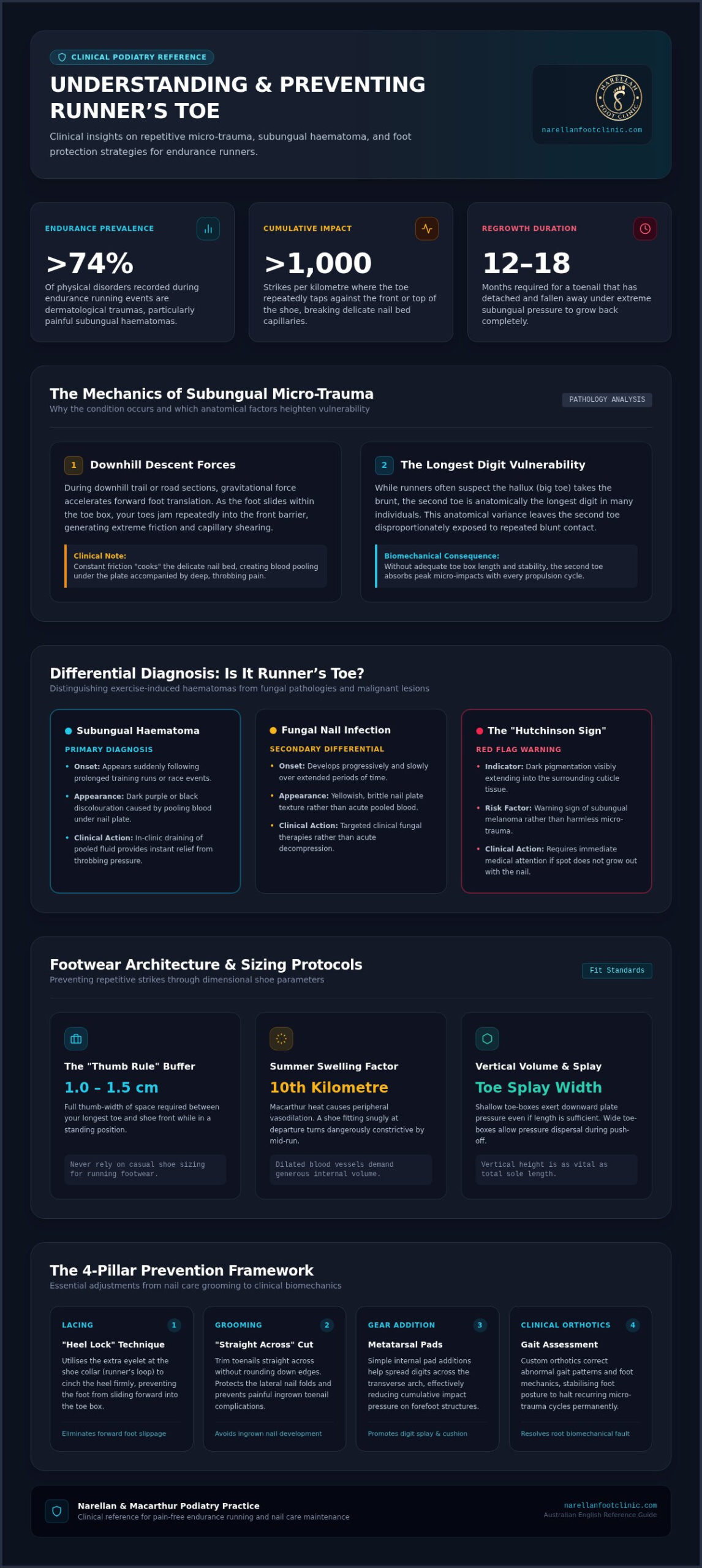
Did you know that dermatological traumas, particularly painful subungual haematomas, represent over 74% of physical disorders recorded during endurance running events? For many in our Narellan and Macarthur community, a black toenail feels like an inevitable badge of honour, yet it is actually a sign of repetitive micro-trauma that you can avoid. If you are tired of the throbbing pressure and want to know how to prevent runner’s toe, you have come to the right place.
We understand the frustration of hiding your feet during the summer months or worrying that a loose nail might derail your race preparation. It is a common struggle that causes genuine stress, but it does not have to be your reality. We believe your kilometres should be defined by your performance, not your discomfort. Our goal is to share the professional secrets to keeping your toenails clear and your feet healthy, regardless of the distance you cover.
This guide provides a clear, actionable path toward pain-free running. We will examine essential gear adjustments, proper grooming habits, and why a professional biomechanical assessment is often the missing piece of the puzzle. You will learn how to transition from a state of worry to one of total confidence on the track.
Key Takeaways
- Learn why the “Thumb Rule” and accounting for foot swelling in the Macarthur heat are essential for ensuring a protective shoe fit.
- Discover the “straight across” trimming technique to maintain healthy nails and avoid the complications of painful ingrown toenails.
- Understand how to prevent runner’s toe by using custom orthotics to stabilise your foot and stop it from sliding forward during long runs.
- Identify if recurring black toenails are a symptom of an underlying gait issue that requires a clinical biomechanical assessment.
- Find out how simple gear additions like metatarsal pads can help spread your toes and reduce the pressure of repetitive micro-impacts.
What is Runner’s Toe? Understanding Subungual Haematoma
While many athletes view a bruised nail as a sign of hard work, it is clinically known as a subungual hematoma. This condition occurs when blood pools under the nail plate, usually following repetitive trauma to the delicate tissues of the nail bed. It is a common sight in our Narellan clinic, particularly after local marathon events or intensive training blocks. Understanding the physical cause of this bruising is the first step in learning how to prevent runner’s toe effectively.
Most people assume a black toe comes from one heavy impact. In reality, it is usually the result of a “micro-trauma” cycle. During a run, your toe may tap the front or top of your shoe more than 1,000 times every kilometre. This constant, rhythmic striking breaks small capillaries, leading to the characteristic dark purple or black discolouration. If the pressure becomes too great, the nail may eventually lift and fall away. You should be prepared for a long recovery if this happens; a lost toenail can take between 12 and 18 months to grow back fully.
The Mechanics of the “Black Toe”
The damage often intensifies during downhill sections of a run. As you descend, gravity forces your foot to slide forward, causing your toes to jam into the front of the shoe. This creates significant friction and pressure within the toe box. While the big toe is strong, the second toe is often the longest digit for many runners. This makes it the most vulnerable to these repetitive strikes. When the nail bed is “cooked” by this constant friction and pressure, the resulting haematoma can cause a deep, throbbing pain that makes every step a struggle.
Is it Runner’s Toe or Something Else?
It is vital to distinguish between a simple bruise and other conditions. Sometimes, what looks like a runner’s toe is actually one of several fungal nail infections. Fungal issues typically develop slowly and cause the nail to become brittle or yellow, whereas a haematoma appears suddenly after exercise. We also look for the “Hutchinson sign,” which is dark pigmentation that extends into the cuticle. This can be a warning sign of subungual melanoma, a serious condition that requires immediate medical attention.
If you notice a dark spot that does not grow out with the nail, or if you are dealing with intense, throbbing pressure, seeking professional general foot care is the safest path forward. We can provide a clear diagnosis and, if necessary, safely drain the fluid to offer instant relief and preserve the health of your nail.
The Perfect Fit: Selecting Shoes to Protect Your Toes
Selecting the right footwear is a cornerstone of how to prevent runner’s toe and ensure long-term comfort. Most runners make the mistake of buying shoes based on their casual shoe size. However, your feet need significantly more room when you are hitting the pavement. We recommend the “Thumb Rule”: there should be a full thumb-width of space, roughly 1 to 1.5 centimetres, between your longest toe and the end of the shoe while you are standing. This space acts as a vital buffer, preventing the repetitive micro-impacts that cause bruising. For more detailed clinical advice on footwear selection, you can refer to the Cleveland Clinic’s guide to runner’s toe prevention.
Living in Narellan means training through the intense Australian summer. Heat causes the blood vessels in your feet to dilate, leading to significant swelling during a long run. A shoe that fits perfectly at the start of your session may become dangerously tight by the tenth kilometre. Beyond length, you must consider the “volume” of the shoe. This refers to the vertical space inside the toe-box. If a shoe is too shallow, it will press down on the nail plate even if there is plenty of room at the front. A wide toe-box is essential to allow for natural “toe splay,” which helps distribute pressure evenly during the push-off phase of your gait.
The “Heel Lock” Lacing Technique
Proper lacing is the most underrated tool for preventing nail trauma. If your foot slides forward inside your shoe, even the best-fitting pair will cause problems. The “heel lock” or “runner’s loop” uses the extra eyelet at the top of your shoe to cinch the heel firmly into place. Follow these steps to secure your fit:
- Lace your shoes normally until you reach the second-to-last eyelet.
- Thread the lace through the final eyelet on the same side to create a small loop.
- Cross the laces and pull each one through the loop on the opposite side.
- Pull the laces downwards to tighten the loop and then tie your shoes as usual.
This simple adjustment creates a secure anchor point, ensuring your toes don’t smash into the front of the shoe during downhill sections or sudden stops.
When to Replace Your Runners
Shoes have a lifespan, and continuing to run in “dead” footwear is a recipe for injury. Most running shoes are designed to last between 600 and 800 kilometres. After this point, the midsole foam loses its ability to absorb shock, and the upper materials may stretch excessively. This lack of structural integrity allows your foot to move unpredictably, increasing the risk of toe trauma. If you notice the fabric around the toes is beginning to bulge or the cushioning feels “flat,” it is time for a new pair. If you are unsure if your current shoes are still supportive, a professional biomechanical assessment can help identify if your gear is contributing to your discomfort.
Footcare Maintenance: The Runner’s Pedicure
While choosing the right footwear is vital, your personal grooming routine plays an equally significant role in how to prevent runner’s toe. Keeping your toenails at the correct length reduces the surface area available for the shoe to strike. There is a delicate balance to maintain here. Trimming your nails too short can lead to painful ingrown toenails, which aren’t just an inconvenience; they’re a significant risk to your training schedule. Your goal is a length that clears the front of the shoe without exposing the sensitive nail bed.
Always follow the “straight across” rule. Avoid the temptation to round the corners deeply into the nail folds. This practice encourages the nail to grow into the skin. Instead, cut them straight and use an emery board to smooth any sharp edges. Filing the top surface of the nail can also be helpful if you have naturally thick nails. Reducing this vertical thickness creates more “volume” within the toe-box. This technique complements proper athletic shoe fitting guidelines by ensuring there’s no constant top-down pressure on the nail plate.
Moisture Management and Sock Choice
Wet skin is soft skin. When your feet become sweaty, they succumb to a “prune effect” that makes the skin and nail bed far more susceptible to friction damage. Cotton socks are a runner’s enemy. They absorb moisture and hold it against your skin, increasing the likelihood of trauma. Switch to moisture-wicking synthetic blends or merino wool. These materials pull sweat away from the foot. It’s especially important during humid runs in the Macarthur region. Some athletes find success with double-layer socks, where the friction occurs between the fabric layers rather than against your skin.
The Role of Silicone Toe Shields
For those with a particularly long second toe, extra protection is often necessary. Reusable silicone toe caps or shields provide a soft, protective buffer between the nail and the shoe wall. These small sleeves absorb the shock of micro-impacts and can be a game-changer for long-distance training. Applying a small amount of anti-blister balm or a silicone-based lubricant to the tips of your toes before a run can further decrease friction. These small, methodical steps are essential components of how to prevent runner’s toe during high-mileage weeks.
Preventative Gear: Beyond the Basic Runner
While shoe fit and nail care are the foundations of how to prevent runner’s toe, many athletes require more advanced interventions to stop the cycle of trauma. Sometimes, the issue isn’t just the shoe; it’s how your foot moves within it. If your foot slides forward during every stride, you’ll eventually face the throbbing pain of a black nail. Advanced gear, such as custom orthotics, provides the structural support needed to keep your foot anchored and protected.
Orthotics and Forefoot Stability
Excessive over-pronation is a common culprit. When your arch collapses too much, your foot actually lengthens slightly within the shoe, pushing your toes closer to the front bumper. Clinical orthotics are specifically designed to control this motion. Unlike chemist-bought insoles, which offer generic cushioning, custom versions are moulded to your unique foot shape. They keep your heel seated firmly in the back of the runner. This stability prevents the “clawing” motion that many runners adopt when they feel their foot sliding, which is a major contributor to nail bed bruising.
Metatarsal pads are another useful addition. These small, teardrop-shaped cushions sit just behind the ball of your foot. They encourage your toes to splay naturally rather than being squeezed together. When your toes have room to spread, the pressure of each impact is distributed across a wider area, reducing the direct force on any single nail. This simple adjustment can be particularly effective for those with wider feet who struggle with standard shoe widths.
Ankle Bracing and Taping
Excessive ankle motion can also contribute to poor toe clearance. If your ankle is unstable, your toes may “flick” upwards as you lift your foot, causing the nail to strike the top of the shoe. Kinesiology tape can be used on the hallux (big toe) to gently discourage this flicking motion. This is a popular hack among marathon runners in the Macarthur region who need to protect their feet over 42 kilometres. Simple taping techniques can also stabilise the ankle, ensuring a more consistent and predictable foot strike.
Your choice of sock thickness is the final piece of the puzzle. A thick, padded sock might feel comfortable, but it reduces the available volume inside your shoe. If your shoes already feel snug, switching to a thinner, technical sock can provide the extra millimetres of space your toes need to stay healthy. If you’re struggling to find the right combination of gear, we invite you to book a consultation at Narellan Foot Clinic to discuss a tailored solution for your running needs.
Stopping the Cycle: The Role of Biomechanical Assessment
When you have adjusted your shoe size, updated your lacing, and mastered your nail grooming, yet still find your toes turning purple after a long run, the issue is likely mechanical. Recurring trauma is often a symptom of an underlying gait irregularity that simple gear changes cannot fix. To truly understand how to prevent runner’s toe for the long term, we must look at how your feet and legs move through every phase of your stride. A professional biomechanical assessment at Narellan Foot Clinic allows us to identify these hidden triggers.
One of the most common causes we see is an irregularity during the “Toe-Off” phase. Many runners unknowingly “claw” or grip their toes against the sole of the shoe as they push forward. This subconscious gripping motion pulls the nail plate upwards, causing it to strike the top of the shoe box with every step. Our clinical video gait analysis captures these split-second movements. By reviewing your stride in slow motion, we can pinpoint the exact moment your toe makes contact with the shoe wall, providing a clear explanation for your discomfort.
What to Expect in Your Assessment
During your consultation, our principal podiatrist, David J. Miller, draws on 25 years of experience to evaluate your unique movement patterns. We begin with a thorough review of your running history and an inspection of your current footwear for specific wear patterns. This is followed by physical testing to assess your joint range of motion and muscle strength. We don’t just look at the toes; we examine how your hips, knees, and ankles work together. This comprehensive approach ensures we create a personalised plan that helps you return to the trails around Mount Annan or Camden with total confidence.
Long-term Solutions for Chronic Runners
Resolution often involves more than just wearing a different shoe. We may prescribe specific strength exercises for the intrinsic foot muscles. These exercises help prevent the clawing motion by improving the stability of the forefoot. In some cases, gait retraining tips can help you adjust your foot strike to reduce the impact on your toes. By addressing the root cause of the trauma, we move beyond temporary fixes toward lasting relief. We believe that every runner deserves to focus on their kilometres rather than their pain.
Ready to run without the worry of losing a nail? Book your biomechanical assessment at Narellan Foot Clinic today.
Reclaim Your Comfort on the Track
Your journey to healthy toenails starts with small, deliberate changes to your gear and routine. Ensuring your shoes have adequate volume and mastering the “heel lock” lacing technique provides the immediate protection your feet need. When combined with proper nail grooming and moisture-wicking socks, you’ve established a solid foundation for how to prevent runner’s toe on every trail.
If bruising persists despite these changes, it’s often a sign that your unique movement patterns need professional attention. Addressing the root cause through expert gait analysis ensures you aren’t just treating symptoms but protecting your long-term mobility. With over 25 years of experience serving the Narellan community, our team is here to help you achieve lasting results. We utilise modern clinical techniques and offer convenient on-the-spot HICAPS claims for all major health funds.
Book a Biomechanical Assessment at Narellan Foot Clinic today to reclaim your comfort. You’ve put in the hard work on the road; now it’s time to give your feet the expert care they deserve.
Frequently Asked Questions
Should I drain the blood from under a runner’s toe myself?
You should never attempt to drain a subungual haematoma at home. Doing so significantly increases the risk of a secondary infection, which can lead to more serious complications. A podiatrist can safely perform trephination using sterile equipment to release the pressure. If you are experiencing intense throbbing, our Narellan clinic provides professional general foot care to manage the trauma safely, ensuring the underlying nail bed is protected while it heals.
How long does it take for a black toenail to grow out?
A completely detached or avulsed toenail typically takes between 12 and 18 months to regenerate fully to the distal edge. This is considerably slower than fingernails, which usually regrow in less than half that time. During this period, it’s essential to keep the nail bed protected and clean. Regular check-ups in our Campbelltown or Penrith service areas can help monitor the regrowth and ensure no fungal infections take hold during the recovery phase.
Can I keep running if I have a black toenail?
You can usually continue running with a black toenail provided the pain is manageable and there are no signs of infection like redness or discharge. However, it is a clear signal that you need to evaluate how to prevent runner’s toe in the future. If the nail is loose, you should tape it down to prevent it from catching on your sock. If the throbbing makes walking difficult, you should rest until the pressure is professionally relieved.
Will my toenail fall off if it turns black after a run?
Whether a nail falls off depends on the extent of the bleeding underneath. If the haematoma covers more than 50% of the nail surface, the nail plate is likely to eventually detach as the new nail grows underneath. This process is natural and acts as a biological dressing for the healing skin. If you are concerned about the stability of the nail before a race, our team can provide advice on protective taping and general foot care.
Is runner’s toe a sign that my shoes are too small?
While small shoes are a common culprit, runner’s toe can also be caused by poor lacing, excessive foot swelling in the heat, or an irregular gait. Even correctly sized shoes can cause issues if they lack sufficient vertical volume in the toe-box. A professional assessment is the best way to determine if your footwear or your biomechanics are the primary problem. We serve runners across Western Sydney to ensure their gear matches their specific physical needs.
Can a podiatrist help with a painful, throbbing toenail?
Yes, a podiatrist provides immediate relief by safely draining the fluid under the nail to reduce pressure. This procedure is most effective when performed within 24 to 48 hours of the injury. Beyond immediate relief, we offer long-term solutions such as custom orthotics and biomechanical assessments. These clinical interventions address the mechanical causes of the trauma, helping you understand how to prevent runner’s toe from recurring during your training cycles.
What is the best lacing technique to prevent toe pain?
The “heel lock” or runner’s loop is widely considered the most effective lacing technique for preventing toe trauma. By using the extra eyelet at the top of your shoe, you create a secure anchor that prevents your foot from sliding forward. This is particularly important for runners tackling hilly terrain in the Macarthur region. It ensures your heel stays seated firmly in the back of the shoe, maintaining that vital space between your toes and the front bumper.
Are there specific socks that prevent black toenails?
Technical socks made from moisture-wicking synthetic blends or merino wool are the best choice for preventing nail trauma. Unlike cotton, which traps moisture and increases friction, these materials keep your skin dry and resilient. Some runners also benefit from individual toe socks, which eliminate interdigital friction and provide a slight buffer for each digit. Combining the right socks with silicone toe caps can provide an extra layer of protection for particularly vulnerable toes.