

Imagine swinging your feet out of bed, ready to start the day, only to be met with a sharp, stabbing sensation in your heel the moment your foot touches the floor. For many Australians, this “first-step” agony is a daily reality that makes even a simple walk to the kitchen feel like a marathon. You’ve likely tried the standard advice of rest and ice, yet the frustration of persistent pain continues to hold you back from your morning walks or weekend sport. Finding an effective plantar fasciitis treatment shouldn’t be a guessing game of trial and error that leaves you feeling stuck.
We understand how debilitating chronic heel pain is, and we know that generic solutions often fall short. This article provides the exact steps you need to manage your symptoms at home while helping you recognise when it’s time for professional podiatry intervention to achieve permanent relief. We’ll walk through the essential phases of recovery, from targeted stretching routines to the importance of a comprehensive biomechanical assessment. By the end, you’ll have a clear, actionable plan to wake up pain-free and return to the activities you love without the fear of long-term foot damage.
Key Takeaways
- Understand why your first steps in the morning are so painful and how the plantar fascia reacts to overnight rest.
- Discover why a professional biomechanical assessment is the essential first step in creating a personalised plantar fasciitis treatment plan.
- Learn about advanced clinical interventions that can speed up your recovery and get you back to your favourite sport or morning walk sooner.
- Master a structured daily routine for home management to alleviate discomfort while supporting your professional clinical care.
- Explore the difference between generic store-bought insoles and medical-grade custom orthotics for providing permanent corrective support.
What is Plantar Fasciitis and Why Does it Cause Heel Pain?
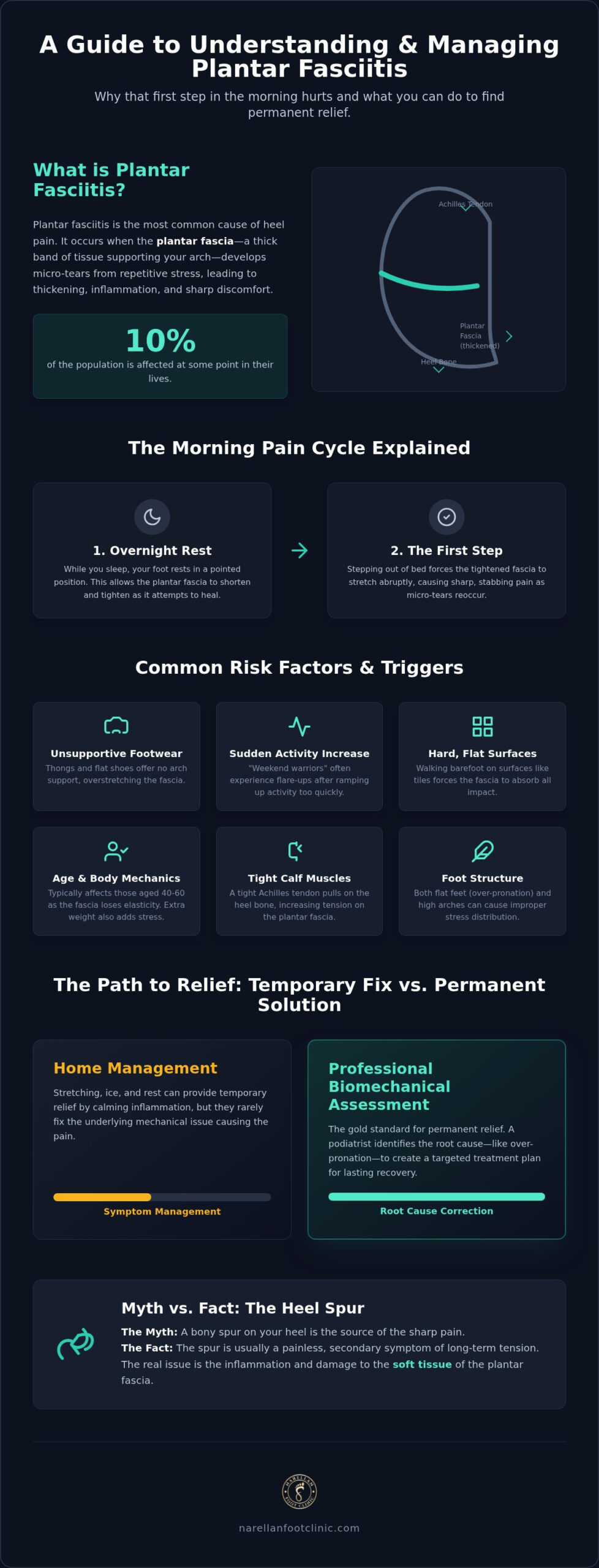
Plantar fasciitis is the most common cause of heel pain, affecting approximately 10% of the population at some point in their lives. To understand the condition, you first need to look at the plantar fascia itself. It’s a thick, resilient band of connective tissue that stretches from your heel bone to the base of your toes, acting as the primary support for your foot’s natural arch. When this tissue is healthy, it’s flexible and strong. However, when it’s subjected to repetitive stress, it can develop tiny micro-tears that lead to thickening and discomfort. Seeking an effective plantar fasciitis treatment isn’t just about masking the soreness; it’s about addressing these structural changes to restore your mobility.
The hallmark of this condition is that sharp, stabbing sensation during your first few steps in the morning. While you sleep, your foot naturally rests in a pointed position, allowing the fascia to shorten and attempt to heal. The moment you step out of bed, you force that tissue to stretch abruptly, causing it to tear again. This cycle of overnight shortening and morning tearing is why the pain often subsides after a few minutes of walking, only to return after you’ve been sitting for a long period.
It’s also vital to distinguish between this condition and heel spurs. Many patients worry when an X-ray reveals a bony protrusion on their heel, but these spurs are often completely painless. The spur is usually a secondary symptom of long-term tension rather than the source of the agony. The real issue is the soft tissue tension, which is why clinical intervention focuses on the fascia rather than the bone.
The Anatomy of Your Arch
Your plantar fascia functions much like a shock absorber, tensioning every time your foot hits the ground to protect your bones and joints. It doesn’t work in isolation; it’s closely linked to your Achilles tendon. If your calf muscles are tight, they pull on the heel bone, which in turn increases the tension on the fascia. Over time, this constant tug-of-war causes the tissue to lose its elasticity. Instead of a smooth, supple band, the fascia becomes scarred and thickened, making it less capable of handling the demands of daily movement. If you are also experiencing pain higher up the heel, it is worth understanding how Achilles tendon pain treatment differs from plantar fasciitis care, as the two conditions are closely related but require distinct clinical approaches.
Common Risk Factors and Triggers
In our local community, we often see lifestyle factors play a major role in triggering symptoms. Australia’s warm climate means many of us spend our weekends in unsupportive thongs or walking barefoot on hard kitchen tiles. These surfaces offer zero arch support, forcing the fascia to overstretch with every step. We also see many “weekend warriors” who experience a sudden flare-up after increasing their physical activity too quickly without proper conditioning. Other factors like age, typically between 40 and 60, and carrying extra weight can place additional mechanical stress on the arch, making a professional plantar fasciitis treatment plan essential for long-term recovery.
The Professional Path: Why a Biomechanical Assessment is Vital
While home remedies like ice and stretching offer temporary relief, they rarely address the underlying mechanical flaws that caused the injury in the first place. This is why a biomechanical assessment is considered the gold standard for any effective plantar fasciitis treatment. It allows us to look beyond the localised pain and examine how your entire lower limb functions as a unit. If you simply treat the inflammation without fixing the mechanics, the pain is almost guaranteed to return as soon as you resume your normal activity levels. We focus on finding the “why” behind your discomfort to ensure your recovery is permanent rather than just a brief pause in symptoms.
Many patients don’t realise that their heel pain is actually a symptom of over-pronation (flat feet) or excessively high arches. Over-pronation causes the foot to roll inward, which overstretches the fascia during every step of your walking cycle. Conversely, high arches create a rigid foot that doesn’t absorb shock well, placing immense pressure on the heel bone. By identifying these issues early, we can create a targeted plan that provides lasting comfort. This scientific approach helps us move from guesswork to a precise understanding of your foot’s unique needs.
What Happens During Your Clinical Consultation?
During your visit, we begin with a thorough physical examination to pinpoint exact areas of tenderness and assess your range of motion in the ankle and midfoot. We also take a detailed history of your activity levels and footwear choices. This is crucial for differentiating plantar fasciitis from other conditions, such as nerve entrapment or stress fractures, which require different management strategies. We then perform a visual gait analysis, watching you walk to see how your feet, knees, and hips align under pressure. This holistic view ensures we are treating the person, not just the foot.
Advanced Diagnostic Techniques
We often use digital pressure mapping to get a precise reading of how weight is distributed across your soles. This data helps us see “hot spots” of high pressure that the naked eye might miss during a standard walk. If your symptoms are particularly stubborn or severe, we may recommend diagnostic imaging, such as an ultrasound, to measure the thickness of the fascia or check for significant tearing. Central to this process is gait analysis, which is a systematic study of human locomotion. This level of detail allows us to provide a “safe pair of hands” for your recovery, ensuring every intervention is based on clinical evidence.
If you’re tired of the morning struggle, booking a comprehensive foot check is the first step toward walking with ease again.
Clinical Treatment Options for Faster Recovery
When the initial shock of morning pain doesn’t subside with rest, a structured clinical approach becomes necessary to avoid long-term damage. Professional heel pain treatment offers a clear hierarchy of care, moving from manual therapies to advanced technology. These interventions are designed to accelerate your recovery by addressing the physiological changes in the fascia that home exercises simply can’t reach. At our clinic, we provide these services in a fully sterilised environment, ensuring your safety and comfort throughout the entire process. By breaking down chronic scar tissue and reducing inflammation, we help your body return to its natural healing state much faster than rest alone.
Manual therapy plays a pivotal role in this process. We use specific techniques to mobilise the small joints of the foot and stretch the connective tissue, which improves flexibility and reduces the mechanical load on the heel. This hands-on approach, combined with modern technology, ensures that your recovery plan is both comprehensive and effective. It’s about moving beyond temporary comfort to achieve a functional, pain-free foot that can handle the demands of your daily life.
Dry Needling and Photo-Biomodulation
Dry needling for foot pain is a highly effective technique for releasing deep-seated tension in the calf muscles and Achilles tendon. Since these structures are directly linked to the tension in your arch, relaxing them provides significant relief to the heel. For those seeking a non-invasive and painless option, photo-biomodulation, or laser therapy, is a modern breakthrough in plantar fasciitis treatment. It uses specific wavelengths of light to stimulate cellular repair and increase blood flow to the damaged area. These modern techniques are excellent alternatives to cortisone injections, which can sometimes weaken the tissue over time if used repeatedly.
Taping and Supportive Strapping
Clinical taping is often the first step in providing immediate mechanical rest for a strained arch. We frequently use “low-dye” taping, a specific strapping technique that mimics the support of a corrective device. This isn’t just about temporary relief; it serves as a vital diagnostic tool. If taping significantly reduces your pain during a normal day, it’s a strong indicator that you’ll benefit from long-term support like custom orthotics. Generally, we recommend keeping the strapping on for three to five days. This allows the fascia a much-needed break from the constant tugging of daily movement, giving the micro-tears a chance to knit back together without being pulled apart again.
How to Manage Plantar Fasciitis at Home: A Step-by-Step Guide
While the clinical interventions we’ve discussed are essential for long-term recovery, your daily habits at home play a massive role in how quickly you see results. Think of home care as the daily maintenance that supports your professional plantar fasciitis treatment. The goal is consistency without aggression. You want to gently encourage the tissue to lengthen and heal without causing further micro-tears that reset your progress. One of the most important rules is to never walk barefoot, especially on hard timber or tile floors. Even a quick trip to the bathroom at night requires a supportive shoe to prevent the fascia from snapping under your body weight.
Adopting a structured routine helps manage the physiological changes occurring in your foot while you sleep. By preparing the tissue before you place your full weight on it, you can significantly reduce that dreaded morning “first-step” agony. These movements should feel like a gentle pull, never a sharp pain. If you find your symptoms aren’t improving despite these efforts, it’s a sign that your mechanics require a professional biomechanical assessment to identify the root cause.
The Morning Relief Sequence
- Step 1: Bedside Warm-up. Before your feet even touch the floor, perform thirty seconds of ankle circles in both directions. Follow this with “towel curls” by using your toes to scrunch up a piece of fabric. This increases blood flow and gently wakes up the fascia.
- Step 2: Ice Massage. Use a frozen water bottle to roll the arch of your foot for five minutes. This provides a dual benefit of cold therapy to reduce inflammation and a gentle massage to stretch the connective tissue.
- Step 3: Immediate Support. Put on supportive footwear immediately. Avoid flat, unsupportive slippers or walking in socks. A contoured footbed provides the arch support necessary to keep the fascia from overstretching during those first few minutes of movement.
Effective Stretching and Strengthening
Calf flexibility is the #1 predictor of plantar fascia health. When your calves are tight, they pull on the heel bone, which increases the tension on the fascia. To combat this, perform the “Wall Stretch” twice daily. Stand facing a wall with one foot back, keeping your heel flat on the ground and your knee straight. Hold for thirty seconds to target the gastrocnemius muscle, then slightly bend the back knee to target the deeper soleus muscle. These same calf stretches are also a cornerstone of evidence-based Achilles tendon pain treatment, as the two conditions share overlapping risk factors and respond well to progressive loading protocols.
You should also incorporate the “Seated Fascia Stretch.” While sitting, cross your affected foot over your opposite knee. Use your hand to gently pull your toes back toward your shin until you feel a stretch in the arch. This direct stretch helps maintain the elasticity of the tissue. Remember, these exercises are designed to supplement your clinical care, ensuring that the work done during your consultation is supported by your actions at home.
Custom Orthotics: The Long-Term Solution for Heel Pain
While manual therapy and home exercises are vital components of a comprehensive plantar fasciitis treatment, they often work best when paired with long-term structural support. At Narellan Foot Clinic, we’ve spent over 25 years helping our local community find lasting relief through custom-designed orthotics. These aren’t just simple cushions; they are medical-grade corrective devices engineered to realign your foot and redistribute the pressure that strains your fascia. By neutralising the mechanical flaws identified in your initial assessment, we provide a “safe pair of hands” for your ongoing mobility. To make the process as seamless as possible, we offer on-the-spot HICAPS and Medicare claims, allowing you to focus on your recovery rather than the paperwork.
The goal of orthotic therapy is to provide a permanent solution to a recurring problem. When your foot is properly supported, the micro-tears in the fascia finally have the chance to heal completely because the constant overstretching is eliminated. This transition from a state of constant worry to one of comfort and ease is the foundation of our patient-centric approach. We focus on delivering results that allow you to return to your morning walks or favourite sport without the fear of the pain returning.
Why Generic Insoles Often Fail
It’s tempting to reach for a generic insole from the local chemist, but these “one size fits all” solutions often fall short. Your bone structure and gait pattern are as unique as your fingerprint. A generic support might be too soft to provide real correction or, worse, it may place pressure on the wrong part of the arch, actually increasing the strain on the plantar fascia. Unlike foam or gel alternatives that lose their shape within weeks, custom orthotics are crafted from durable, high-quality materials designed to maintain their corrective properties for years. This durability ensures that your investment provides a consistent foundation for every step you take.
The Fitting and Adjustment Process
The journey to a perfect fit begins with precise measurements and a detailed understanding of your daily life. We don’t just look at your feet in isolation; we consider the shoes you wear most often. Whether you’re spending your day in heavy work boots on a construction site or walking the dog in sneakers, our orthotics are designed to fit into most Australian footwear styles. Once your devices are ready, we guide you through a gradual “break-in” period, allowing your muscles and tendons to adapt to their new, corrected position. Follow-up appointments are a standard part of our care, ensuring that the devices are performing exactly as intended and providing the relief you deserve.
Take the First Step Toward Pain-Free Mornings
Regaining your mobility starts with moving beyond temporary fixes and addressing the structural causes of your discomfort. By combining a disciplined home routine with professional clinical support, you can break the cycle of morning pain and prevent long-term damage to your feet. The most effective plantar fasciitis treatment isn’t found in a chemist aisle; it’s developed through a precise understanding of your unique gait and bone structure.
At Narellan Foot Clinic, Principal Podiatrist David J. Miller and our team bring over 25 years of local experience to help you walk with confidence again. We provide a “safe pair of hands” for your recovery, offering advanced therapies and custom solutions tailored specifically to your needs. With on-the-spot HICAPS and Medicare claims available, accessing expert care is straightforward and stress-free. Don’t let chronic heel pain dictate your lifestyle or keep you from the activities you love. Book your biomechanical assessment at Narellan Foot Clinic today and start your journey toward a more comfortable, active future. You deserve to wake up ready to embrace the day without hesitation.
Frequently Asked Questions
How long does it typically take for plantar fasciitis to heal?
Most patients notice significant improvement within six to twelve weeks when following a structured plantar fasciitis treatment plan. However, full recovery depends on the severity and duration of the symptoms. If the condition has been present for months, it may take longer to fully resolve the underlying tissue thickening. Consistency with prescribed exercises and professional support is the key to accelerating this timeline and ensuring the pain doesn’t return for good.
Is walking good for plantar fasciitis or should I rest?
Total bed rest is rarely the answer, as it can lead to further stiffness. We recommend “relative rest,” which means staying active while avoiding high-impact activities that flare up your symptoms. Short, gentle walks in supportive footwear are usually beneficial for maintaining circulation. If a particular activity causes a sharp increase in pain, it’s a signal from your body to scale back and focus on low-impact alternatives like swimming or stationary cycling.
Can I get a Medicare rebate for my podiatry treatment in Narellan?
You can certainly access Medicare rebates at our clinic if you have a valid Chronic Disease Management (CDM) plan from your GP. This plan allows for up to five rebated sessions per calendar year for chronic conditions. We provide on-the-spot processing through our HICAPS terminal, which means your claim is handled immediately at the time of your appointment. This ensures a smooth, hassle-free experience while you focus on your recovery and mobility.
Do I need a GP referral to see a podiatrist for heel pain?
You don’t need a GP referral to see a podiatrist as a private patient. Many people book directly with us to start their recovery journey as soon as possible. However, if you’re planning to claim a Medicare rebate under a Chronic Disease Management plan or if you’re a Department of Veterans’ Affairs (DVA) cardholder, a referral from your doctor is required. Our team is always happy to help clarify which path is best for your situation.
Are cortisone injections necessary for treating plantar fasciitis?
Cortisone injections are rarely our first choice because they often provide only temporary relief and can weaken the tissue over time. We focus on modern, non-invasive alternatives like dry needling for foot pain and photo-biomodulation to stimulate natural healing. While injections can be useful in extreme, acute cases to settle intense inflammation, they don’t address the mechanical issues causing the strain. A comprehensive plantar fasciitis treatment plan usually makes these invasive measures entirely unnecessary.
What are the best types of shoes to wear for heel pain?
The best footwear for heel pain features a firm heel counter, a supportive arch, and a slight heel lift to take the tension off the Achilles tendon. You should look for shoes that don’t bend easily in the middle of the sole. Avoid flat, flexible shoes like ballet flats or worn-out sneakers, as these offer no structural support. We often recommend specific brands that accommodate custom orthotics to ensure your feet remain stable throughout the day.
Will my health fund cover the cost of custom orthotics?
Most private health funds cover custom orthotics under their “extras” or “ancillary” policies. The exact amount of your rebate depends on your specific level of cover and your fund’s annual limits. Because we use on-the-spot HICAPS technology, we can process your claim during your consultation, so you only pay the remaining gap. It’s a good idea to check with your provider beforehand to understand your specific entitlements for podiatry appliances and clinical devices.
What happens if I leave my plantar fasciitis untreated?
Leaving the condition untreated can lead to chronic, debilitating pain that eventually changes the way you walk. When you alter your gait to avoid heel pain, you place unnatural stress on other parts of your body, often leading to secondary issues in your knees, hips, and lower back. Over time, the fascia can become permanently thickened and scarred, making future treatments more complex and potentially leading to a significant loss of your physical freedom.




1 Comment
[…] of the most effective applications of this technique is in plantar fasciitis treatment. The plantar fascia is a thick band of tissue under the foot, but it doesn’t work in […]