
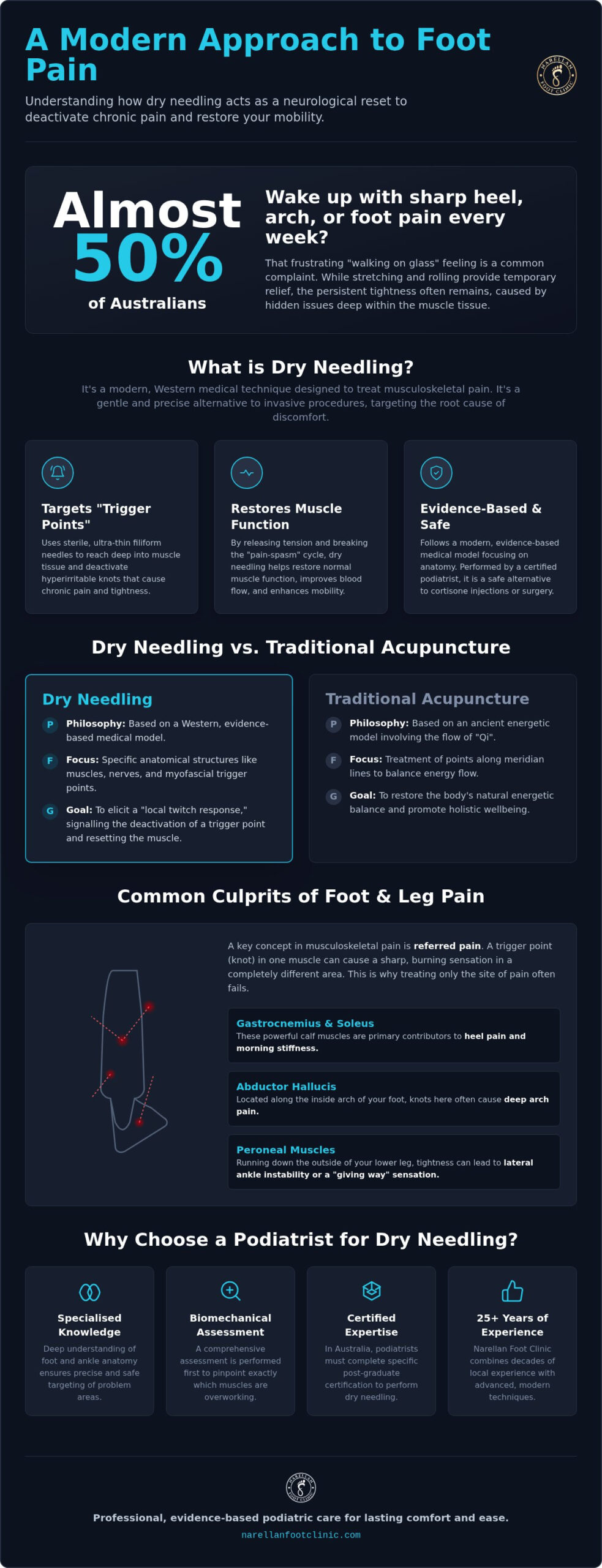
Did you know that almost half of all Australians wake up with sharp heel, arch, or foot pain at least once every week? It’s a frustrating way to start the day, especially when that first step out of bed feels like walking on glass. You’ve likely tried stretching your calves or rolling your foot over a cold bottle, yet the persistent tightness in your arches remains. Many people fear that invasive cortisone injections are the only answer left, but there’s a gentler, more modern path to relief. This guide explores how dry needling for foot pain acts as a neurological reset to deactivate chronic trigger points and restore your mobility.
At Narellan Foot Clinic, we combine over 25 years of clinical experience with advanced techniques to help you return to your favourite morning walks or sports. We’ll explain the science behind this targeted approach, how it differs from traditional acupuncture, and why it’s often the missing piece in a comprehensive podiatric treatment plan. You’ll discover how we transition patients from a state of constant worry to one of lasting comfort and ease through professional, evidence-based care.
Key Takeaways
- Understand the clinical distinction between Western medical needling and traditional acupuncture for more precise pain relief.
- Discover how dry needling for foot pain deactivates myofascial “knots” to resolve persistent heel and arch tightness.
- Learn why this sterile, modern technique serves as a gentle alternative to invasive surgery or cortisone injections.
- Find out what to expect during a professional podiatry session, from skin preparation to the restoration of your mobility.
- Explore how combining needling with a biomechanical assessment provides a holistic path toward returning to your daily activities.
Understanding Dry Needling for Lower Limb and Foot Pain
Many people feel a sense of hesitation when they hear the word “needle,” but understanding the clinical purpose of this technique often replaces that worry with confidence. Dry needling is a modern, Western medical approach designed specifically to target musculoskeletal issues. Unlike treatments that might only address surface-level symptoms, dry needling for foot pain reaches deep into the muscle tissue to deactivate myofascial trigger points. These “knots” are often the hidden culprits behind chronic discomfort. By addressing them directly, we can restore normal muscle function and improve your overall mobility without the need for invasive surgery.
At Narellan Foot Clinic, this procedure is performed within a fully sterilised clinical environment. We use single-use, sterile filiform needles that are significantly thinner than those used for injections or blood tests. This ensures the process is as gentle as possible while maintaining the high standard of care you expect from a professional podiatry practice. It’s a precise, methodical way to encourage the body’s natural healing response in a safe and supportive setting.
Dry Needling vs Acupuncture: What is the Difference?
While both practices use similar tools, the philosophy behind each is quite different. Traditional acupuncture is based on an ancient energetic model involving meridians and the flow of “Qi.” In contrast, dry needling follows an evidence-based medical model. We focus on specific anatomical structures, such as the muscles and nerves of the lower limb. A key clinical marker we look for is the “local twitch response.” This is a brief, involuntary contraction of the muscle that signals the trigger point has been successfully stimulated. For those suffering from persistent aches, this response is a sign that the muscle is beginning to reset and relax.
The Role of the Podiatrist in Manual Therapy
Choosing a podiatrist for this treatment offers a distinct advantage. We possess a deep, specialised knowledge of foot and ankle anatomy that generalists may not have. At Narellan Foot Clinic, David J. Miller brings over 25 years of local experience to every consultation. Before we begin, we perform a comprehensive biomechanical assessment. This allows us to pinpoint exactly which muscles are overworking or dysfunctional. In Australia, podiatrists must also complete specific post-graduate certification to perform needling. This means you’re in a safe pair of hands. Using dry needling for foot pain allows us to target the source of your discomfort while addressing the underlying movement patterns that caused it in the first place.
The Science of Trigger Points: Why Your Feet Feel Tight
Imagine a tiny, persistent knot tucked deep within your muscle fibres. In clinical terms, we call this a myofascial trigger point. These hyperirritable spots are more than just a nuisance; they actively restrict blood flow to the surrounding tissue. When a muscle stays in a constant state of contraction, it creates a “pain-spasm-pain” cycle. The lack of oxygenated blood causes the muscle to tighten further, which in turn increases your discomfort and prevents the tissue from healing naturally.
One of the most complex aspects of this condition is referred pain. It’s quite common for a knot located in your calf to manifest as a sharp, burning sensation in your heel. This is why stretching alone often fails to provide lasting relief; you’re treating the symptom rather than the source. Using dry needling for foot pain allows us to address these biochemical changes directly. Research into the Effects of Dry Needling on Plantar Heel Pain suggests that needling helps neutralise the localised acidity within the muscle, breaking the cycle of chronic tension and encouraging the tissue to return to a neutral, relaxed state.
Common Trigger Points Affecting the Foot and Ankle
Several key muscle groups are frequently involved in lower limb discomfort and require precise clinical attention:
- Gastrocnemius and Soleus: These powerful calf muscles are primary contributors to heel pain and morning stiffness.
- Abductor Hallucis: Located along the inside of your foot, this muscle often causes deep arch pain when trigger points are active.
- Peroneal Muscles: These run down the outside of your lower leg and are vital for lateral ankle stability. Tightness here can lead to a feeling of weakness or persistent “giving way” during daily activities.
How Needling Facilitates a Neurological Reset
Think of dry needling as a way to “reboot” a dysfunctional muscle. When the needle enters the trigger point, it mechanically disrupts the dysfunctional motor end plate, which is the site where your nerves communicate with your muscle fibres. This disruption triggers a neurological reset, prompting the brain to release endorphins, which are the body’s natural analgesics. A local twitch response is an involuntary muscle contraction that signals the trigger point has been successfully released. This process not only reduces immediate pain but also improves your range of motion. If you’ve been struggling with persistent tightness, you might find that a professional consultation at Narellan Foot Clinic is the first step toward reclaiming your active lifestyle.
Conditions Successfully Managed with Dry Needling
Dry needling for foot pain is a versatile tool that we use to address a wide array of lower limb conditions. While many patients come to us seeking relief for one specific area, they often find that treating the underlying muscle tension resolves secondary issues they’ve lived with for years. By deactivating trigger points in the lower leg and foot, we can significantly reduce the strain on tendons and joints, allowing the body to function with greater efficiency and comfort.
Relieving Chronic Heel Pain and Plantar Fasciitis
One of the most effective applications of this technique is in plantar fasciitis treatment. The plantar fascia is a thick band of tissue under the foot, but it doesn’t work in isolation. When your calf muscles are tight, they create a constant upward pull on the heel bone, which increases tension on the fascia. By needling the calf muscles, we reduce this mechanical stress. This forms a vital part of a broader heel pain treatment plan, especially for chronic cases where traditional stretching hasn’t been enough. We typically introduce needling once the initial acute inflammation has subsided to help break the cycle of recurring tightness.
Sports Injuries and Performance Recovery
Athletes frequently use dry needling as a maintenance tool to keep their muscles supple and prevent injuries before they occur. It’s particularly useful for managing Achilles tendon pain treatment and calf strains, where maintaining muscle length is essential for load management. We also use this technique to treat “Shin Splints,” technically known as Medial Tibial Stress Syndrome, by targeting the deep posterior muscles that pull on the shin bone. Restoring a full range of motion before a major event or race can be the difference between a personal best and a painful recovery.
Beyond sports, dry needling for foot pain provides relief for conditions like Morton’s Neuroma and metatarsalgia. By relaxing the small muscles between the long bones of the foot, we can reduce the pressure on sensitive nerves and joints. This gentle approach helps ensure your feet are ready for daily activities, whether that’s a morning walk or a long day on your feet at work. It’s a methodical way to help you return to the movements you love without the constant distraction of physical discomfort.
Your Clinical Experience: What to Expect During Treatment
Many patients feel a mix of curiosity and apprehension before their first session. It’s completely natural to feel a little uneasy about needles, especially when your feet are already sensitive. At Narellan Foot Clinic, we prioritise your comfort by following a methodical, five step process. We begin with thorough skin preparation using antiseptic, ensuring every procedure occurs within a fully sterilised clinical environment. We only ever use single use, sterile needles that are far finer than those used for vaccinations.
Once the area is prepared, David uses precise palpation to locate the active trigger points within your lower limb. This expert touch allows us to identify the exact source of your tension. When we perform dry needling for foot pain, the insertion itself is often felt as a tiny pinch, or sometimes not at all. The therapeutic goal is to elicit a local twitch response; a brief, involuntary muscle contraction that signals the “reset” of the dysfunctional tissue. After the needles are removed, we perform post treatment palpation and provide specific stretching guidance to help your muscles settle into their new, relaxed state.
Does Dry Needling Hurt?
The most common question we hear is whether the process is painful. Because the needles are roughly the same thickness as a human hair, the initial insertion is remarkably gentle. You won’t feel the sharp sting associated with a typical injection. The local twitch response can feel like a deep ache or a momentary cramp, which usually lasts only a second or two. While you might experience some mild muscular soreness after the session, similar to the feeling after a heavy gym workout, this typically resolves within 24 hours. Most patients find this minor, temporary sensation a small price to pay for the significant relief that follows.
Aftercare and Maximising Your Results
To get the most out of your treatment, we recommend staying well hydrated and engaging in gentle movement, like a light walk, immediately after your appointment. If you do feel any lingering soreness, a warm bath or a heat pack is often more effective than ice, as heat encourages the blood flow needed to flush out metabolic waste. We generally advise waiting 24 to 48 hours before returning to high impact sports or heavy running. This allows your nervous system to fully integrate the changes. If you’re ready to move beyond temporary fixes, you can book an initial consultation to see if this approach is right for your recovery.
A Holistic Approach: Integrating Needling with Podiatric Care
While the immediate relief from dry needling is often significant, it’s rarely a standalone solution for long term structural issues. If your foot pain stems from how you walk or stand, simply releasing a muscle knot won’t change the underlying mechanics. This is why we view dry needling for foot pain as a vital component of a broader, more comprehensive treatment plan. By integrating this technique with other podiatric interventions, we ensure that we aren’t just masking your symptoms, but actively working toward a permanent resolution.
Manual therapy works best when it’s paired with functional rehabilitation. Once the trigger points are deactivated and your range of motion has improved, it’s the perfect time to introduce targeted strengthening exercises. This dual approach helps build resilience in the muscles, making it much less likely for those painful knots to return. We don’t just want you to feel better for a week; we want to help you stay active for years. At Narellan Foot Clinic, we pride ourselves on being a local centre for complete lower limb rehabilitation, providing you with a clear roadmap from initial discomfort to lasting physical freedom.
Synergy Between Dry Needling and Orthotic Therapy
There is a powerful synergy between needling and the use of custom orthotics. Think of it this way: dry needling treats the soft tissue, while orthotics manage the structural mechanics. If your muscles are in a state of constant spasm, your feet may struggle to adapt to a new orthotic device. By releasing that tension first, we make the transition to orthotic therapy far more comfortable and effective. This integrated strategy addresses both the “engine” (your muscles) and the “alignment” (your bones and joints). Our long term goal is to provide the support your feet need to prevent trigger points from reactivating during your daily activities.
Booking Your Consultation in Narellan
We’ve designed our clinic to be a reliable sanctuary for the local community, led by David J. Miller and his 25 years of clinical experience. We offer on the spot HICAPS claims to make your visit as seamless as possible; we also accept Medicare EPC pathways for those who are eligible through their GP. Whether you’re travelling from Campbelltown, Camden, or even Blacktown, you’ll find a team dedicated to providing gentle, modern care that respects your individual needs. We understand the stress that chronic pain causes, and we’re here to guide you through a methodical recovery process. You don’t have to live with persistent discomfort or the fear of invasive procedures. Book your biomechanical assessment and dry needling session today.
Take Your First Step Toward Lasting Comfort
Restoring your mobility starts with understanding the source of your discomfort. We’ve explored how dry needling for foot pain acts as a precise neurological reset to deactivate chronic trigger points and break the cycle of persistent tightness. By choosing a practitioner with over 25 years of local experience in Narellan, you’re ensuring your recovery is managed with clinical authority and genuine care. This modern technique offers a gentle, evidence based alternative to more invasive procedures, especially when it’s integrated into a holistic plan featuring biomechanical assessments and custom orthotics.
At Narellan Foot Clinic, we provide a fully sterilised environment using only single use needles to ensure the highest standard of safety. We also offer on the spot HICAPS claims to make your visit efficient and stress free. You don’t have to let sharp heel pain or calf tightness dictate your daily routine any longer. It’s time to transition from a state of worry to one of lasting physical freedom and ease. Book your expert dry needling consultation at Narellan Foot Clinic today. We look forward to helping you return to your favourite morning walks and sports with renewed confidence.
Frequently Asked Questions
Is dry needling for foot pain covered by private health insurance?
Most Australian private health funds cover dry needling when it’s performed by a registered podiatrist as part of a consultation. Since it’s categorised under podiatry extras, you can usually claim a rebate on the spot using our HICAPS facility. It’s always a good idea to check with your specific provider first. This ensures that dry needling for foot pain remains an accessible and affordable part of your recovery journey.
How many sessions of dry needling will I need for plantar fasciitis?
The number of sessions depends on how long you’ve been experiencing symptoms and the severity of the muscle tightness. Most patients begin to feel a noticeable difference after two or three appointments. For chronic cases like long term plantar fasciitis, a course of four to six weekly sessions is often recommended to achieve a full neurological reset. We monitor your progress closely to ensure the treatment plan remains efficient.
Can I drive home after a dry needling session in my foot?
Yes, you can typically drive home immediately after your appointment. While you might experience a sensation of heaviness or mild muscle fatigue in the treated area, it shouldn’t interfere with your ability to operate a vehicle safely. If we’ve treated multiple areas or if you feel particularly sensitive, we might suggest a few minutes of gentle walking in the clinic before you head to your car. Your safety is our priority.
Are there any side effects or risks associated with dry needling?
Dry needling is considered very safe when performed by a qualified podiatrist in a sterilised clinical environment. The most common side effect is mild muscular soreness, similar to the feeling after a gym workout, which usually resolves within 24 hours. Occasionally, minor bruising or a small spot of bleeding may occur at the insertion site. Because we use single use, sterile needles and follow strict infection control protocols, the risk of serious complications is extremely low.
Is dry needling safe for people with diabetes or poor circulation?
Podiatrists are experts in diabetic foot health, so we take extra care with patients who have circulation issues. While dry needling for foot pain can be safe for many, we must first perform a thorough assessment of your vascular status. If your skin integrity is compromised, we might recommend alternative manual therapies. We always prioritise a cautious, professional approach to ensure your long term safety and physical wellbeing.
What is the difference between dry needling and a cortisone injection?
The primary difference lies in the mechanism. A cortisone injection involves injecting a strong anti inflammatory medication into a joint or tissue to reduce swelling. In contrast, dry needling uses a fine, medication free needle to mechanically disrupt trigger points and encourage a natural neurological reset. While cortisone targets inflammation, dry needling focuses on restoring muscle function. It’s often chosen as a gentler, less invasive alternative for managing chronic musculoskeletal tension.
How long does the pain relief from dry needling typically last?
Initial relief from a single session can last anywhere from a few days to several weeks. However, the goal of dry needling is to create a cumulative effect. When integrated with biomechanical corrections and strengthening exercises, the results can be long lasting. By deactivating the trigger points and then addressing the reason they formed, we aim to move you from temporary comfort to a state of sustained physical freedom.
Can dry needling help with chronic ankle instability?
Yes, dry needling can be a valuable tool for managing chronic ankle instability. When you’ve had multiple sprains, the muscles around the ankle often become tight or dysfunctional as they try to protect the joint. By releasing these trigger points, we can improve muscle reaction time and proprioception. This helps the muscles support the ankle more effectively during movement, especially when combined with a specific rehabilitation program to build balance. If you’re dealing with recurring ankle issues, consulting an ankle pain podiatrist can help identify the underlying mechanical cause and prevent further injury.




1 Comment
[…] often combine laser therapy with dry needling for foot pain, which involves the precise insertion of fine needles into myofascial trigger points in the calf […]