
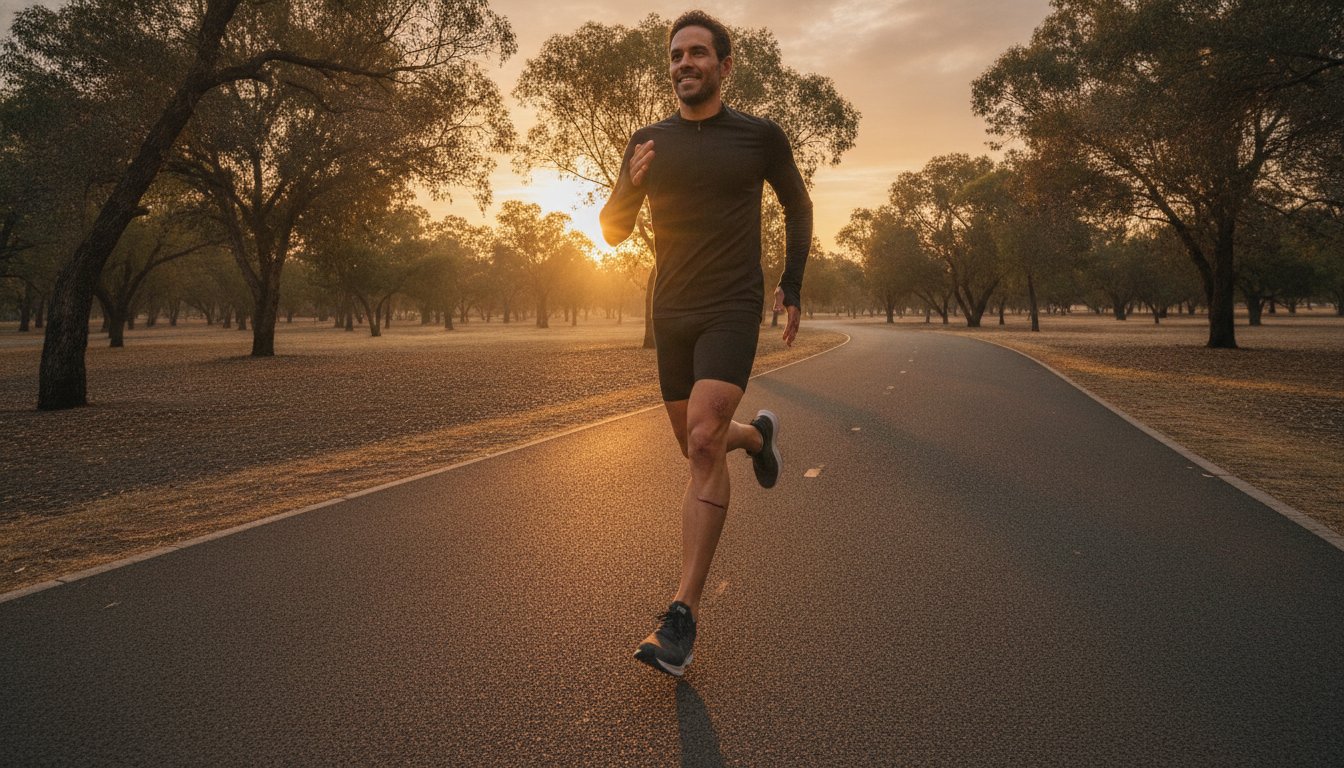
What if the rest you have been prescribed for your heel pain is actually the very thing holding your recovery back? For many Australians, the frustration of seeking effective Achilles tendon pain treatment starts with those sharp, hobbling steps first thing in the morning or the crushing realisation that you cannot finish your local parkrun. You might have tried “taking it easy” for weeks, only to find the pain returns the moment you lace up your trainers again. It is a common cycle, but it is one you can break with the right clinical approach.
We understand how much you value your mobility and the freedom to stay active in our sporting communities. This guide provides a professional look at evidence-based strategies to help you return to high-impact exercise without the constant fear of a flare-up. You will discover why modern protocols favour progressive loading over complete rest and how a detailed biomechanical assessment can identify the root cause of your strain. We also explore how specialised therapies like custom orthotics and dry needling can redistribute pressure and relieve calf tension, ensuring you get back to your best with confidence and ease.
Key Takeaways
- Understand why the location of your pain is the most critical factor in determining which exercises will help or hinder your progress.
- Learn how a clinical Achilles tendon pain treatment plan prioritises progressive loading over complete rest to build long-term tissue resilience.
- Discover why traditional stretching techniques may be counterproductive for insertional pain and how to adjust your routine for better results.
- Identify how advanced tools like custom orthotics and dry needling work together to manage calf tension and correct underlying biomechanical issues.
- Gain clarity on when to seek professional therapy to ensure a safe, sustainable return to your favourite high-impact Australian sports and activities.
Understanding Achilles Tendon Pain: What Is Your Body Telling You?
The Achilles tendon is the thickest and strongest tendon in your body. It has to be; it withstands forces up to twelve times your body weight during a sprint. Despite this incredible strength, it remains one of the most frequently injured areas for active Australians. Understanding the specific nature of your discomfort is the first step toward effective Achilles tendon pain treatment. Clinical definitions have evolved over the years, moving away from simple labels to a more nuanced understanding of how tendon tissue behaves under stress.
While many people use the term “tendinitis,” this usually refers to an acute, inflammatory response that occurs immediately after an injury. Most chronic cases are actually “tendinopathy,” which involves a breakdown of the tendon’s collagen fibres rather than simple swelling. For a comprehensive overview of Achilles tendinitis and its pathophysiology, clinical research highlights how these structural changes affect your recovery timeline and the type of load your tendon can handle.
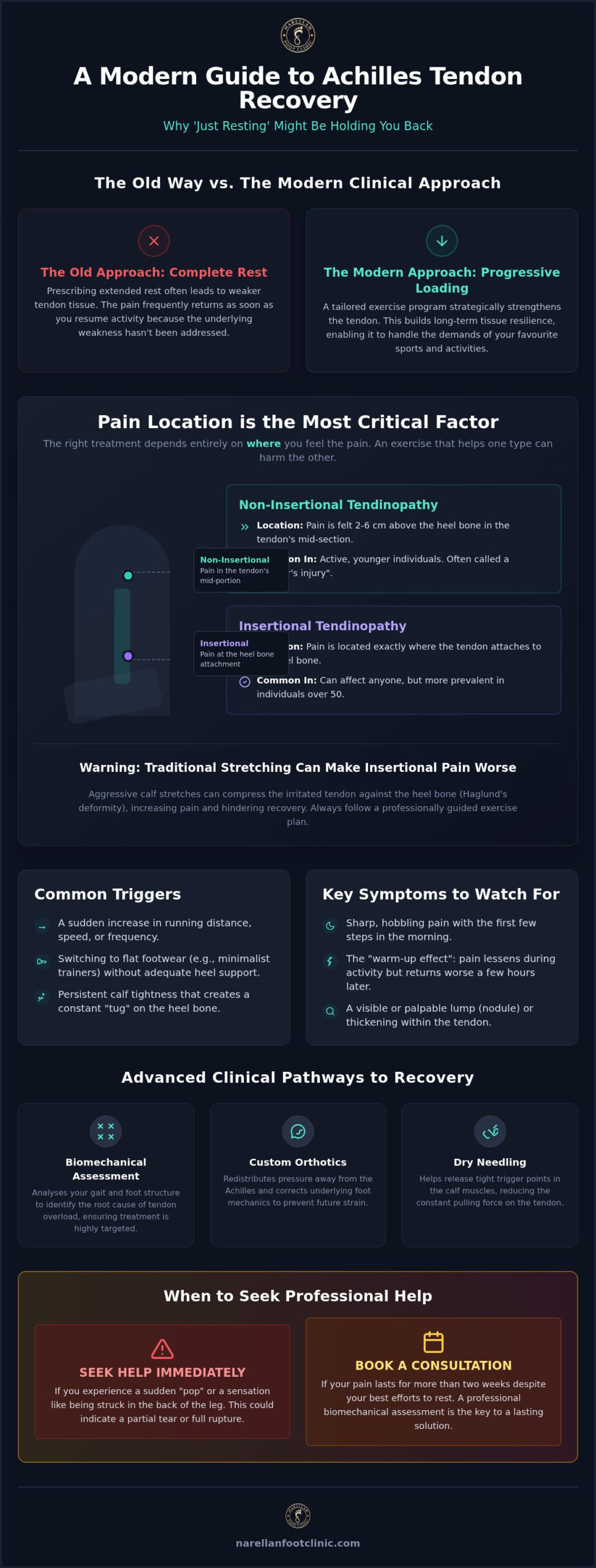
A hallmark of this condition is the “warm-up effect.” You might feel stiff and sore as you start your morning walk, but the pain often dulls or disappears once you are moving. This is deceptive. The pain typically returns with a vengeance a few hours after you stop, or even the following morning. Common triggers include a sudden increase in your running kilometres, switching to flat footwear without enough heel elevation, or persistent calf tightness that creates a constant “tug” on the heel bone.
Common Symptoms: From Morning Stiffness to Sharp Heel Pain
Morning stiffness is the most reported symptom. Those first few steps out of bed can feel incredibly restrictive, almost as if the back of your leg has shortened overnight. You might also notice a visible lump or a “nodule” within the tendon itself. It is vital to identify the exact location of the discomfort. Pain located 2 to 6 centimetres above the heel bone is classified as mid-portion pain, while discomfort right where the tendon meets the bone is insertional pain. These two variations require very different management strategies.
When to Seek a Professional Podiatry Consultation
If you experience a sudden “pop” or a sensation like being struck in the back of the leg, seek help immediately. This often indicates a partial tear or full rupture. For most people, however, the warning sign is persistent pain that lasts longer than two weeks despite your best efforts to rest. A professional biomechanical assessment is the most reliable way to find a solution. It allows a podiatrist to analyse your gait and foot structure to determine why the tendon is being overloaded, ensuring your recovery plan targets the underlying cause rather than just the surface-level symptoms.
Insertional vs. Non-Insertional Achilles Tendinopathy
Identifying where your pain sits is the most vital step in planning your Achilles tendon pain treatment. Many patients are surprised to learn that a treatment working for a friend might actually make their own condition worse if the location of the injury is different. Clinical management isn’t a one-size-fits-all approach; it depends entirely on which part of the tendon is struggling to handle the load.
Non-insertional tendinopathy occurs in the middle portion of the tendon, roughly 2 to 6 centimetres above your heel bone. This is the classic “runner’s injury” and often affects younger, active individuals who have recently ramped up their training or changed their running surface. In contrast, insertional tendinopathy happens exactly where the tendon attaches to the heel bone. This type can affect anyone, including those who aren’t particularly active, and often involves complex factors like bone shape and mechanical compression.
Age and lifestyle play a significant role in which type you develop. While non-insertional cases are frequently linked to high-impact sports like basketball or netball, insertional issues are more common in patients over 50 or those with specific foot mechanics that put constant pressure on the heel attachment. If you’re struggling to identify your pain point, a professional review at Narellan Foot Clinic can provide the clarity you need to start the right recovery path.
The Role of Haglund’s Deformity in Heel Pain
Some people develop a bony enlargement on the back of their heel known as Haglund’s deformity, or a “pump bump.” This isn’t just a cosmetic issue. The prominent bone can create mechanical friction against the tendon, leading to chronic irritation and inflammation of the surrounding bursa. If you find your shoes are constantly rubbing or your heel feels physically wider, footwear modifications and professional guidance are essential to manage this mechanical stress and prevent further tissue breakdown.
Why Imaging (Ultrasound/MRI) Matters for Treatment
While a physical exam tells us a lot, imaging provides the internal map for your recovery. Ultrasound is excellent for viewing the disorganisation of the tendon fibres, helping us see if the tissue is thickening or losing its structural integrity. If we suspect hidden issues like retrocalcaneal bursitis or deep tears that don’t show up on surface scans, an MRI offers a more detailed look. These tools ensure your Achilles tendon pain treatment is based on your specific pathology rather than guesswork. We always combine these scans with a functional assessment to see how your feet move in real-time.
Why Traditional Stretching Might Be Making Your Pain Worse
When you feel tightness in the back of your leg, your first instinct is likely to stretch it out. It feels like the logical thing to do. However, for many patients seeking Achilles tendon pain treatment, aggressive stretching is often the hidden culprit behind a plateau in recovery. This is particularly true if you are dealing with insertional tendinopathy. Traditional stretches, such as dropping your heel off the edge of a step, create what clinicians call “compressive load.” This happens when the tendon is squashed against the heel bone at its attachment point, which can severely irritate the already sensitive tissue.
The “Rest Trap” is another common hurdle. While it seems helpful to stop all activity, complete rest is rarely the answer for a tendon. Tendons are designed to handle force; they are like high-tension springs. When you stop using them entirely, they undergo “disuse atrophy,” losing their structural integrity and their ability to spring back. This is why many people find their pain returns the second they try to run again. Effective recovery isn’t about avoiding load; it’s about managing it with precision. We move away from passive treatments like ice or total rest and focus on active load management to rebuild the tendon’s capacity.
The Myth of “Just Resting It”
A tendon that isn’t loaded becomes a weak tendon. Instead of stopping, we recommend “relative rest,” which means modifying your activities so you don’t exceed what the tissue can handle. A helpful tool is the pain-monitoring scale. On a scale of 0 to 10, any discomfort during or after exercise should ideally stay below a 3. If you wake up the next morning with increased stiffness or pain reaching a 4 or 5, it’s a clear sign that the previous day’s load was too high. This methodical approach allows you to stay active without causing further damage.
Load Management: The Modern Gold Standard
Modern Achilles tendon pain treatment protocols often start with isometric exercises. These involve holding a position, such as a mid-range heel raise, for 30 to 45 seconds. Isometrics are fantastic because they can provide immediate pain relief by changing how the brain processes signals from the tendon. Once the pain is stable, we transition to isotonic exercises, which involve moving through a controlled range of motion. Many Australian podiatrists now favour “heavy-slow resistance” training. This involves performing heel raises with added weight at a very slow tempo, which has been shown to stimulate the best healing response in chronic tendinopathy cases.
Advanced Clinical Treatments for Achilles Recovery
Achilles tendon pain treatment is rarely a linear process. While the loading protocols discussed previously are essential for long-term health, clinical interventions provide the immediate support your body needs to tolerate those exercises. One of the most effective ways to provide instant relief is through strategic unloading. This often involves using temporary heel lifts inside your footwear to shorten the distance the tendon has to travel, effectively taking the “tug” off the sorest area during the acute phase of recovery.
In our Australian climate, we often see patients who spend most of their time in flat thongs or “zero-drop” runners. While these are comfortable for some, they can be incredibly taxing on a sensitive Achilles because they force the tendon to work at its maximum length. Switching to a shoe with a slight heel-to-toe drop can make a world of difference. Our role is to guide you through these footwear transitions so you don’t accidentally stall your progress by wearing the wrong shoes to the local shops or the beach. It is also worth noting that unresolved ankle instability from a previous sprain can alter your gait and place additional strain on the Achilles, which is why consulting an ankle pain podiatrist can be an important step if you have a history of ankle injuries alongside your tendon symptoms.
Orthotic Therapy and Footwear Modification
A common point of confusion for patients is the difference between generic chemist-bought inserts and custom orthotics. While a simple gel heel cup might offer some cushioning, it does not address the underlying biomechanical issues like excessive pronation that might be twisting the tendon. Custom orthotics are designed to change the “pitch” of your foot position and redistribute load away from the damaged fibres. This precise correction is what allows many of our patients to return to high-impact sports without the constant fear of a flare-up. It’s about creating a stable foundation that supports the tendon’s natural function.
Manual Therapy: Dry Needling and Soft Tissue Work
To accelerate the results of your exercise programme, we often incorporate dry needling for foot pain. This modern technique targets trigger points in the gastrocnemius and soleus muscles, which are the two major muscles that form your calf. When these muscles are chronically tight, they create a state of constant tension on the Achilles. Dry needling helps to “reset” these muscle fibres, reducing the overall stiffness of the system. This doesn’t just provide relief; it makes your loading exercises more effective by ensuring the tendon isn’t fighting against a restricted calf muscle during movement.
If you are tired of “managing” the pain and are ready for a structured solution, book a consultation at Narellan Foot Clinic to see how these advanced treatments can work for you.
Achilles Recovery at Narellan Foot Clinic
Choosing the right environment for your recovery is just as important as the clinical protocol itself. At Narellan Foot Clinic, we have spent over 25 years refining our approach to heel pain treatment for the local community. We know that behind every case of Achilles discomfort is a person who simply wants to get back to their morning walk, their weekend sport, or their busy workday without distraction. Our patient-centric approach ensures you aren’t just another appointment; you are an individual with unique goals and a specific lifestyle that we aim to protect.
Effective Achilles tendon pain treatment requires more than a generic list of exercises. It demands a thorough understanding of your unique movement patterns and how they contribute to tissue stress. To make your journey as smooth as possible, we offer on-the-spot HICAPS and Medicare claims, allowing you to focus entirely on your recovery rather than the paperwork. From your initial diagnosis through to long-term prevention, our team provides a supportive sanctuary where clinical expertise meets genuine care.
Your First Appointment: What to Expect
During your first consultation, we take the time to listen. We review your sporting history, your current training load, and the footwear you use daily. A key part of this process is our video gait analysis. By recording and reviewing your movement in slow motion, we can see exactly how your foot posture and timing affect the load on your Achilles. This objective data allows us to create a personalised “Return to Sport” roadmap, giving you clear milestones and the confidence to move again without the fear of a setback.
Convenient Local Care for Macarthur Residents
We are proud to serve residents across Narellan, Campbelltown, and the Camden area from our professional, fully sterilised clinic. Principal podiatrist David J. Miller leads a team committed to evidence-based podiatric medicine, ensuring every treatment plan is grounded in the latest clinical research. Whether you are a high-performance athlete or someone looking to enjoy a pain-free stroll through the Macarthur region, we provide the seasoned expertise you need. We invite you to book a comprehensive biomechanical assessment today to take that first definitive step toward lasting relief and physical freedom.
Reclaiming Your Physical Freedom
Recovery from chronic heel discomfort is not about waiting for the pain to fade through inactivity. It is about understanding the mechanical stressors on your tendon and implementing a structured, evidence-based plan. By distinguishing between mid-portion and insertional pain and moving away from the “rest trap,” you can build the resilience needed for a full return to the Australian lifestyle you love. You deserve to move without the hesitation that sharp morning pain creates.
Professional Achilles tendon pain treatment provides the roadmap you need to move with confidence again. At Narellan Foot Clinic, we combine over 25 years of local experience with advanced gait analysis technology to identify the root cause of your strain. With on-the-spot HICAPS claims available, we ensure your focus remains entirely on your recovery. It is time to transition from a state of worry to one of comfort and ease with a team that understands your needs.
Take the first definitive step toward lasting relief and long-term wellness today. Book Your Achilles Assessment at Narellan Foot Clinic and let our clinical team guide you back to your best. You don’t have to manage this alone; your journey to improved health starts with a safe pair of hands and a personalised plan.
Frequently Asked Questions
How long does it take for Achilles tendon pain to go away with treatment?
Recovery timelines vary depending on whether the condition is acute or chronic. Most patients notice a significant improvement within six to twelve weeks of starting a structured loading programme. However, for long-standing tendinopathy where tissue changes have occurred, it can take three to six months of consistent Achilles tendon pain treatment to achieve full resilience. Patience and adherence to your prescribed exercises are the most critical factors in ensuring a permanent recovery.
Can I still exercise if I have Achilles tendon pain?
You don’t need to stop moving entirely, but you must modify your activity level. Complete rest actually weakens the tendon and makes it less capable of handling force. We recommend using a pain-monitoring scale from zero to ten. If your discomfort stays below a three during and after exercise, and doesn’t increase the following morning, your current load is likely safe. We will help you organise a gradual return to your favourite sports.
Is Achilles tendinitis the same as a heel spur?
No, these are distinct conditions, although they can sometimes occur together. Tendinitis involves inflammation or structural changes within the tendon fibres themselves. A heel spur is a bony outgrowth on the calcaneus, often caused by long-term tension where the tendon or fascia attaches to the bone. While a spur can sometimes irritate the surrounding tissue, your treatment will focus on managing the tendon’s health and improving your overall foot mechanics.
Why is my Achilles pain worse in the morning but better after walking?
This is known as the “warm-up effect.” Overnight, the tendon remains in a shortened position and blood flow to the area decreases, leading to significant stiffness. As you begin walking, the tendon’s temperature increases and it becomes better lubricated, which temporarily dulls the pain. It’s important to remember that this ease is often temporary. The discomfort typically returns later in the day once the tissue cools down or the total daily load exceeds its capacity.
Will I need surgery for my Achilles tendon pain?
Surgery is considered a last resort and is rarely necessary. Statistics show that over 70% of patients with chronic tendinopathy respond successfully to conservative Achilles tendon pain treatment like progressive loading and shockwave therapy. Clinical guidelines suggest that only about 20% to 29% of patients who do not respond to six months of dedicated non-surgical care require a surgical opinion. Most people find lasting relief through professional podiatric intervention and biomechanical correction.
Does Medicare cover podiatry for Achilles tendon treatment?
Medicare provides rebates for podiatry if you have a chronic condition managed by a GP-prepared Chronic Disease Management plan. As of July 2025, this plan allows for up to five allied health sessions per calendar year with a rebate of $61.80 per session. At Narellan Foot Clinic, we offer on-the-spot HICAPS and Medicare claims to make this process as simple as possible for you, ensuring you can focus on your recovery.
What are the best shoes for someone with Achilles tendonitis?
The best shoes for recovery typically have a “higher drop,” meaning the heel is elevated 10 to 12 millimetres above the forefoot. This elevation reduces the stretch and tension on the tendon during every step. You should avoid completely flat shoes, zero-drop runners, or flimsy thongs, as these force the Achilles to work at its maximum length. A supportive trainer with a firm heel counter provides the stable foundation necessary for the tendon to heal.
Can dry needling really help with tendon pain?
Dry needling is a highly effective tool for reducing the secondary tension that complicates tendon recovery. By targeting trigger points in the gastrocnemius and soleus muscles, we can “reset” the calf complex and reduce the constant mechanical tug on the Achilles. This doesn’t just provide immediate relief; it makes your strengthening exercises more effective. It is an excellent adjunct to a broader treatment plan focused on long-term tissue health and mobility.


1 Comment
[…] daily movement. If you are also experiencing pain higher up the heel, it is worth understanding how Achilles tendon pain treatment differs from plantar fasciitis care, as the two conditions are closely related but require distinct […]