

Have you ever wondered why that “minor” ankle sprain from months ago still feels like a weak point every time you step off a kerb or head out for a bushwalk? It’s a common frustration for many here in Narellan, where a nagging ache can quickly turn into a fear of permanent joint weakness. If you’re tired of resting only for the pain to return the moment you pick up the pace, seeing an ankle pain podiatrist is the first step toward reclaiming your mobility. Persistent discomfort is rarely just a “niggle” that needs more rest; it’s often a sign of a mechanical issue that hasn’t been properly addressed.
We understand how confusing it is to distinguish between a simple strain and a more serious tendon tear, especially when that “unstable” sensation keeps happening. You’re likely looking for more than just a temporary fix; you want the confidence to return to local sports or weekend trails without the constant worry of rolling your ankle again. This guide explains how a professional biomechanical approach can pinpoint the exact source of your discomfort. We’ll explore the path from a clear diagnosis to a tailored recovery plan, ensuring you can move with ease and long-term comfort.
Key Takeaways
- Understand why persistent pain often stems from “functional instability,” where the connection between your brain and muscles isn’t fully restored after a sprain.
- Learn how an ankle pain podiatrist performs a comprehensive biomechanical assessment to identify misalignments in your entire lower limb, not just the joint itself.
- Discover the crucial differences between common ligament sprains and more complex issues like peroneal tendonitis or Achilles tendon pain.
- Transition from the traditional “RICE” method to the modern “POLICE” protocol to ensure you are safely loading the joint for a faster recovery.
- Explore how clinical solutions like dry needling and custom orthotics work together to release tight muscles and provide a stable foundation for long-term relief.
Why is my ankle pain not going away? Understanding the “Wait-and-See” Trap
It’s a common story in our clinic. You suffered an ankle sprain months ago, followed the advice to rest, and waited for the swelling to subside. While the initial bruising disappeared, the joint just doesn’t feel “right” anymore. This is what we call the “wait-and-see” trap. Acute pain is the immediate, sharp response to tissue damage, while chronic pain is discomfort that persists long after the physical structures should have healed. If you find yourself constantly cautious about how you step, an ankle pain podiatrist can help you break this cycle of instability.
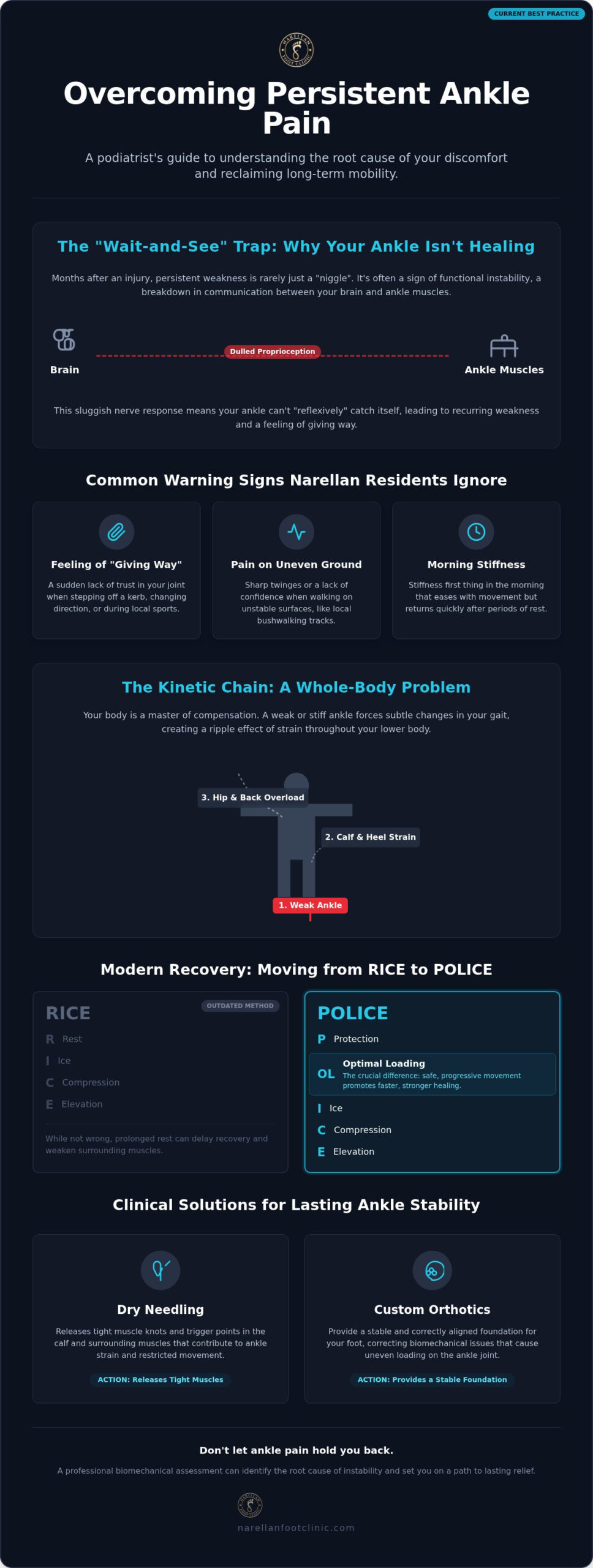
Many patients experience what’s known as “functional instability.” This happens when your ligaments have physically repaired or scarred over, but the communication between your brain and the muscles surrounding the joint remains sluggish. Proprioception is the nervous system’s ability to sense the position and movement of your joints without you having to look at them. When this sense is dulled after an injury, your ankle lacks the “reflex” to catch itself during a stumble, leading to those recurring niggles that never quite go away.
The Kinetic Chain: How your ankle affects your whole body
Your body is a master of compensation. When an ankle is stiff or weak, you naturally shift your weight to avoid discomfort. This subtle limp changes your gait, often forcing the opposite hip to take more impact or causing your lower back muscles to overwork. We frequently see a direct link between restricted ankle mobility and the need for heel pain treatment, as the calf muscles and plantar fascia strain to stabilise a wobbly foundation. Don’t fall for the misconception that if a pain doesn’t throb, it isn’t serious; a lack of intense pain doesn’t always mean the joint is healthy.
Common “Niggles” that Narellan residents ignore
Living in Narellan means enjoying our local trails and outdoor spaces, but these areas can be testing for a compromised joint. You should watch out for these specific warning signs:
- Sharp twinges or a lack of confidence when walking on uneven ground, such as our local bushwalking tracks.
- Stiffness first thing in the morning that seems to “warm up” with movement but returns as soon as you sit down for a coffee.
- A sudden feeling of “giving way” or a lack of trust in the joint when stepping off a kerb or changing direction during local sports.
If these symptoms sound familiar, your body is signalling that your mechanics are out of alignment. Consulting an ankle pain podiatrist ensures you address the root cause of the instability before it leads to a more significant injury or impacts your broader mobility.
What happens during a professional ankle biomechanical assessment?
Understanding the exact cause of your discomfort is the first step toward lasting relief. When you visit an ankle pain podiatrist, the goal isn’t just to treat the immediate symptom, but to map out the “why” behind the pain. David J. Miller brings over 25 years of clinical experience to every biomechanical assessment, ensuring that your diagnosis is grounded in decades of local expertise. This process is entirely non-invasive and designed to be informative, providing you with a clear, visual picture of how your body moves. We don’t simply focus on the joint itself; we examine the entire lower limb alignment to see how your hips, knees, and feet work together as a single unit.
This comprehensive approach ensures that no subtle abnormality is missed. By looking at the “big picture,” we can identify if a problem in your hip is actually the culprit behind your recurring ankle issues. It’s about providing a “safe pair of hands” for your recovery, moving you away from the stress of uncertainty and toward a structured plan for ease and mobility.
Step 1: The Non-Weight Bearing Clinical Exam
During this initial phase, we assess the structural integrity of your ankle while you’re seated or lying down. This allows us to test your joint range of motion without the interference of body weight. We specifically look at dorsiflexion (your ability to lift the foot up) and inversion (turning the foot inward) to identify any mechanical blockages. Muscle strength testing is also crucial here. We look for “lazy” stabilisers that might be failing to support the joint during activity. By using gentle palpation, we can accurately locate tenderness in specific ligaments or tendons, which is vital for distinguishing between a standard sprain and a more complex injury.
Step 2: Weight-Bearing and Gait Analysis
The next stage involves watching how your foot interacts with the ground during a normal stride. This gait analysis reveals whether you have a tendency toward over-pronation, where the foot rolls inward excessively, or supination, which puts undue stress on the outer ankle. These movements are often influenced by your choice of shoes, so we take a close look at your current footwear to see how it might be contributing to your discomfort. Identifying these subtle abnormalities in your walking pattern allows us to create a plan that addresses the root cause of your instability. If you’re ready to stop guessing and start healing, you can book a consultation with our experienced team to get a professional perspective on your recovery.
Is it a sprain or something more? Comparing common ankle conditions
When your ankle hurts, it’s easy to assume you’ve just rolled it. However, an ankle pain podiatrist often sees patients who have misidentified a tendon issue as a simple sprain. Lateral ligament sprains occur when the connective tissue on the outside of the ankle stretches or tears during a sudden twist. In contrast, peroneal tendonitis is an overuse injury causing inflammation in the tendons that run along the outer ankle bone. While a sprain happens in a split second, tendonitis often builds up over weeks of repetitive activity. “A sprain is a ligament injury, while tendonitis is a soft-tissue strain; both require different management.”
Stability is a team effort involving various structures. If your calf muscles are tight, they pull excessively on the heel, which is why Achilles tendon pain treatment is often a core component of a broader plan to improve ankle function. Without a strong, flexible Achilles, the joint loses its primary driver, leading to compensatory wobbles. If you feel a sharp, “blocking” pinch at the front of the joint when you squat or walk uphill, you might be dealing with ankle impingement. This occurs when soft tissue or bone fragments get “nipped” in the joint space, requiring a careful clinical eye to distinguish it from a standard muscle strain.
The “Invisible” Injury: Sinus Tarsi Syndrome
This is the “invisible” injury. It feels like a deep, gnawing ache on the outside of the ankle, specifically in the sinus tarsi, which is a small “cave” between the heel and ankle bones. It’s often the result of an old injury that never quite resolved, leading to chronic inflammation in that sensitive space. Because the pain is diffuse and doesn’t always involve swelling, it’s frequently dismissed as just having a “weak ankle.” Our specialised approach uses precise clinical testing to identify this specific condition and provide the targeted relief needed to stop that persistent ache.
Osteoarthritis vs. Acute Injury
For many in Narellan, staying active is a priority, whether it’s local sports or walking through the Macarthur region. If your pain is a dull, deep ache that feels worse in cold weather or after a long day on your feet, it might be osteoarthritis rather than a new injury. Unlike an acute sprain, which happens in a single moment, arthritis is the result of long-term wear and tear on the joint’s cartilage. Managing this doesn’t mean giving up your active lifestyle. An ankle pain podiatrist can help you select the right footwear and support to significantly reduce joint stress, allowing you to stay mobile without the constant worry of flare-ups.
Managing ankle discomfort at home: The 48-hour rule
When you first tweak your ankle, the instinct is often to wait it out and hope for the best. While many minor strains resolve with a bit of care, we follow a strict “48-hour rule” here in Narellan. If your pain hasn’t significantly improved within two days, or if you’re unable to bear weight, it’s time to consult an ankle pain podiatrist. Early intervention prevents the functional instability we discussed earlier from becoming a permanent fixture in your life. You should seek professional help immediately if you notice significant bruising, a “locking” sensation in the joint, or if the ankle feels like it might give way when you stand.
The old RICE (Rest, Ice, Compression, Elevation) method has largely been replaced by the more modern POLICE protocol. The shift focuses on “Optimal Loading” rather than total rest. This means protected, gentle movement that encourages blood flow without overstressing the damaged tissue. Ice remains helpful for the initial 48 hours to manage inflammation and provide natural pain relief. After this window, if the area feels stiff rather than throbbing, switching to heat can help relax the surrounding muscles and improve mobility. However, heat should be avoided in the first two days as it can increase swelling.
Safe stretching vs. Dangerous stretching
Many people try to “stretch out” a stiff ankle, but if you have a ligament tear, aggressive pulling can actually make the injury worse. We recommend “active rest,” which involves gentle range-of-motion exercises like drawing the alphabet with your toes while seated. This keeps the joint mobile without the danger of further tearing. If you use a compression sleeve, ensure it’s firm but doesn’t cause your toes to tingle or change colour. It should support the joint, not cut off your circulation. Total immobilisation is rarely the answer for soft tissue injuries; the goal is to keep the joint moving safely.
Footwear Audit: Is your “comfy” shoe the culprit?
Take a look at your favourite walking shoes or joggers. If the “heel counter”, which is the firm part at the back of the shoe, feels soft or leans to one side, it’s no longer protecting you. Worn-out footwear is the leading cause of recurring ankle rolls because it fails to provide a stable base for the joint. When buying new shoes in Narellan, look for a firm heel and a sole that doesn’t twist easily in the middle. If your shoes are showing uneven wear patterns, it’s a clear sign that your alignment needs a professional review. To get your mechanics back on track, book a biomechanical assessment with our team today.
Clinical solutions for lasting ankle stability and relief
Once the initial inflammation of an injury settles, the focus shifts from protection to restoration. An ankle pain podiatrist provides the clinical intervention needed to ensure your recovery isn’t just temporary. David J. Miller utilises manual therapy techniques to improve joint mobilisation, gently coaxing restricted bones back into their natural range of motion. This hands-on approach is often the “missing piece” for patients who feel their joint is stuck or stiff. To make your visit as seamless as possible, our Narellan clinic offers HICAPS on-the-spot claims, allowing you to process your private health insurance or Medicare rebate immediately.
Working with an experienced ankle pain podiatrist ensures that every treatment is tailored to your specific biomechanical needs. We don’t believe in a “one size fits all” approach; instead, we focus on the specific structural imbalances that led to your discomfort in the first place. This methodical care transitions you from a state of worry to one of comfort and ease, giving you the confidence to return to your daily activities without the fear of a setback.
Custom Orthotics: More than just an arch support
A common mistake is thinking that all insoles are created equal. While “chemist shop” inserts provide a bit of cushioning, they lack the structural integrity to correct complex mechanical issues. Custom orthotics are medical-grade devices designed to provide a firm foundation for your entire lower limb. By re-aligning the subtalar joint, these supports prevent the foot from “rolling out” or “collapsing in” excessively. This stability is a long-term investment in your mobility, protecting your ankles from future sprains and reducing the wear and tear that leads to chronic joint changes.
Dry Needling for Ankle Rehabilitation
Chronic stiffness often persists because the muscles surrounding the ankle stay in a protective, “guarded” state. Dry needling for foot pain is a modern technique that targets specific trigger points in the calf and peroneal muscles. By inserting fine, sterile needles into these tight bands of tissue, we can “reset” the muscle, encouraging it to release and lengthen. During your first session at Narellan Foot Clinic, you might feel a dull ache or a tiny twitch, which is a positive sign that the muscle is responding. It’s a highly effective way to speed up recovery and restore the fluid movement you need for local sports or weekend bushwalking.
Stepping toward a pain-free future in Narellan
Persistent ankle pain doesn’t have to be your new normal. By moving away from the “wait-and-see” trap and understanding the mechanical roots of your discomfort, you can reclaim the mobility you need for an active Macarthur life. Whether you’re dealing with functional instability or a complex tendon issue, a professional ankle pain podiatrist provides the clarity and expertise required to stop the cycle of recurring injury. We focus on addressing the source of your pain, not just the symptoms, ensuring you can return to the activities you love without the constant worry of another roll.
David J. Miller brings over 25 years of local experience to every consultation, offering a “safe pair of hands” for your recovery journey. Our clinic simplifies the process with modern techniques and on-the-spot HICAPS and Medicare claims, so you can focus entirely on your rehabilitation. Don’t let a nagging ache keep you on the sidelines any longer. Book your biomechanical assessment at Narellan Foot Clinic today and start your transition from a state of worry to one of comfort and ease. We’re ready to help you move with confidence once again.
Frequently Asked Questions
Do I need a GP referral to see an ankle pain podiatrist in Narellan?
No, you don’t need a referral to see us as a private patient. However, if you’re claiming through Medicare under a Chronic Disease Management plan, you’ll need a referral from your GP to access the rebate. We accept all patients and can process your Medicare or DVA claims on-the-spot using our HICAPS system. This makes the process straightforward for residents across the Narellan and Macarthur region.
Can a podiatrist tell if my ankle is fractured or just sprained?
Yes, we use specific clinical tests and the Ottawa Ankle Rules to determine if an X-ray is necessary. While we can often identify a fracture through physical examination and palpation, we’ll refer you for bulk-billed imaging if there’s any suspicion of a break. Distinguishing between a high ankle sprain and a hairline fracture is crucial for ensuring you receive the correct immobilisation or loading plan from the start.
How much does an ankle assessment cost at Narellan Foot Clinic?
Our consultation fees vary depending on whether you’re a new or returning patient and the complexity of the biomechanical assessment required. We don’t provide fixed quotes online as every case is unique; however, we offer on-the-spot HICAPS claims to reduce your out-of-pocket expenses. You’re welcome to call our clinic for current consultation rates and to check your eligibility for Medicare rebates or private health fund cover.
Will I need to wear orthotics forever if I have weak ankles?
Not necessarily, as orthotics are often used as a supportive “scaffold” while you rebuild your natural strength. For some patients with structural misalignments, long-term use provides the best protection against re-injury. For others, custom orthotics are a temporary measure used alongside dry needling and strengthening exercises. Our goal is to provide the level of support that matches your specific lifestyle and your long-term mobility and wellness goals.
Is dry needling painful for ankle injuries?
Most patients describe the sensation as a dull ache or a brief “twitch” rather than sharp pain. The needles used are significantly thinner than those used for injections, making the process much more comfortable than people expect. It’s a highly effective way to release the deep muscular tension that often follows a chronic sprain. You might feel some mild soreness for 24 hours, similar to the feeling after a gym workout.
Can I claim my podiatry appointment on my private health fund?
Yes, if your private health insurance includes “Extras” cover for podiatry, you can claim your consultation immediately. We use the HICAPS system at our Narellan clinic, which means you only pay the gap at the time of your appointment. The amount covered depends on your specific fund and level of cover, so it’s a good idea to check with your provider before your visit to confirm your benefits.
How long does it take to recover from a chronic ankle injury?
Recovery times vary, but most patients see significant improvement within six to twelve weeks of starting a structured plan. Chronic injuries take longer than acute sprains because we aren’t just healing tissue; we’re retraining your brain-muscle connection. Factors like your age, activity level, and how closely you follow your rehabilitation exercises will all influence the speed of your return to local sports or weekend bushwalking in the Macarthur area.
What shoes are best for preventing ankle pain while walking?
You should look for footwear with a firm heel counter and a stable midsole that doesn’t twist easily in the centre. Shoes with a wide base of support help prevent the “rolling” motion that leads to sprains. Avoid overly flexible or worn-out joggers that have lost their structural integrity. During your assessment, an ankle pain podiatrist can review your current shoes and provide specific recommendations based on your unique foot type and walking style.