

Have you ever found yourself hiding your feet in the sand at the beach, hoping no one notices the stubborn discolouration of your nails? It’s incredibly frustrating to spend months applying expensive chemist paints only to see the same yellowing remain. If you’ve struggled with thickened nails that make every step in your shoes uncomfortable, consulting a toenail fungus podiatrist is the first step toward reclaiming your comfort. You aren’t alone in this frustration, as many Australians find that over-the-counter options rarely reach the source of a deep-seated infection.
By seeking professional clinical intervention, you can finally move past the embarrassment and restore your confidence with clear, healthy nails. This article explains why a medical-grade approach is the most effective way to clear persistent infections and provides a pain-free path to recovery. We’ll show you how professional expertise replaces guesswork with results.
We will look at how advanced laser therapy works and the specific steps needed to prevent the fungus from returning. You’ll discover a logical, two-front strategy that combines expert clinical destruction with a practical home plan to ensure your feet stay healthy and your nails remain clear for the long term.
Key Takeaways
- Understand why standard chemist lacquers struggle to penetrate the nail’s thick keratin layer and often leave the underlying infection untreated.
- Discover how a professional toenail fungus podiatrist provides an accurate diagnosis to distinguish onychomycosis from similar-looking conditions, such as nail trauma or psoriasis.
- Compare the high efficacy of modern clinical laser therapy against traditional methods and see how light energy safely targets fungal cells.
- Learn a comprehensive long-term prevention plan, including the “Shoe Factor” strategy for eliminating dormant spores from your footwear.
- Explore the clinical advantages of professional treatment in a fully sterilised environment to ensure your path to recovery is both safe and effective.
Why Chemist Treatments Often Fail for Stubborn Toenail Fungus
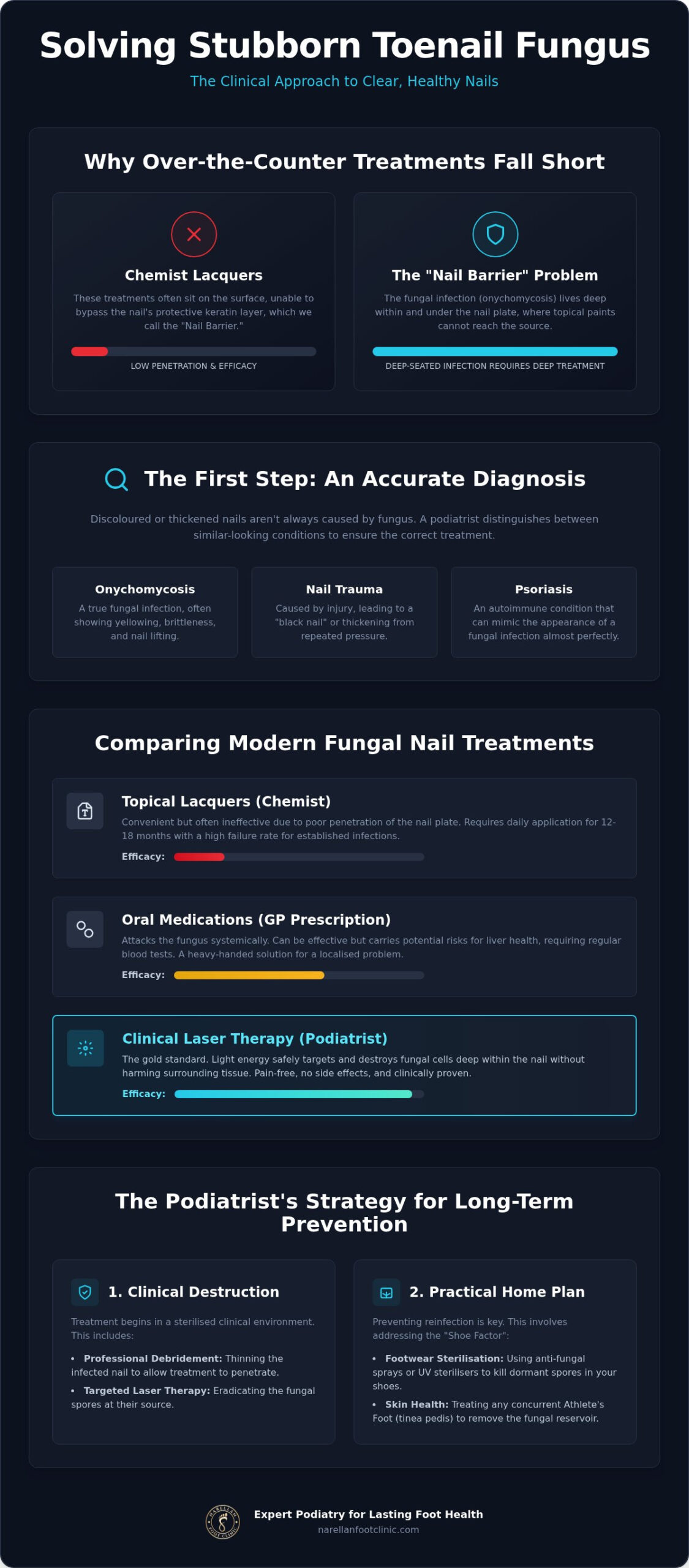
Many Australians visit a local chemist at the first sign of a yellowing nail, hoping a quick lacquer or paint will fix the issue. However, what you are likely dealing with is onychomycosis; a persistent fungal infection that lives deep within the nail bed and the nail plate itself. While these over-the-counter options seem convenient, they often fail to address the root cause because of what we call the “Nail Barrier.”
Your toenails are made of dense, protective keratin. This structure is naturally designed to keep external elements out, which unfortunately includes most topical medications. Because the fungus thrives underneath and within the nail plate, surface-level lacquers struggle to penetrate deep enough to reach the active infection. This is why a toenail fungus podiatrist is so important, as they provide clinical treatments that bypass this barrier to target the infection at its source.
Another significant challenge is the biological timeline of your feet. Toenails grow incredibly slowly, often taking 12 to 18 months to fully replace themselves. Many patients feel frustrated when they don’t see immediate results and stop their treatment too early. Without professional oversight, it is easy to assume the treatment isn’t working when, in reality, the fungus hasn’t been fully eradicated from the new growth. Stopping too soon allows the infection to simply reclaim the nail.
The Limitation of Anti-Fungal Lacquers
Anti-fungal lacquers often fail because they simply sit on the surface of a thickened nail. Without professional debridement, which is the clinical process of thinning the infected nail mass, the medication cannot reach the fungal spores hiding in the lower layers. This leads to a taxing “apply every day for 12 months” routine that often ends in disappointment. It is a cycle of frustration that occurs because the treatment never truly touched the fungus it was meant to kill.
Oral Medications: Benefits and Potential Risks
In some cases, oral tablets are used to attack the infection from the inside out. While these can be effective, they circulate through your entire system and carry potential risks for liver health, often requiring regular blood tests to monitor for side effects. For many people, this systemic approach feels like a heavy-handed solution for a localised problem. A toenail fungus podiatrist may suggest laser therapy as a safer, more direct alternative. Laser treatments target the fungal cells specifically without affecting your internal organs. Like all methods, oral medications still require the nail to grow out, making the clinical, localised approach a preferred choice for those seeking a gentle but effective path to recovery.
Clinical Diagnosis: How a Podiatrist Identifies Onychomycosis
Identifying the exact cause of a discoloured or distorted nail is more complex than it first appears. While yellowing and thickening are classic signs, they don’t always point to a fungal infection. A toenail fungus podiatrist performs a comprehensive assessment to determine if the issue is truly fungal or a result of physical trauma, such as a “black nail” caused by a sports injury. We also look for signs of psoriasis, which can mimic the appearance of a fungal infection almost perfectly. Getting this distinction right is vital because the treatment for a bruised nail is vastly different from the clinical protocols required to kill a persistent fungus.
During your consultation, we also examine the skin between your toes and across your soles. This allows us to check for tinea pedis, commonly known as Athlete’s Foot. If the skin infection isn’t addressed, it acts as a constant reservoir for fungal spores that will eventually migrate back to your nails. We use professional debridement to gently remove the infected nail mass and debris from under the nail. This process clears the way for a more accurate visual assessment and prepares the area for effective treatment by removing the “shield” of dead keratin that protects the fungus.
Visual Indicators and Physical Assessment
We look for specific texture changes, such as brittleness or a crumbly appearance at the edges of the nail. You might notice the nail is “lifting” away from the bed, a condition called onycholysis, which creates a dark, moist pocket where spores thrive. Onychomycosis is a persistent fungal infection of the nail unit caused primarily by dermatophytes that feed on the keratin found in your nails. Identifying these entry points helps us build a plan to seal them off and protect the healthy nail as it grows out.
Laboratory Testing vs. Clinical Experience
While most infections can be identified through a physical exam, we occasionally send a nail clipping for laboratory culture to identify specific fungal strains. However, there is no substitute for clinical expertise when it comes to your foot health. With over 25 years of experience serving the Narellan community, David J. Miller and our team provide the “safe pair of hands” needed for an immediate, reliable assessment. Receiving an accurate clinical diagnosis ensures you don’t waste time or money on the wrong solutions. We believe in providing a clear, logical path toward recovery from your very first visit.
Comparing Modern Fungal Nail Treatments: Laser, PACT, and Medications
Choosing the right treatment is often the most confusing part of the journey toward clear nails. While chemist paints require months of daily application for minimal gain, clinical options offer a much more direct path to resolution. Research indicates that clinical laser treatments provide significantly higher clearance rates compared to home-based lacquers, which often struggle to penetrate more than a fraction of the nail thickness. This is because a toenail fungus podiatrist uses medical-grade technology specifically designed to reach the nail bed where the infection truly lives.
The primary mechanism involves emitting precise light energy that passes harmlessly through the nail plate. This energy is absorbed by the darker fungal cells, causing them to break down. We also utilise photo-biomodulation, which is a modern, pain-free adjunct that encourages healthy tissue regeneration during the healing process. Because of this high precision and safety profile, laser treatment for toenail fungus has become the gold standard in professional podiatry care.
How Fungal Nail Laser Treatment Works
Patients often feel anxious about medical lasers, but the experience is remarkably gentle and straightforward. Most people describe the sensation as a mild, comfortable warming of the nail area. During the “destruction” phase, the light energy disrupts the fungal cell walls without damaging your healthy skin or the nail matrix. A typical schedule involves several sessions spaced several weeks apart. This methodical timing allows us to target the fungus at different stages of its growth cycle, ensuring a thorough and effective clearance.
The Role of PACT (Photodynamic Therapy)
PACT, or Photodynamic Therapy, is another innovative tool we use to combat stubborn infections. This process involves applying a photosensitising gel that specifically binds to fungal cells, effectively “labelling” them for destruction. When we apply a specific light wavelength, it triggers a reaction that destroys the marked fungus. While laser uses direct energy, PACT relies on this light-activated chemical process. Both methods are far superior to standard creams because they bypass the nail plate barrier that stops topicals from working. Your toenail fungus podiatrist will assess your nails to determine if Laser or PACT is the most suitable path for your specific condition.
The Podiatrist’s Protocol for Long-Term Prevention
Clinical treatments like laser or PACT are incredibly powerful tools for destroying active infections. However, these procedures only address the fungus present during your appointment. A toenail fungus podiatrist views clinical intervention as the first half of a two-front war; the second half takes place in your daily environment. Without a rigorous decontamination strategy, dormant spores hiding in your shoes or hosiery can easily migrate back to your newly cleared nails. We provide you with a logical, step-by-step plan to ensure your investment in professional care leads to a permanent result.
The “Shoe Factor” is a common reason why many home treatments fail. Fungi thrive in the dark, damp, and warm conditions found inside work boots and joggers. Simply applying a cream to your toes while wearing contaminated shoes is a recipe for frustration. We recommend using anti-fungal sprays or specialised UV shoe sanitisers to neutralise spores. Additionally, you must address the physical damage the infection leaves behind. For those struggling with the discomfort of distorted nail shapes, our guide on thick toenails treatment offers practical advice on restoring the nail’s appearance and relieving pressure while the healthy nail grows out.
Decontaminating Your Environment
Your home hygiene routine needs to be thorough to prevent cross-contamination. We advise patients to change their towels daily during the active treatment phase and never share nail clippers or files with family members. When visiting local pool centres or using public showers at the gym, always wear thongs to provide a physical barrier against floor-bound spores. For your laundry, standard cold-water cycles are often insufficient. Use a dedicated anti-fungal wash additive or, if the fabric allows, wash your socks at a high temperature to ensure no spores survive the rinse.
Skin Care and Tinea Prevention
There is a direct link between “Athlete’s Foot” (tinea pedis) and recurring nail infections. If the skin on your soles or between your toes remains infected, it acts as a reservoir for fungus to jump back into the nail plate. We recommend daily foot inspections to catch any peeling or itching early. Keeping the areas between your toes bone-dry is essential, as is wearing moisture-wicking socks made from bamboo or wool blends. These materials help maintain a “fungus-unfriendly” environment by pulling sweat away from the skin. If you’re ready to break the cycle of reinfection, you can book a comprehensive assessment with our team to create your personalised prevention plan.
Restoring Your Nail Health at Narellan Foot Clinic
Choosing a toenail fungus podiatrist means moving beyond temporary fixes and towards a clinically proven resolution. At Narellan Foot Clinic, David J. Miller and his dedicated team have provided expert care to the community for over 25 years. We understand the embarrassment and physical discomfort that accompanies stubborn nail infections. Our clinic serves as a professional sanctuary where your health is the primary focus. We operate within a fully sterilised, medical-grade environment that far exceeds the hygiene standards of a typical nail salon. This clinical rigour is essential for your safety and ensures that every treatment session is conducted in a pristine setting.
Our “Whole-Foot” approach sets us apart from generic providers. We don’t just look at the infection in isolation; we assess your gait, your footwear, and your overall foot health to understand why the infection took hold. Consulting a professional toenail fungus podiatrist ensures that your treatment plan is grounded in medical science rather than guesswork. By identifying these underlying factors, we can provide more than just a quick treatment. We provide a long-term solution. Our goal is to return you to your daily activities, whether that’s walking through the Macarthur region’s beautiful parks or simply feeling comfortable in open-toed shoes again.
Why Narellan Residents Trust Our Clinic
We’ve built our reputation on a “safe pair of hands” philosophy that prioritises patient comfort and clinical results. Our clinic is conveniently located for residents across Narellan, Campbelltown, and the broader Macarthur area. We utilise advanced medical techniques, including photo-biomodulation and laser therapy, to ensure your treatment is as gentle as it is effective. This commitment to modern, evidence-based care allows us to offer solutions that are both efficient and deeply personalised to your individual needs. You can feel confident that you are receiving the highest standard of contemporary podiatry care.
What to Expect at Your Initial Consultation
Your journey begins with a thorough diagnostic assessment. During this first visit, we take the time to explain the biological reality of your infection and address several common fungal nail treatment myths that often mislead patients. Once we’ve established the severity of the condition, we create a clear, logical treatment plan tailored specifically for you. For your convenience, we offer on-the-spot HICAPS and Medicare claims to streamline the process. If you are ready to reclaim your confidence and achieve clearer, healthier nails, book your consultation at Narellan Foot Clinic today and let our experienced team guide you toward a pain-free future.
Step Into a Future of Clearer, Healthier Nails
Reclaiming the health of your feet doesn’t have to be a source of ongoing frustration. You now understand that while chemist lacquers often fail to reach the root of the problem, a professional approach targeting the nail bed can finally break the cycle of infection. By combining advanced clinical technology with a disciplined home hygiene protocol, you can move from hiding your feet to walking with renewed confidence. This dual strategy is the most reliable way to ensure the fungus is not only destroyed but prevented from returning for the long term.
If you’re tired of ineffective treatments, consulting an experienced toenail fungus podiatrist provides the clarity and results you deserve. At Narellan Foot Clinic, we offer over 25 years of experience within a fully sterilised medical environment, ensuring your care is both safe and effective. We also provide the convenience of on-the-spot HICAPS claims to make your journey toward recovery as smooth as possible. It’s time to stop guessing and start healing. Book Your Fungal Nail Assessment at Narellan Foot Clinic today and take the first step toward the healthy, clear nails you’ve been waiting for. We look forward to helping you find lasting relief.
Frequently Asked Questions
Is toenail fungus treatment painful?
Clinical treatments offered by a toenail fungus podiatrist are designed to be gentle and non-invasive. Most patients describe the sensation of laser therapy as a mild, comfortable warming of the nail plate. There is no need for local anaesthesia or downtime. Because we focus on a pain-free experience, you can return to your normal daily activities immediately after your appointment without any lingering discomfort or sensitivity in your toes.
How many laser sessions will I need to see results?
The number of sessions required depends on the severity and duration of your infection. While some mild cases respond quickly, most patients require several sessions spaced several weeks apart to achieve full clearance. You won’t see an instant change in the nail’s appearance because the damaged nail must grow out. Clear, healthy nail growth typically becomes visible at the base of the nail within a few months of starting treatment.
Can I wear nail polish during the treatment period?
It’s best to avoid traditional nail polish during your active treatment phase. Standard polishes create an impermeable barrier that blocks laser light and PACT energy from reaching the fungal cells. Additionally, polish traps moisture underneath the nail, which can encourage fungal growth. We recommend keeping your nails natural to allow the clinical treatments to work effectively. Once the infection is cleared, we can discuss safer, breathable alternatives for future use.
Will Medicare or my private health fund cover the cost of treatment?
Most Australian private health funds provide rebates for podiatry consultations and clinical treatments, depending on your level of extras cover. We offer on-the-spot HICAPS claims for your convenience. Medicare generally only provides rebates if you have a Chronic Disease Management (CDM) plan from your GP. It is always a good idea to check with your specific provider to understand your eligibility and any out-of-pocket costs before your first visit.
How long does it take for a fungal toenail to grow out completely?
Patience is a vital part of the recovery process because toenails grow quite slowly. On average, it takes between 12 and 18 months for a completely new, healthy nail to replace the infected one. Factors like your age, general health, and circulation can influence this timeline. We monitor your progress during follow-up appointments to ensure the new growth remains clear and that our prevention strategies are working effectively.
Is nail fungus contagious to other family members?
Yes, fungal infections are highly contagious and easily spread within a household. Spores can live on shared surfaces like bathroom floors, bath mats, and towels. To protect your family, we recommend avoiding bare feet in communal areas and never sharing nail clippers or footwear. Your toenail fungus podiatrist will provide specific advice on household hygiene to ensure you don’t accidentally pass the infection to your loved ones during your recovery.
What is the difference between a podiatrist and a pedicurist for nail fungus?
A podiatrist is a university-trained health professional who provides a medical diagnosis and clinical treatment in a fully sterilised environment. We use medical-grade technology like lasers to kill the infection at its source. In contrast, a pedicurist focuses on cosmetic appearance and cannot legally diagnose or treat fungal infections. Visiting a salon for an infected nail actually increases the risk of cross-contamination and may mask a serious underlying health issue.
Can I still exercise and wear joggers during treatment?
You can certainly continue to exercise, but you must be diligent about foot hygiene. Sweat creates a damp environment that fungi love, so it’s essential to wear moisture-wicking socks and dry your feet thoroughly after every workout. We also recommend using an anti-fungal spray in your joggers to kill any dormant spores. Alternating between different pairs of shoes allows each pair to dry out completely before you wear them again.




1 Comment
[…] the keratin shield, your fungal nail treatment is likely only touching the surface. Consulting a toenail fungus podiatrist is the most reliable way to access treatments that can genuinely reach the source of the […]